
Best Spanish Vocab App: Top Picks and Guide 2026
Find the ideal Spanish vocab app and build a learning system that sticks. Our 2026 guide covers key features, retention strategies, and habit tracking.
Your phone probably has at least two Spanish apps on it already. One looked fun, one promised fluency, one gave you a streak, and one buried you in flashcards by day four. A week later, you still hesitate on basic words in real conversation, and the apps sit there like unopened gym memberships.
That's the normal outcome when you treat a Spanish vocab app like the solution instead of the tool. Apps can help a lot. But random downloads, streak-chasing, and passive review create the feeling of progress more often than actual recall. If you want vocabulary that shows up when you need it, you need a system that tells you what to study, how to review it, and what keeps you returning tomorrow.
Table of Contents
- Why Most Spanish Vocab Apps Fail You
- Decoding the Tech 7 Must-Have App Features
- Strategies for Vocabulary That Actually Sticks
- How to Choose the Right Spanish App for You
- From Intention to Action Building Your Daily Vocab Habit
- Your First Week A Social Tracking Workflow
- Common Questions About Spanish Vocab Apps
Why Most Spanish Vocab Apps Fail You
The market is huge, which partly explains why so many people keep trying new apps instead of fixing their method. The global language learning apps market reached $6.34 billion in 2024 and is projected to reach $24.39 billion by 2033, with 316 million global downloads in 2024 and nearly 48% of adults aged 18 to 24 actively using these apps, according to language learning app market statistics from LingoBright. Big adoption doesn't mean efficient learning. It means a lot of people are still searching.
Most apps fail users in the same predictable ways. They reward tapping, not remembering. They mistake exposure for mastery. They teach isolated words long before they teach usable phrases.
The real problem isn't motivation
If you keep abandoning apps, the issue usually isn't discipline. It's design. A lot of learners rely on novelty, then feel guilty when novelty fades, even though habit formation depends more on repeatable cues and friction reduction than on enthusiasm. That's why behavior systems matter more than app-store ratings, and why behavior change psychology in daily routines is more useful than another “best app” roundup.
Practical rule: If your app makes you feel busy but not more expressive, it's entertaining you more than training you.
Where learners get trapped
A weak setup usually looks like this:
- Too many apps: You use one for flashcards, one for games, one for verbs, then lose track of what you're learning.
- No review logic: You meet a word once, get it right in multiple choice, and assume it's learned.
- No speaking transfer: You recognize mesa or querer on screen, but can't produce them fast enough in a sentence.
- Gamification overload: Points and streaks become the goal. The language becomes secondary.
The fix is less exciting than downloading a new app. Pick one strong tool. Build a repeatable study loop around it. Review words in context. Pull them into sentences you'd say. Then add accountability so the routine survives ordinary life.
That's when a Spanish vocab app starts acting like a training instrument instead of a slot machine.
Decoding the Tech 7 Must-Have App Features
A Spanish vocab app doesn't need every shiny feature. It needs the right mechanics. When mobile vocabulary treatments lasted ten weeks or longer, they showed a large overall effect size of 1.28 in a Bayesian meta-analysis published in Cambridge's ReCALL, as summarized in this review of Spanish vocabulary app research. That matters because it shows app-based vocabulary learning can work when the design is grounded in sound principles and the learner sticks with it long enough.
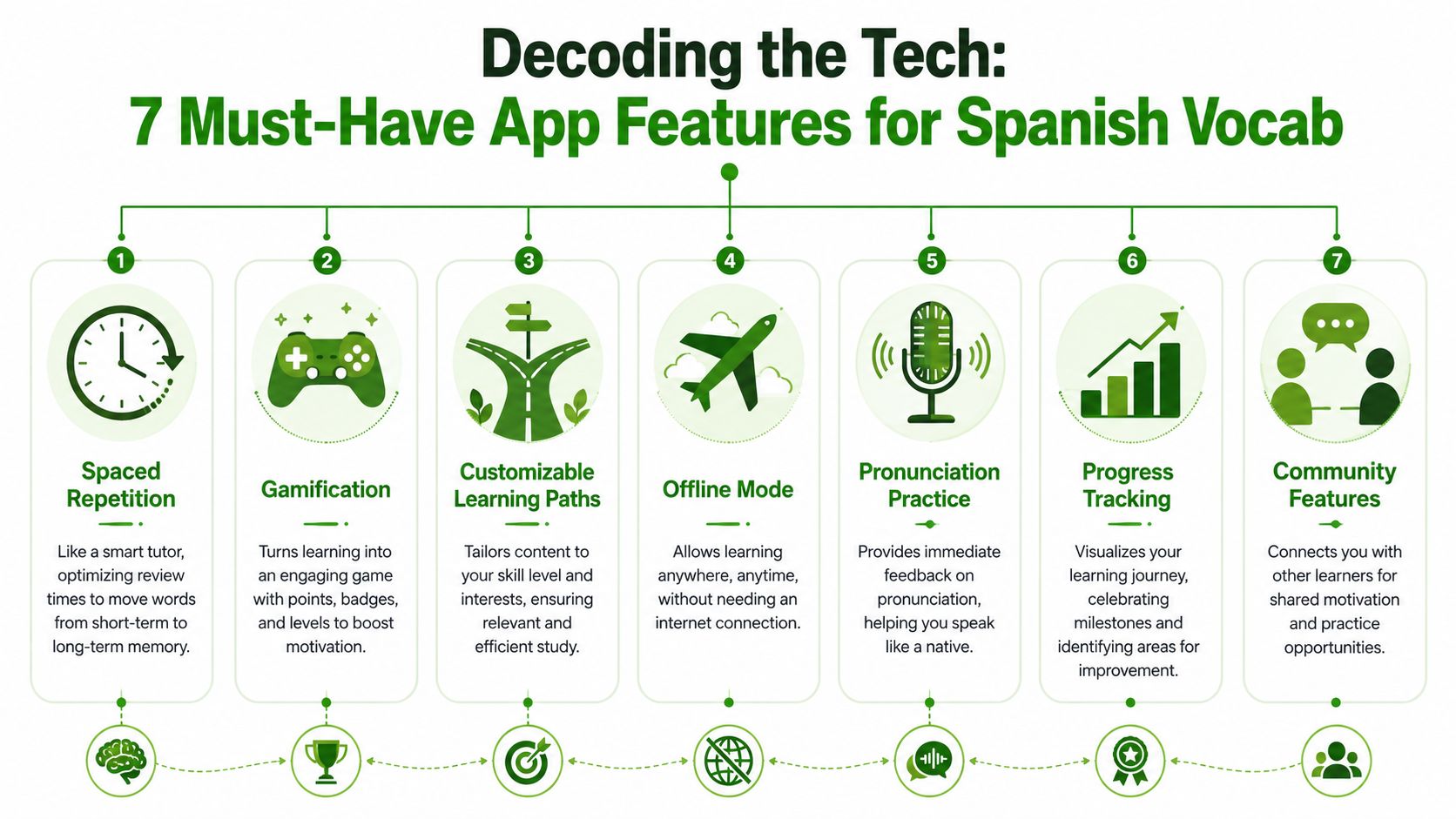
The non-negotiables
Think of these as the engine, not the paint job.
| Feature | Why it matters | What to watch for |
|---|---|---|
| Spaced repetition | It brings a word back just before you're likely to forget it | Review timing should adapt to your performance |
| Native audio | Vocabulary without sound stays abstract | You want clear, repeatable pronunciation from native speakers |
| Example sentences | Words change meaning depending on context | The app should show how a word behaves in real Spanish |
| Custom study control | You need to flag, suspend, or prioritize words | Good learners don't study every item equally |
Spaced repetition is the biggest one. It works like a gardener watering plants before they droop, not after they've died. If an app only gives you static lists or random quizzes, it's making you work harder than necessary.
Context is a close second. A word list teaches labels. A sentence teaches use. If an app gives you llevar without examples, you'll “know” it until Spanish starts using it in ways English doesn't.
The features people overvalue
Some features help, but they're often overrated.
- Gamification: Points, badges, and streaks can get you started. They rarely carry you through the boring middle where memory is built.
- Beautiful design: Clean design helps, but glossy animations don't improve recall on their own.
- Huge libraries: More content sounds impressive. If you can't sort by usefulness or frequency, depth becomes clutter.
A good app reduces forgetting. A great app also reduces hesitation.
Here are the remaining features worth having, but only after the fundamentals are covered:
- Offline access matters because consistency often happens in ugly little pockets of time. Commutes, waiting rooms, lunch breaks.
- Progress tracking helps when it measures recall quality, not just time spent.
- Community or accountability features can be powerful if they create actual follow-through, not just a public leaderboard.
A slightly contrarian point here: gamification is useful when it supports the work, not when it replaces it. If an app keeps you answering easy prompts to protect your streak, it's training compliance. Not vocabulary.
The best setup is simple. Use an app that schedules reviews intelligently, includes audio, gives examples in real sentences, and lets you control your own deck. Everything else is a bonus.
Strategies for Vocabulary That Actually Sticks
A well-built Spanish vocab app gives you raw material. Retention comes from what you do with it. For intermediate to advanced learners, apps using spaced repetition with intelligent scheduling improve retention of 2,000–10,000 frequent words, and pairing real audio with timed gaps accelerates auditory vocabulary acquisition by forcing immediate recall, according to Clozemaster's guide to advanced Spanish learning apps.

Use retrieval, not recognition
Recognition feels good because it's easy. You see a word, pick the right answer, and your brain says, “I know that.” Then you try to speak and nothing comes out.
Use your app in ways that force production:
- Hide the translation first: See the Spanish word and say the meaning aloud before checking.
- Pause before audio reveals the answer: Make yourself retrieve, don't just confirm.
- Turn example sentences into prompts: If the app shows a sentence, cover one key word and rebuild it.
Audio matters. Timed gaps force speed. Speed exposes weak memory.
Don't measure vocabulary by how familiar it feels. Measure it by how fast you can retrieve it.
Build a bridge from app to real speech
The jump from flashcards to conversation is where most learners stall. Use three habits to close that gap.
- Sentence mining: Save only words that appear in phrases you'd use.
- Thematic clustering: Study vocabulary in usable groups like ordering food, asking for directions, or describing work.
- Micro-monologues: After a review session, speak for one minute using the day's words.
If you like voice-based review, this is also where how SpeakNotes enhances language study becomes useful. Recording quick spoken summaries or example sentences exposes whether a word is really available to you or just visually familiar.
A practical routine works better than a heroic one. Build around study habits that reduce friction, not around motivation spikes. Ten deliberate minutes with active recall beats thirty minutes of mindless tapping.
One more contrarian point. Don't chase word volume too early. Learners often stuff apps with new cards and then drown in reviews. Fewer words, used more thoroughly, create better long-term vocabulary than a giant digital pile of half-known items.
How to Choose the Right Spanish App for You
The best Spanish vocab app depends less on popularity and more on where you break down. Some learners need structure. Others need context. Others need a way out of the intermediate swamp where they know plenty of words but can't deploy them cleanly.
One of the most overlooked criteria is sentence context. Language practitioners report that students learning words within full sentences achieve 3x faster retention than those using isolated lists, as noted in this discussion of contextual vocabulary learning. That should change how you choose.
The absolute beginner
Beginners usually overestimate how much vocabulary they need and underestimate how much clarity they need.
Choose an app that gives you:
- High-frequency words first: Common words beat niche vocabulary every time.
- Clear native audio: You need to hear the word well before you can own it.
- Full example sentences: These stop you from learning dictionary fragments.
- A guided path: Too much freedom early on becomes avoidance.
Skip apps that throw thousands of disconnected cards at you. At this stage, less breadth and more structure wins.
The intermediate plodder
This learner knows enough Spanish to function, but not enough to feel fluid. They often keep reviewing beginner material because it feels successful.
What matters here is different:
| Learner type | Must-have | Nice to have | Usually a distraction |
|---|---|---|---|
| Intermediate plodder | Context-rich sentences, SRS, audio recall | Personalization | Heavy streak mechanics |
| Advanced builder | Deep vocabulary range, import options, nuanced examples | Stats dashboards | Beginner-style onboarding |
If this is you, look for sentence-based review, cloze exercises, and ways to focus on the vocabulary you keep missing. You need pressure on weak spots, not more praise for words you already know.
You already know you can change.
You just need to take the first step. Habit Huddle helps you build habits around your goals, alongside friends who keep you accountable.
The advanced vocabulary builder
Advanced learners often outgrow standard app paths fast. They need a tool that can keep up with abstract words, regional vocabulary, and domain-specific language.
Prioritize:
- Import flexibility for custom vocabulary.
- Real sentence exposure over single-word flashcards.
- Audio tied to natural phrases instead of isolated pronunciations.
If you're comparing options beyond marketing pages, guides like Translate AI's Spanish app guide can help you sort translation-focused tools from actual learning tools. That distinction matters. Translation support is useful, but it isn't the same as vocabulary acquisition.
Pick the app that matches your current bottleneck, not the app with the loudest fan base.
A final filter helps. Ask one question before committing: “Will this app help me use words in sentences I care about?” If the answer is vague, keep looking.
From Intention to Action Building Your Daily Vocab Habit
Most learners don't fail because they picked a terrible app. They fail because their plan has no floor. The routine depends on having energy, spare time, and enthusiasm all on the same day. That's not a system. That's wishful scheduling.
Set a floor and a target
Use a two-level standard for daily study.
- Minimum: The smallest action that keeps the habit alive. Example: review five words, or complete one short review block.
- Daily goal: The full version on a normal day. Example: finish one lesson, review due cards, and speak a few example sentences aloud.
Language learning is fragile under all-or-nothing thinking. If your only acceptable day is a “perfect” day, you'll skip the imperfect ones and lose continuity.
A useful setup looks like this:
| Habit layer | Example action | Purpose |
|---|---|---|
| Minimum | Review a tiny set of due words | Protects consistency on busy days |
| Daily goal | Do the full vocab session | Moves skill forward on normal days |
| Stretch | Add listening or speaking practice | Uses surplus energy without making it mandatory |
The floor should feel almost too easy. That's the point.
Add accountability before motivation fades
Private intentions are fragile. Shared commitments are stickier because someone else notices whether you showed up. That's why a social system often beats a solo promise.
A simple way to lock this in is to start with one clearly defined habit and make it visible to a small group. If you need a practical setup, how to start a habit that survives real life is a useful framework for keeping the behavior small enough to repeat.
After you've got your floor and target, add a rhythm:
- Check in at the same time each day.
- Log whether you hit the minimum or full goal.
- Leave a short note about what you studied.
- Keep the group small enough that people notice absences.
Here's a visual walkthrough of the kind of cadence that makes this easier to sustain:
The social part matters because vocabulary study is repetitive by nature. Repetition gets easier when someone else is running alongside you. Not to judge you. To normalize the boring days and keep the chain from breaking.
Your First Week A Social Tracking Workflow
Systems sound neat in theory. They become real when an ordinary week goes sideways.
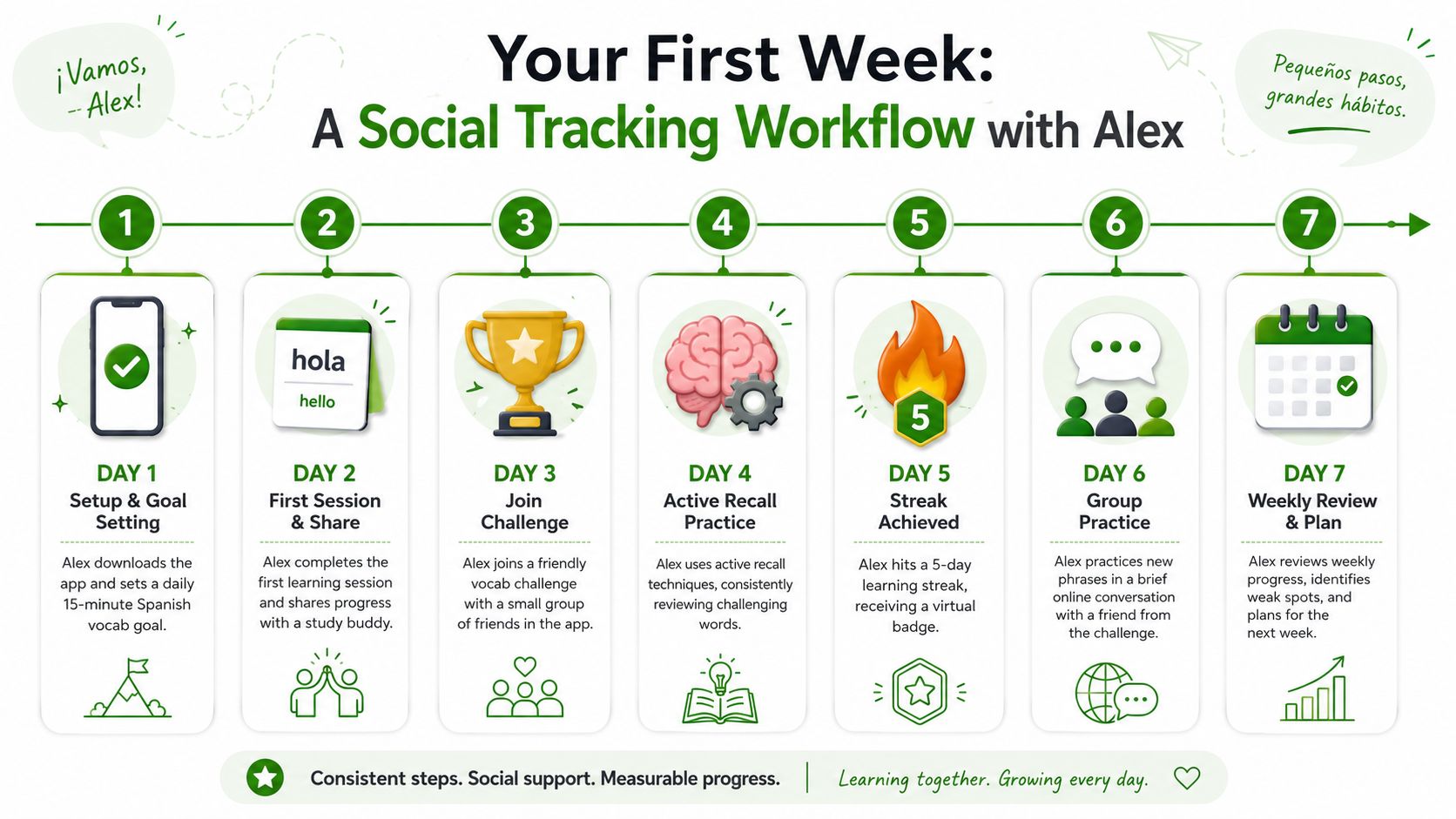
How Alex handles a real week
Alex downloads one Spanish vocab app and starts a small accountability group with two friends who are each building their own study routine. The rule is simple. Check in daily. Mark either the minimum or the full goal. Leave one short note.
On Monday, Alex sets the minimum at “review a small batch of due words” and the daily goal at “finish the app lesson and say the example sentences aloud.” Monday goes well. Full goal.
Tuesday is messy. Work runs late. Alex is tired and tempted to skip. Instead, Alex does the minimum, checks in with “Only had time for a short review, but I kept the chain alive,” and moves on. That's a small win, but it matters because the habit stays intact.
On bad days, the system should shrink the task, not erase it.
Wednesday feels easier because there's no decision left. The app opens, the review gets done, and Alex posts a quick note about two words that kept slipping. One friend replies with encouragement. Another says they also struggled with recall speed that day.
Thursday is where social accountability earns its keep. Alex doesn't feel like studying. But seeing the others check in removes the illusion that skipping is harmless. Alex completes the minimum again.
What makes the workflow work
By Saturday, Alex has more time and pushes for the full goal. The session includes review, a few new words, and a short spoken recap using recent vocabulary. Sunday becomes a light review day with a note about what to repeat next week.
The important detail isn't that Alex was perfectly motivated. It's that the workflow handled different kinds of days.
- Busy day: Minimum keeps continuity.
- Normal day: Full goal creates progress.
- Strong day: Extra effort happens without becoming the baseline.
Coach's note: Most people don't need a harder plan. They need a plan that still works on Tuesday night.
A week like this doesn't look dramatic. That's why it works. Vocabulary builds through repeat exposure, retrieval, and use. Social tracking adds one missing layer. Someone else sees whether you showed up. That small amount of visibility changes behavior more than another badge ever will.
Common Questions About Spanish Vocab Apps
How many new words should I learn each day
Use the smallest number you can review well. If new cards pile up faster than you can recall older ones, you're building backlog, not vocabulary. Start modestly, then increase only if recall stays strong.
Are free apps good enough
Sometimes, yes. A free app can work if it has strong review logic, audio, and sentence context. Paid plans make more sense when they remove friction you've already felt, such as weak review scheduling, shallow examples, or limited control over what you study.
What should I do with words that have multiple meanings
Don't memorize them as one-to-one translations. Learn them through several example sentences. Treat each common use as its own mini pattern. This is one reason isolated flashcards cause trouble. They hide how flexible many Spanish words really are.
Why do vocab apps still leave me confused when asking questions
Because vocabulary apps often skip syntax. According to The Spanish Experiment's explanation of Spanish question words, 68% of beginner Spanish learners struggle with question formation because Spanish doesn't use auxiliary verbs like “do” or “will” in the way English does. Words like ¿quién?, ¿qué?, and ¿dónde? typically go straight before the verb. If your app teaches question words without teaching that structure, you'll know the vocabulary and still form awkward questions.
Should I use more than one app
Usually not at first. One app, used thoroughly and consistently, beats a pile of half-used tools. Add a second tool only when it solves a specific problem your first one doesn't solve.
If you want your Spanish vocab app to become a real daily practice instead of another forgotten download, build accountability into the process. Habit Huddle gives you a simple way to track one study habit with friends, keep a streak alive through minimum check-ins, and use group visibility to stay consistent long after the novelty wears off.
Ready to Build Habits With Friends?
Stop failing alone. Join thousands using the #1 habit tracker with friends for real accountability and lasting results.
Prefer mobile? App Store · Google Play
Related Guides
More Habit Huddle articles on building habits with accountability.

HabitShare Alternatives: 6 Apps for Tracking Habits With Friends (2026)
Looking for a HabitShare alternative? Six social habit trackers compared by model, price, platforms, and what happens on a missed day, plus how to switch wit...
What to Do When You Miss a Workout Day: The 5-Step Comeback Plan
Missed a workout day? What one miss does to your body and habit, according to research, plus a five-step plan for the next 24 hours, when to make it up, and...
Habit Streak App With Friends: 7 Apps Compared (2026)
Seven habit streak apps with friends compared: Habit Huddle, HabitShare, Daily Pact, Habitica, Streaks, Habit Streak duels, HabitStreak.io. What friends see,...