
Habit Accountability: Pick the Right Level of Pressure and Make Habits Stick
Habit accountability is what makes habits stick. Learn the five levels, from self-tracking to money stakes, how to pick yours, and the tools that fit each.

📺 Related Video: 5 Steps to Succeed with an Accountability Partner
Video by: Develop Good Habits · Watch on YouTube
Habit accountability means someone or something outside your own head notices whether you did the habit today. That is the whole trick. Most habits do not fail because the habit is too hard; they fail because nobody, including future you, ever finds out you skipped. Add visibility and a little expectation, and skipping starts to cost something.
If you want the short version: pick the lightest level of accountability that actually changes your behavior, make the daily action embarrassingly small, and report the action itself (done or not done) rather than your intentions. This guide walks through the five levels of habit accountability, how to pick the right one for your personality, how to set up the loop so it survives past week three, and which tools fit each level.
Why habits need accountability at all
Willpower is a terrible long-term strategy because it asks you to re-decide every single day. Accountability replaces that daily negotiation with a standing expectation: someone is going to see whether you showed up.
The most commonly cited research here is a study by psychology professor Gail Matthews at Dominican University of California. Participants who wrote down their goals, committed to specific actions, and sent weekly progress reports to a friend accomplished significantly more than those who merely thought about their goals, roughly 76 percent versus 43 percent on the study's achievement measure. You can read the research summary from Dominican University directly. The interesting detail is that writing goals down helped, but the biggest jump came from the weekly report to another human.
Personality matters too. Author Gretchen Rubin's Four Tendencies framework sorts people by how they respond to inner and outer expectations. Her "Obliger" type, which she argues is the largest group, reliably meets expectations that come from other people while quietly abandoning promises made only to themselves. If you have ever trained hard for a team but cannot get yourself to the gym alone, you already know which type you are, and no amount of habit-app confetti will substitute for a real person expecting you to show up.
The five levels of habit accountability
Think of accountability as a ladder. Each rung adds more external pressure, more logistics, and more social cost for skipping. More pressure is not automatically better; the goal is the lowest rung that changes your behavior.
Level 1: Self-tracking
You record the habit privately: a paper calendar, a notes file, or a solo habit tracker app. The record itself is the accountability, because a broken chain of X marks is mildly painful to look at.
This works surprisingly well for people who are already self-motivated and just need memory support. It fails silently for everyone else, because the only witness is you, and you are easy to negotiate with. If you have three abandoned tracker apps on your phone, level 1 is not your level.
Level 2: Public commitment
You announce the habit: a social media post, a message to your group chat, a public spreadsheet. Announcing creates a one-time spike of commitment and a vague sense of being watched.
The catch is that nobody actually follows up. Research on public goal-sharing is mixed for exactly this reason: the announcement can deliver the identity reward ("I'm a runner now") before you have run a single mile. Public commitment works best as a supplement to a level that includes real follow-up, not as the whole plan.
Level 3: An accountability partner
One person, checking on one habit, on a schedule. This is the classic setup, and when it works it works beautifully: a partner notices patterns, asks uncomfortable questions, and celebrates progress that would otherwise be invisible. We wrote a full guide to what an accountability partner is and how the arrangement works.
The weakness is fragility. A partnership has exactly two points of failure. When your partner gets busy, sick, or bored, your structure disappears with them, and most informal partnerships quietly dissolve within a month. If you go this route, agree up front on the cadence, the format of the daily report, and what either of you says when the other misses.
Level 4: Group accountability
A small group, each person tracking their own habit, everyone's progress visible to everyone else. This is the level most people should try first, and it is the one we think is most underrated.
Groups fix the fragility problem: if one member disappears for a week, the structure survives. They also add a mild, useful form of peer pressure. Social accountability research consistently shows that being observed by a group changes behavior more reliably than private intentions, and a group generates encouragement, rivalry, and banter that a spreadsheet never will. The failure mode is diffusion: in a big loose group, nobody in particular notices you vanished. Groups work best small, with visible daily records rather than occasional pep talks.
Level 5: Stakes
You put something real on the line: money, forfeits, or a commitment contract. Miss the habit, lose the stake. Economists call these commitment devices, and services like stickK let you sign a contract where missed goals send your money to a charity you despise, which stings considerably more than losing it to a good cause.
Stakes are powerful and blunt. They produce high short-term compliance and real resentment; when the contract ends, the habit often ends with it, because the reason for doing it was the penalty rather than the identity. Save stakes for short, decisive pushes (a 30-day launch of a habit, a deadline project), not as permanent architecture.
How to pick your level
Start with two questions.
First: do other people's expectations move you more than your own? Be honest. If yes (Rubin's Obliger pattern), levels 1 and 2 will not hold you, and you should start at level 3 or 4. If you are genuinely self-directed and just forgetful, level 1 plus good reminders may be all you need.
Second: what is your track record with this specific habit? A habit you have failed to build three times has earned a higher rung than a new experiment. Repeated failures at one level are information: move up a rung rather than repeating the same level with a new app.
A reasonable default for most people: start at level 4 (a small group), because it gives you level 3's human expectation without the single point of failure, and it costs nothing to try. Add level 5 stakes only for a defined sprint. Whatever you pick, staying consistent with a goal is mostly about the daily loop, which brings us to setup.
You already know you can change.
You just need to take the first step. Habit Huddle helps you build habits around your goals, alongside friends who keep you accountable.
Setting up the loop so it survives week three
Whatever level you choose, the mechanics are the same four decisions.
1. Shrink the daily action until it is almost silly. The unit you are accountable for should be the smallest version that still counts: ten minutes of writing, one set of pushups, opening the language app. Jerry Seinfeld's famous advice was "don't break the chain," and chains only stay unbroken when the daily link is small enough to forge on your worst day. Big ambitious daily targets are the number one killer of accountability systems, because one overloaded Tuesday breaks the chain and the shame of reporting it breaks the habit.
2. Report actions, not intentions. The daily report is binary: did the action happen, yes or no. Not plans, not feelings, not "getting back on track tomorrow." Systems built on daily done/not-done records outperform systems built on weekly conversations, because the record removes the wiggle room where habits die.
3. Decide in advance what a miss means. A miss should trigger curiosity, not punishment: "what got in the way?" is useful, guilt is not. But a miss must be visible. An accountability system that lets misses pass silently is decoration.
4. Fix the cadence. Daily reports, plus a light weekly review. Put the reporting in a place you already look (your group chat, your Discord server, an app with reminders) rather than a place you must remember to visit.
Tools for each level
You can run every level of habit accountability with a paper calendar and a group chat. Tools earn their place by removing the logistics that make systems decay. A few honest picks, and for a deeper comparison see our roundup of the best accountability apps.
Self-tracking (level 1): Streaks (iOS) and Loop Habit Tracker (free, open source, Android) are both excellent private trackers. Clean, fast, and entirely dependent on your own motivation, which is the point and the problem.
Partner (level 3): honestly, a recurring calendar slot and a messaging thread beat most dedicated partner apps. If you want structure, GoalsWon and similar coaching apps give you a paid human accountability partner, at coaching prices.
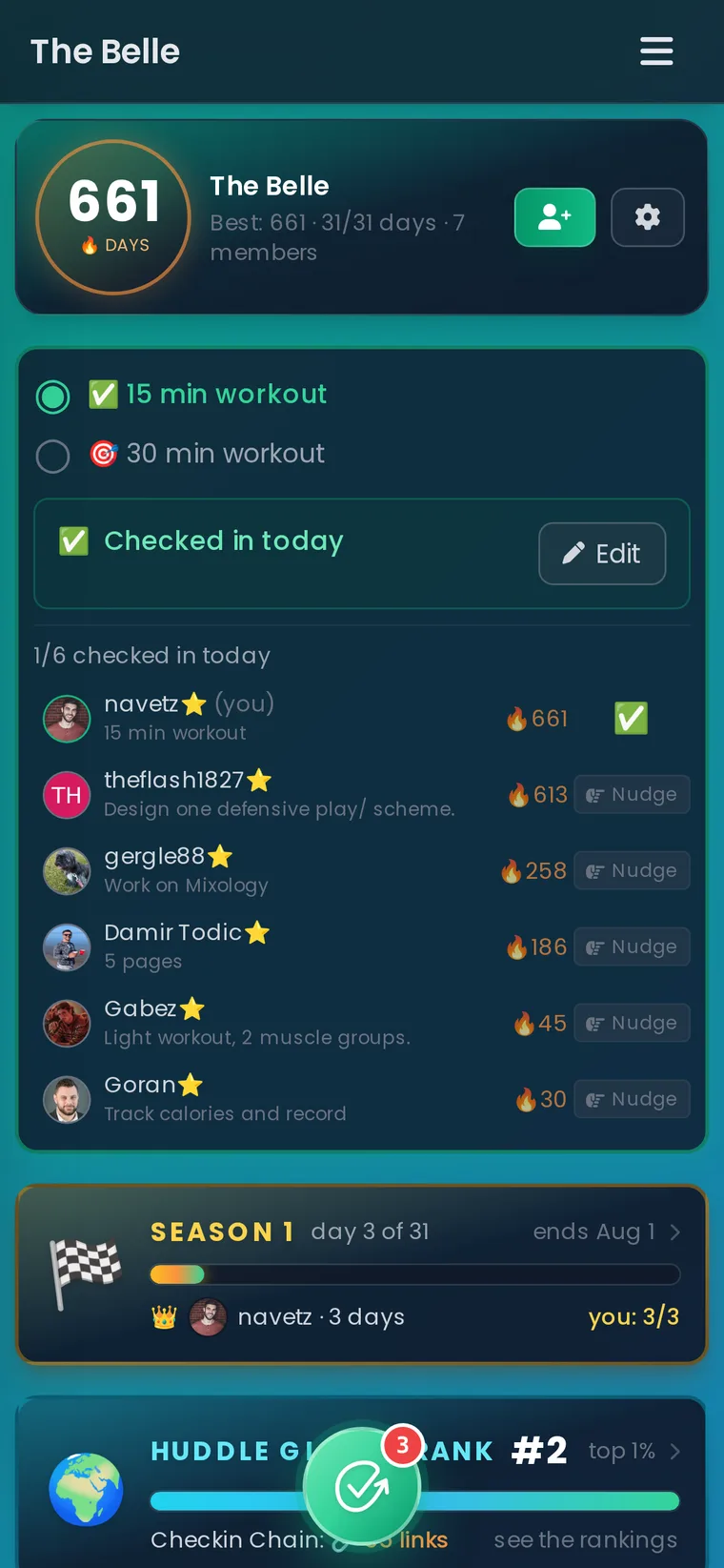
Group (level 4): this is where Habit Huddle lives, and full disclosure, it is our app, so judge the reasoning rather than the ranking. Every habit lives in a "huddle," a small group where daily checkins, streaks, and missed days are visible to the members, so the accountability is ambient instead of something a partner must remember to do. Each habit has a floor, the smallest daily action that fully counts, which bakes in the shrink-the-action rule, and the group's combined consistency builds a shared Checkin Chain that nobody wants to be the one to snap. There is also a Discord bot so checkins can happen where your community already talks. The trade-offs: it is web-first (the mobile apps are newer), the free plan caps you at one habit you start yourself, and like any group tool it is at its best when you bring at least one other person, though solo huddles still make your record visible rather than hiding it in a private tracker.
Stakes (level 5): stickK, built by Yale economists, remains the standard for commitment contracts with real money and anti-charities. Forfeit is a newer alternative with photo verification.
Body doubling (a level of its own): Focusmate pairs you with a stranger for a silent 25 or 50 minute video session where you both work. It is accountability for a single session rather than a habit record, and it is remarkably effective for ADHD brains, where the quiet presence of another person working is often the difference between starting and not starting.
Common failure modes
Accountability theater. You have a partner, a group, and an app, and everyone cheers everything, and nobody ever mentions a miss. Warmth without visibility is a support group, which is lovely and changes nothing. Keep the done/not-done record at the center.
The week-three fizzle. Almost every informal system decays at the same point: novelty gone, first misses accumulated, reporting feels awkward. Expect it. This is precisely the week to have the "what got in the way?" conversation instead of quietly letting the thread go silent.
Stakes as self-punishment. If losing the stake becomes routine, the contract has failed and is now just a fine you pay for being human. Lower the daily bar or drop back a level.
Choosing a soft judge. A partner who accepts every excuse is not accountability, and neither is a spouse who loves you too much to be annoying about it. Pick people, or groups, comfortable saying "you missed twice this week, what happened?"
Try group accountability this week
If the ladder above points you at level 4, Habit Huddle is a fast way to test it: create a huddle for one habit, set a floor small enough to hit on your worst day, and invite one or two friends (or join through a community's Discord). Your daily checkin takes about ten seconds, everyone sees the record, and you will find out within two weeks whether visible group accountability is the missing piece. It is free to start with one habit.
Frequently asked questions
Does accountability actually help you build habits?
Yes, and the effect is one of the more reliable findings in goal research. The Dominican University study by Gail Matthews found that people who sent weekly progress reports to a friend achieved substantially more of their goals than people who only thought about them. The mechanism is simple: visibility raises the cost of skipping and gives showing up a witness.
What if I have no one to hold me accountable?
Borrow structure instead of a person. Join an existing group built around your habit (running clubs, writing groups, habit-tracking huddles and Discord communities), use body doubling services like Focusmate, or use a commitment contract with money on the line. Groups of friendly strangers work better than most people expect, because the record does the judging.
Should I put money on the line for my habits?
Money stakes work best as a short, defined push, such as 30 days to launch a habit, rather than a permanent system. They produce strong compliance while active, but the habit often lapses when the contract ends. If you use stakes, keep the daily requirement small and pair the contract with a group or partner who continues after it ends.
What is the best accountability method for ADHD?
Body doubling, working alongside another person in real time, is consistently the most recommended method for ADHD, because it supplies external structure at the moment of action instead of after the fact. Pair it with a tracker that makes the daily record visible to someone other than you, and keep the daily unit very small so that executive-function bad days still count.
Ready to Build Habits With Friends?
Stop failing alone. Join thousands using the #1 habit tracker with friends for real accountability and lasting results.
Prefer mobile? App Store · Google Play
Related Guides
More Habit Huddle articles on building habits with accountability.

HabitShare Alternatives: 6 Apps for Tracking Habits With Friends (2026)
Looking for a HabitShare alternative? Six social habit trackers compared by model, price, platforms, and what happens on a missed day, plus how to switch wit...
What to Do When You Miss a Workout Day: The 5-Step Comeback Plan
Missed a workout day? What one miss does to your body and habit, according to research, plus a five-step plan for the next 24 hours, when to make it up, and...
Habit Streak App With Friends: 7 Apps Compared (2026)
Seven habit streak apps with friends compared: Habit Huddle, HabitShare, Daily Pact, Habitica, Streaks, Habit Streak duels, HabitStreak.io. What friends see,...