
Sugar in Coffee: Your Guide to a Healthier Habit
Trying to reduce sugar in coffee? Our guide explains the health impacts, offers smart alternatives, and provides a 4-week plan to build a healthier habit.
Your coffee routine probably feels harmless. You wake up, start the kettle or stop at the café, add what you always add, and get on with the day. The coffee isn't typically the problem. The autopilot is.
That's why sugar in coffee is worth looking at with a little more honesty and a lot less guilt. A spoonful here, a flavored drink there, a second cup in the afternoon. None of it feels dramatic in the moment. Repeated every day, it becomes a habit with its own taste expectations, energy effects, and triggers.
The good news is that this habit is highly trainable. You don't need to give up coffee, force yourself to drink bitter brews you hate, or jump straight to artificial sweeteners. You need a practical way to reduce sugar, make coffee taste better, and build enough accountability that the change lasts.
Table of Contents
- The Daily Ritual and The Hidden Cost
- How Much Sugar Is In Your Favorite Coffee Drink
- The Metabolic Price of a Sweetened Cup
- It's Not Just a Sweet Tooth It's Science and Habit
- Re-engineering Taste Healthier Alternatives That Work
- Your 4-Week Plan to Break the Sugar Habit
The Daily Ritual and The Hidden Cost
Coffee is one of the most repeated behaviors in a person's day. That matters because repeated behaviors don't feel like decisions for long. They become identity, comfort, timing, and muscle memory.
For many people, sugar in coffee isn't about dessert-like indulgence. It's about smoothing the edge off the first sip, making rushed mornings easier, and keeping a familiar ritual intact. That's why cutting back can feel oddly emotional. You're not just changing flavor. You're changing a cue-linked routine.
Sweetened coffee is normal, not unusual
Recent consumer data makes that clear. In a coffee survey, 44% of respondents said they prefer coffee with a sweetener, and among those consumers, 67% used normal sugar while 38% preferred stevia. The same survey found that 73% of Americans drink coffee every day, which shows how often this choice repeats in ordinary life, not just on weekends or special occasions, according to this coffee consumer survey from Drive Research.
That same survey also notes that sweetened coffee sits inside a much bigger daily pattern. If coffee shows up every morning, and often again later, even a small sugar habit gets reinforced by repetition.
Practical rule: Don't judge your coffee habit one cup at a time. Judge it by how often you repeat it.
The hidden cost is cumulative, not dramatic
Most people don't sit down and decide, “I want sugar in coffee to become a fixed daily dependence.” They just repeat the preparation that tastes easiest. Over time, the palate adapts upward. Less sugar tastes flat. Unsweetened coffee tastes harsher than it really is. The old amount starts to feel “normal.”
That's the hidden cost. Not panic. Not shame. Just drift.
A healthier coffee habit starts when you notice three things:
- Your default amount: The scoop, packet, syrup pump, or pour you use without thinking.
- Your repeat moments: Morning commute, desk refill, post-lunch slump, afternoon café run.
- Your actual goal: Better energy, less sweetness, fewer cravings, or more intentional choices.
If you can identify those three points, you can change this habit without fighting yourself every morning.
How Much Sugar Is In Your Favorite Coffee Drink
The hard part about sugar in coffee is that it often hides behind labels that sound harmless. “Lightly sweetened.” “Vanilla.” “Caramel.” “Mocha.” “House special.” At home, it hides behind free-pouring and large mugs. In cafés, it hides behind syrups, sauces, whipped toppings, and sweetened milk combinations.
There's an important limit here. The available verified sources for this article do not provide precise gram or teaspoon counts for individual coffee-shop drinks. So instead of inventing a table of numbers, the useful move is to show you where sugar usually enters the drink and how to audit your own order accurately.
Sugar Content of Popular Coffee Drinks
| Coffee Drink | Sugar (grams) | Sugar (teaspoons) |
|---|---|---|
| Black coffee with added sugar | Varies by how much you add | Varies by how much you add |
| Flavored latte | Often higher than plain coffee because syrups and milk sweetness can stack | Varies by recipe |
| Mocha | Often higher because it commonly includes chocolate-based sweetening | Varies by recipe |
| Blended coffee drink | Often among the sweetest options because it may combine base mix, syrup, and topping | Varies by recipe |
| Sweetened iced coffee | Varies widely depending on bottled, café, or homemade recipe | Varies by recipe |
| Plain latte or cappuccino | Usually lower than flavored drinks if no extra sugar or syrup is added | Varies by milk and additions |
That may look less dramatic than a table packed with numbers, but it's more honest. If a source doesn't verify the count, the right move is to avoid fake precision.
Where the sugar usually comes from
If you want a real-world check, look at the build of the drink, not just the name.
- Added table sugar: The obvious spoonfuls or packets in brewed coffee.
- Flavored syrups: Vanilla, caramel, hazelnut, brown sugar, seasonal flavors.
- Sauces: Mocha and dessert-style sauces usually create a richer, sweeter profile than syrup alone.
- Sweetened dairy choices: Some milk-based combinations taste mild but still increase sweetness.
- Toppings: Whipped cream, drizzles, flavored cold foam.
A plain coffee with one addition behaves very differently from a layered café drink built to taste like a treat.
A better way to audit your cup
Use this quick checklist the next time you order or make coffee:
- Start with the base. Is it black coffee, espresso with milk, or a blended dessert-style drink?
- Count sweetening steps. Did you add sugar, syrup, sauce, or a topping? Each one matters.
- Notice size creep. A larger cup often means more sweetener unless you ask otherwise.
- Separate habit from preference. Would you still enjoy the drink with one less sweet element?
People usually achieve their first useful breakthrough, not by banning coffee-shop drinks, but by realizing that “coffee” and “sweet coffee beverage” aren't the same thing. Once you see the build clearly, you can change it.
The Metabolic Price of a Sweetened Cup
A sweetened cup can create a very familiar pattern. Quick pleasure. Fast lift. Then a drop in steadiness that makes another coffee, another snack, or another sweet taste feel appealing. That's the metabolic rollercoaster people often notice long before they ever think about nutrition guidelines.

Coffee itself can be part of a stable routine. The issue is what repeated added sugar can do when the drink becomes a delivery system for sweetness several times across the day. One sweet cup rarely feels like a big deal. Repetition changes the picture.
Why small additions matter
The World Health Organization recommends reducing free sugars to less than 10% of total energy intake, and ideally below 5% for additional health benefits, as summarized in this discussion of coffee, sugar, and WHO guidance. That matters because coffee often isn't consumed once. It's woven into morning, midday, meetings, commutes, and convenience stops.
If you sweeten coffee repeatedly, intake can accumulate unnoticed. The body doesn't care whether that sugar arrived in a soda, a pastry, or a cup labeled “just coffee.”
The rollercoaster effect in everyday life
You don't need a lab test to recognize the pattern. It often feels like this:
- Early reward: The drink tastes comforting and easy to finish.
- Short-term lift: You feel more alert and satisfied.
- Later dip: Hunger, irritability, or wandering attention show up sooner than expected.
- Compensation: You reach for another sweetened drink or snack.
That cycle doesn't happen identically for every person, but it's common enough that many people can map it to their workday almost immediately.
Coffee should support your day. If your drink keeps creating cravings, it's asking your metabolism to clean up a mess your routine created.
You already know you can change.
You just need to take the first step. Habit Huddle helps you build habits around your goals, alongside friends who keep you accountable.
A useful mindset shift
Don't think only in terms of “Is sugar bad?” Ask a better question. How much am I adding, how often, and what does that pattern feel like in my body?
That framing keeps the focus on behavior you can change:
- Per cup amount
- Frequency across the day
- How steady your energy feels afterward
When people reduce sugar in coffee gradually, one of the first benefits they notice isn't moral satisfaction. It's a calmer afternoon.
It's Not Just a Sweet Tooth It's Science and Habit
People don't add sugar because they lack discipline. They add it because coffee can taste bitter, and the brain learns very quickly which version of the ritual feels rewarding.
Sugar has a simple job in coffee. It can mute bitterness and round out sharp edges. That's especially relevant when the beans are darkly roasted, stale, over-extracted, or brewed in a rushed way. If the cup tastes aggressive, sweetness acts like a fast correction.
Sweetened coffee became normal for a reason
There's also a cultural layer here. By 1946, annual per-capita coffee consumption in the United States reached 19.8 pounds, roughly double the level of 1900, according to this coffee history overview covering 1900 to 1950. Once coffee became that widespread, people weren't just drinking it. They were standardizing ways to prepare it, serve it, and make it more approachable.
Sweetened coffee didn't become common because everyone independently discovered the same “bad habit.” It became common because mass-market coffee drinking made familiar preparation styles stick.
Your brain loves a repeatable loop
A coffee habit usually follows a classic loop:
| Cue | Routine | Reward |
|---|---|---|
| Wake up, drive to work, hit a slump | Make or buy coffee, add sugar automatically | Relief, comfort, alertness, familiarity |
Once the loop is established, the sugar step stops feeling optional. It feels like part of coffee itself.
That's why people can reduce sugar in desserts more easily than in coffee. Dessert is occasional. Coffee is rhythmic. It's attached to place, time, emotion, and identity.
The automatic part matters most
When someone says, “I just like sweet coffee,” that may be true. But it's usually incomplete. They may also like predictability, emotional ease, and a bitterness-free first sip at a moment when they have no patience for experimentation.
That's a habit issue, not a character flaw.
If you've worked on other daily routines before, the same pattern shows up in sleep, mood, and stress-management behaviors. Habit systems matter more than motivation, which is why resources on mental health habits that support daily stability can be surprisingly relevant here too.
The sugar spoon often solves a taste problem and a routine problem at the same time.
When you see that clearly, the fix changes. You stop trying to “be stronger” and start redesigning the cup, the cue, and the reward.
Re-engineering Taste Healthier Alternatives That Work
Most advice about sugar in coffee stops at sweetener swaps. Use stevia. Try monk fruit. Pick a sugar-free syrup. Sometimes that helps. Often it doesn't. People abandon the change because the replacement solves sweetness on paper but leaves the drink thin, odd, or unpleasant.
A better strategy is to make coffee taste naturally softer, sweeter, or more balanced.
What works better than a straight swap
Recent sensory research and barista practice suggest that roast profile, brew ratio, temperature, milk, salt, or acidity balance can change perceived sweetness and bitterness more effectively than swapping in artificial sweeteners, as discussed in this practical piece on sweetness perception in coffee.
That's the key insight. If your coffee tastes less bitter and more rounded, you need less correction.
Here are the strongest levers:
- Choose a gentler roast profile: Some coffees present as softer and more naturally sweet than harsh, smoky roasts.
- Adjust brew ratio: If coffee is too concentrated, bitterness can dominate.
- Watch temperature: Extremely hot coffee can taste sharper at first sip.
- Use milk strategically: Milk can soften bitterness and add body.
- Try a tiny pinch of salt: In some cups, it can reduce bitterness without making the drink taste salty.
- Balance acidity: A coffee that feels bright and clean may need less sugar than one that feels rough and flat.
Alternatives worth trying carefully
Not every alternative deserves equal trust. Test them as tools, not magic fixes.
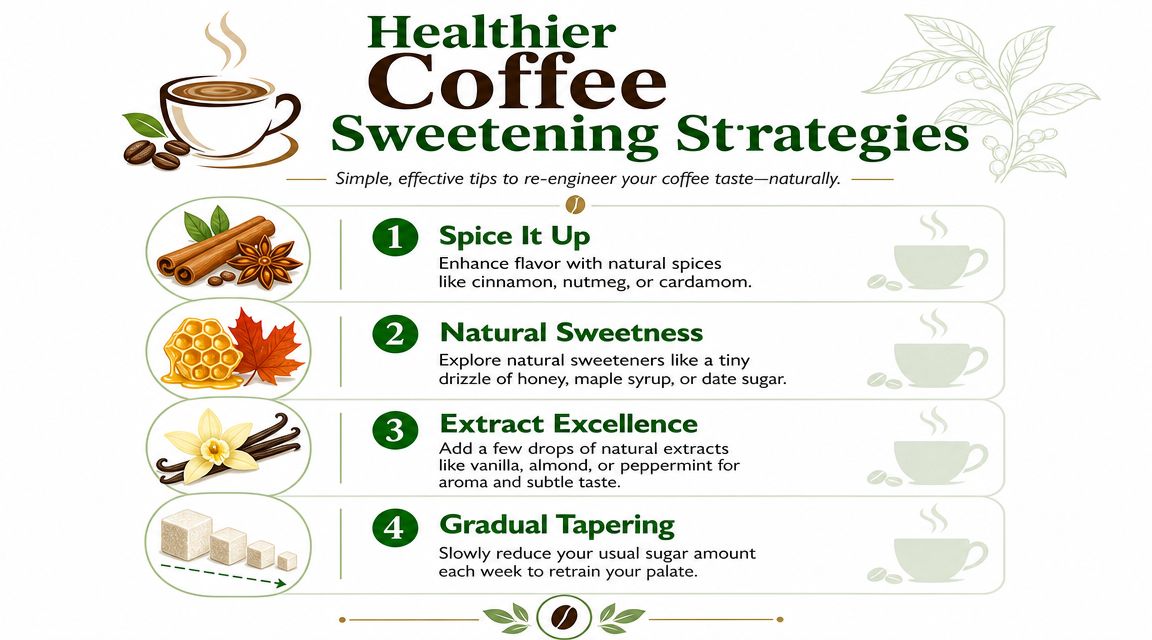
Spices
Cinnamon, cardamom, and nutmeg change aroma first. That matters because aroma strongly shapes sweetness perception.Extracts
A small amount of vanilla or almond extract can make a cup feel more dessert-like without turning it syrupy.Natural sweeteners
Honey, maple syrup, or date sugar may appeal more to some palates, but they're still sweeteners. Use them intentionally, not as a “health halo.”Stevia or similar options
Some people do well with them. Others notice aftertaste quickly. If you dislike the finish, forcing it usually backfires.
A good parallel is hydration. Tiny changes in setup and cues make consistency easier than forcing a perfect standard every day. That same logic shows up in tools designed for hydration tracking and repeatable daily follow-through.
Better coffee usually beats better willpower.
If your current cup needs sugar to become drinkable, improve the cup first. Then taper the sugar. In practice, that works far better than trying to win a daily fight against bitterness.
Your 4-Week Plan to Break the Sugar Habit
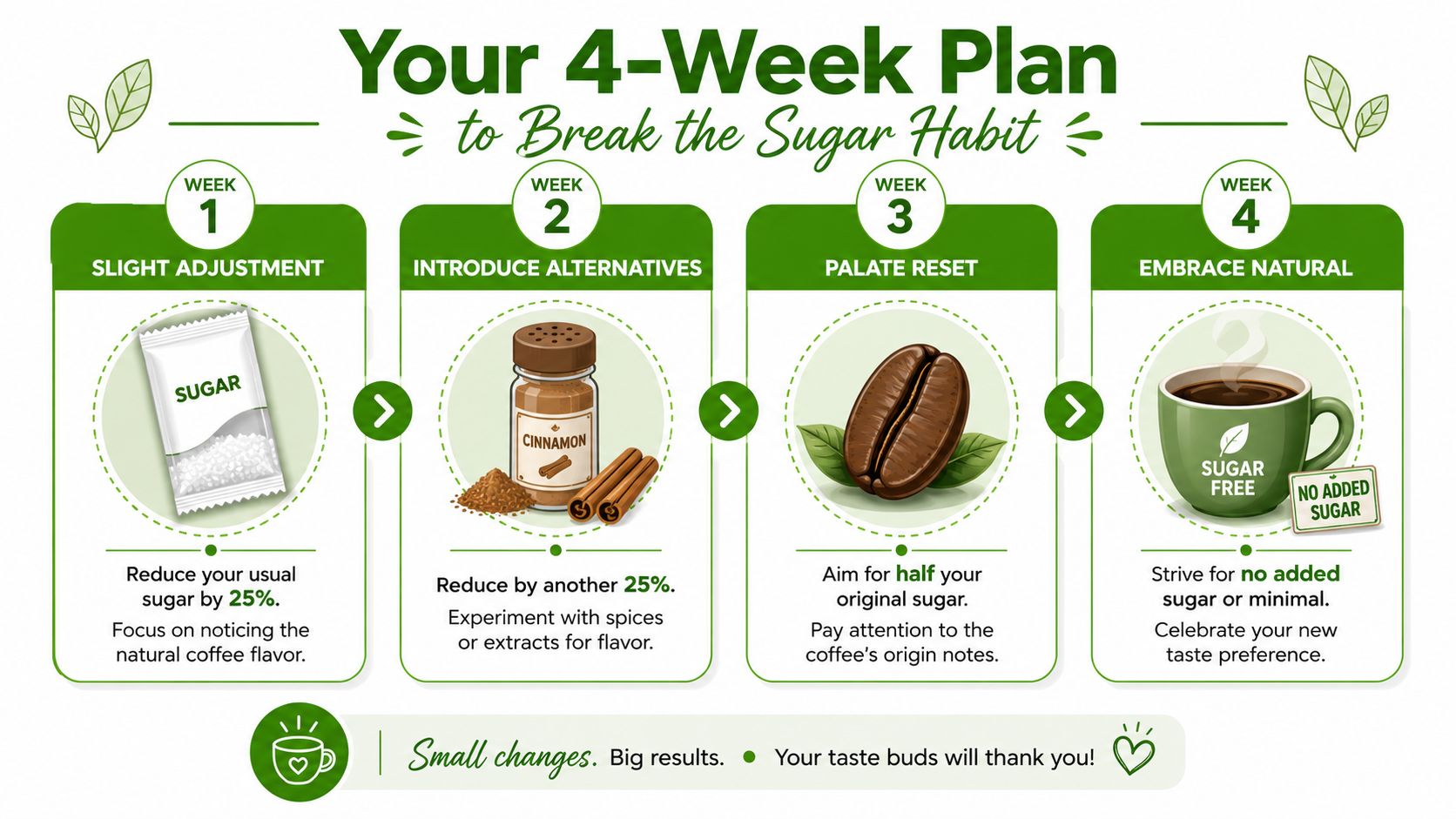
The most reliable way to reduce sugar in coffee is not to quit abruptly. It's to lower the dose gradually enough that your palate can adapt without making the ritual feel punishing.
The 4-week taper
Use your current amount as the baseline. Don't estimate vaguely. Measure it once so you know what “normal” means for you.
Week 1
Reduce your usual sugar by a small step. Keep everything else the same. Same mug, same brew, same time of day. The goal is to prove the ritual still works.Week 2
Reduce again. Add one taste-support tool such as cinnamon, vanilla extract, milk, or a better bean. Change only one variable besides sugar so you can tell what helps.Week 3
Hold at roughly half of your original amount if that feels manageable. Focus on drinking more slowly and noticing whether the first sip is the hardest part. For many people, it is.Week 4
Move toward minimal sugar or none in at least one daily cup. If you still want sweetness in a second cup, make that choice consciously instead of automatically.
A lot of people succeed faster when they attach the new action to an existing sequence. If that approach works well for you, this guide to habit stacking examples for everyday routines fits naturally with a coffee taper.
How to make it stick with social accountability
Plans fail when they depend on mood. A rough morning, a bad night of sleep, a stressful meeting, and the old sugar amount comes back.
Accountability changes that.
Tell one or two people exactly what you're doing. Not “I'm trying to be healthier.” Say, “For the next four weeks, I'm reducing sugar in my morning coffee and checking in daily.” Specific habits are easier to support than vague intentions.
You can also make the challenge visible. A shared note, text thread, kitchen checklist, or group tracker works better than private willpower because someone else sees whether you followed through.
For extra motivation, this short video is a useful companion while you're resetting the habit:
Keep the standard flexible
The smartest accountability systems don't require perfection. They separate a minimum win from an ideal win.
For example:
| Day type | Minimum win | Better win |
|---|---|---|
| Busy morning | Use less sugar than your old default | Drink the cup with your planned reduced amount |
| Social coffee run | Skip extra syrup or topping | Order the lower-sugar version confidently |
| Low-energy afternoon | Pause before sweetening automatically | Choose the least sweet version you still enjoy |
That flexibility matters. If the plan only counts on perfect days, it won't survive real life.
If you want a simple way to turn this into a repeatable group challenge, Habit Huddle is built for exactly that kind of habit change. You can create a small huddle for a no-sugar coffee challenge, set a minimum check-in for reduced sugar on hard days, aim for a full daily goal on good days, and let visible streaks keep the habit alive. It's a practical way to make social accountability real instead of relying on memory and motivation alone.
Ready to Build Habits With Friends?
Stop failing alone. Join thousands using the #1 habit tracker with friends for real accountability and lasting results.
Prefer mobile? App Store · Google Play
Related Guides
More Habit Huddle articles on building habits with accountability.
HabitShare Alternatives: 6 Apps for Tracking Habits With Friends (2026)
Looking for a HabitShare alternative? Six social habit trackers compared by model, price, platforms, and what happens on a missed day, plus how to switch wit...

What to Do When You Miss a Workout Day: The 5-Step Comeback Plan
Missed a workout day? What one miss does to your body and habit, according to research, plus a five-step plan for the next 24 hours, when to make it up, and...
Habit Streak App With Friends: 7 Apps Compared (2026)
Seven habit streak apps with friends compared: Habit Huddle, HabitShare, Daily Pact, Habitica, Streaks, Habit Streak duels, HabitStreak.io. What friends see,...