Hydration Tracking App: The 6 Best Water Trackers (2026)
The best hydration tracking app depends on what breaks your water habit. Compare Waterllama, WaterMinder, Hydro Coach, Plant Nanny, HidrateSpark, and Habit H...
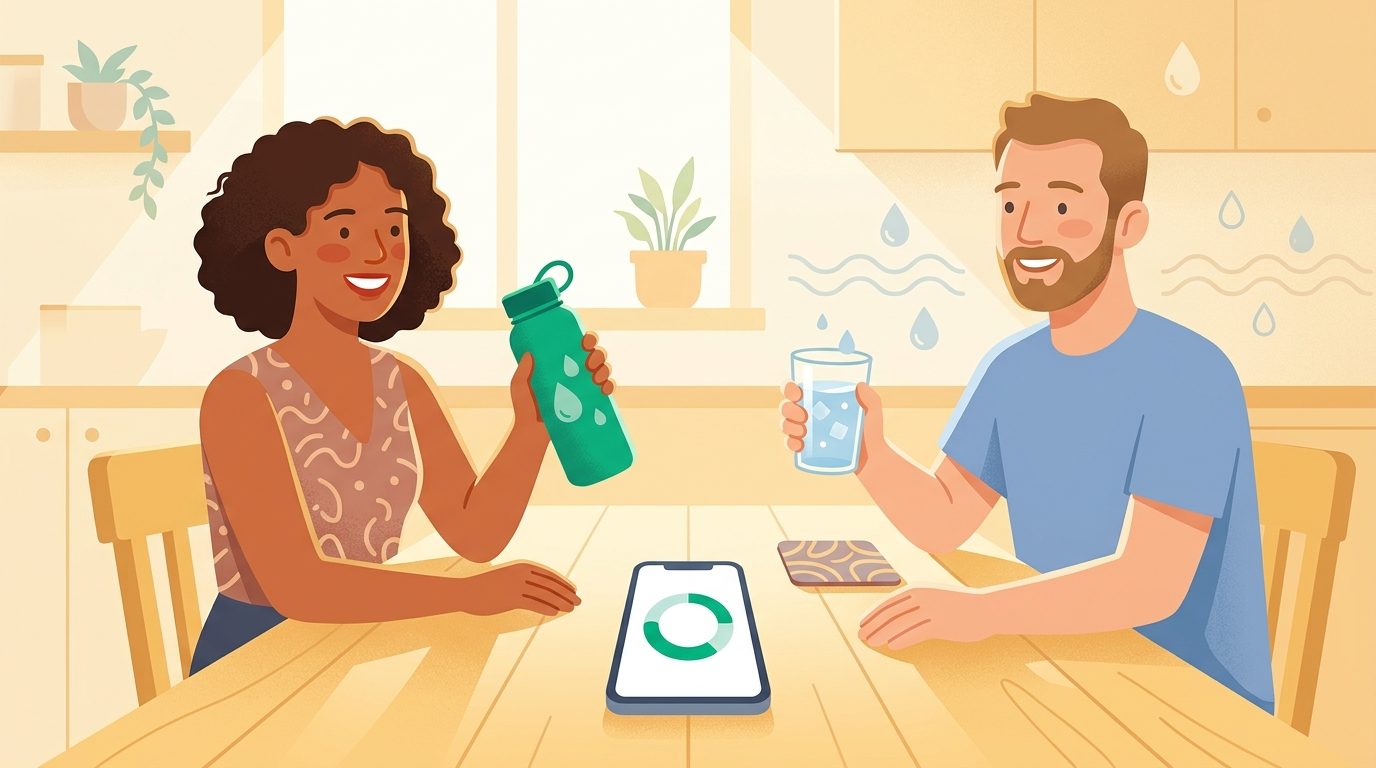
📺 Related Video: How to Properly Hydrate & How Much Water to Drink Each Day | Dr. Andrew Huberman
Video by: Huberman Lab Clips · Watch on YouTube
Looking for a hydration tracking app? The short answer: the right app depends on what actually breaks your water habit. If you forget to drink, you want smart reminders, and Hydro Coach does that free. If logging bores you, you want charm, which is Waterllama or Plant Nanny. If you want precise data on your wrist, WaterMinder is the veteran. And if your real pattern is starting strong and quietly quitting in week three, the fix is not a better reminder. It is other people, which is where a social habit tracker like Habit Huddle comes in.
This guide compares six apps, then covers the part most reviews skip: how to set a goal you can hit on a bad day, make logging automatic, and keep the habit alive after the novelty wears off.
The 6 best hydration tracking apps
Most water apps compete on reminders. Almost none compete on follow-through. A peer-reviewed content analysis of 51 water apps found that 98% send reminders and 71% use motivational cues, but only 31% offer any competitiveness with peers. The category is excellent at pinging you and thin on reasons to keep going.
That gap is worth keeping in mind as you compare:
| App | Platforms | Free tier | What keeps you drinking | Social layer |
|---|---|---|---|---|
| Waterllama | iOS, Apple Watch | Yes, premium upgrade | Playful characters and challenges | Share results with friends |
| WaterMinder | iOS, Android, Mac, Apple Watch | Limited, then subscription | Data, widgets, one-tap wrist logging | Sharing and challenges |
| Hydro Coach | iOS, Android | Yes, core features free | Smart reminders tuned to your schedule | Minimal |
| Plant Nanny | iOS, Android | Yes, premium upgrade | A plant that grows when you drink | Minimal |
| HidrateSpark | iOS, Android, smart bottle | App free, bottle is hardware | A bottle that glows and logs sips | App-based |
| Habit Huddle | Web, iOS, Android, Discord | Free, 1 active habit | Friends cheering your daily checkin | Built around a small group |
Waterllama: best if logging needs to feel fun
Waterllama turns each day's intake into an animal character that fills up as you drink. It covers 40+ beverage types with water-content ratios, so coffee and smoothies count honestly, and it runs hydration challenges like caffeine breaks and water-only streaks. Apple Health sync and Apple Watch logging are built in.
The trade-off: it is Apple-only, and the full experience sits behind a premium upgrade. There is no Android version to share with half your friends.
WaterMinder: best for data and wrist logging
WaterMinder has been the category veteran since 2013. It calculates a personal target from your weight, activity, and climate, offers custom cups for one-tap logging, and has the deepest Apple Watch support in the category. History charts, widgets, and health-app sync are all solid, and it includes sharing and challenge features if your friends use it too.
The trade-off: the free tier feels limited quickly, and the polish costs a subscription.
Hydro Coach: best free option
Hydro Coach keeps all essential tracking free: intake logging, goal calculation, and reminders that respect your wake and sleep times. It is one of the few apps that plans honestly for night-shift schedules and fasting periods, and it syncs with Google Fit and Samsung Health.
The trade-off: the design is functional rather than delightful. If you need charm to come back daily, look at Waterllama or Plant Nanny instead.
Plant Nanny: best gamified motivation
Plant Nanny gives you a virtual plant that grows when you log water. Caring for something, even a cartoon succulent, is a surprisingly strong daily pull, and the formula has been refined for over a decade on iOS and Android.
The trade-off: there is no Apple Watch app, and the wilting-plant mechanic motivates some people and stresses others. If a sad plant would feel like one more thing to disappoint, pick a different motivator.
HidrateSpark: best if you want the bottle to do the logging
HidrateSpark is a smart water bottle that glows to remind you to drink and syncs each sip to its app over Bluetooth. It removes the logging step entirely, which is the step most people drop first.
The trade-off: it is hardware money for a habit you can track free, and it only works when that specific bottle is the one in your hand.
You already know you can change.
You just need to take the first step. Habit Huddle helps you build habits around your goals, alongside friends who keep you accountable.
Habit Huddle: best for accountability with real friends
Full disclosure: Habit Huddle is our app, so judge the reasoning rather than the ranking. It is not a dedicated water tracker and it will not do ounce math for you. It exists for the failure mode none of the apps above address: nobody but you notices whether you kept going.
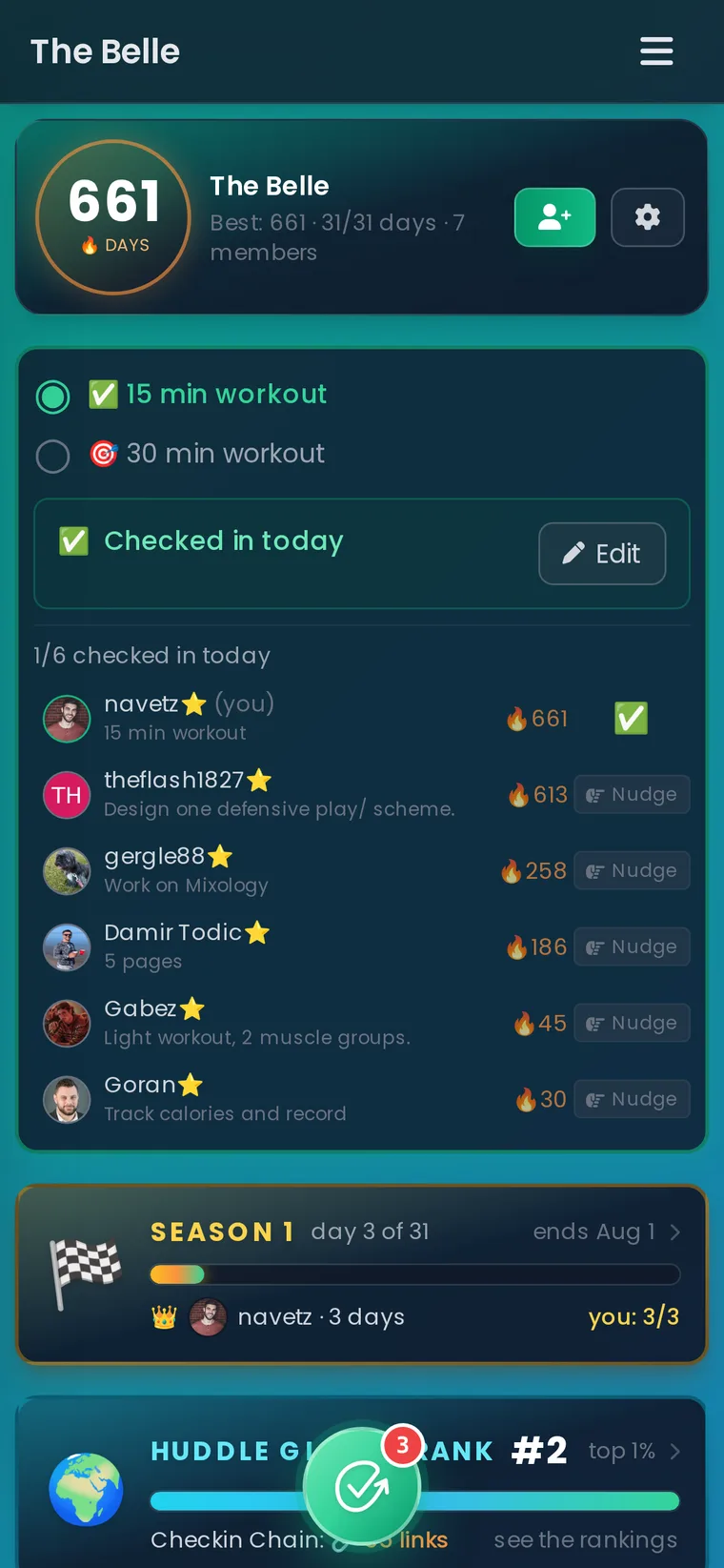
You create a drink-more-water habit with a floor, the smallest daily action that fully counts, like one full bottle before noon, and a ceiling to burst through on your best days, like two liters. Then you put the habit in a huddle, a small group of friends who see and react to each other's daily checkins. Each day a member checks in adds a link to the huddle's Checkin Chain, the group's shared count of showing up. Misses stay invisible; only checkins are celebrated.
The trade-off: checkins are manual, and there is no smart-bottle sync or milliliter chart. Plenty of people pair it with one of the trackers above: the water app measures, the huddle keeps you coming back. Free with one active habit; Habit Huddle Builder unlocks more from $100/yr. Try it here.
How to choose: pick for your worst weekday
Pick the app you are most likely to use on your worst weekday, not your most motivated Sunday. Every app demos well when you are fresh and motivated. The habit is decided on the day you are busy, tired, and behind.
Four traits predict whether an app survives that day:
- Fast logging. A common drink should take one or two taps to record.
- Flexible drink types. Real life includes coffee, tea, and sparkling water, not just plain water.
- Adjustable reminders. Pings that fit your actual schedule beat hourly buzzing you learn to ignore.
- An optional social layer. Some people do best in private. Others quit quietly without company.
If water is one of several habits you are working on, a general tracker may serve you better than a dedicated water app. Our habit tracking template guide covers that trade-off in depth.
Set a goal you can hit on a bad day
The default goal is where most water habits die. People accept whatever number the app suggests, treat it as a moral test, miss it three days running, and stop opening the app.
Treat the suggested number as a starting point, not a verdict. Needs vary with body size, activity, and climate, which is why the better apps ask about all three. Then set yourself a floor: the smallest intake that still counts as a win, small enough to hit on your busiest day. A floor day is a full win, not a partial one. Save the bigger number for training days and heat waves.
Reminders work the same way. Anchor them to moments that already exist instead of arbitrary intervals:
| Situation | Better reminder timing |
|---|---|
| Morning routine | With breakfast or right after brushing teeth |
| Desk work | At the start of each work block |
| Exercise days | Before training and during recovery |
| Commute | Right before leaving |
| Evening | Early enough not to disrupt sleep |
Make logging nearly automatic
Logging survives when it stops requiring decisions. Save presets for the four drinks you actually have: your main bottle, your usual coffee order, your workout drink, your evening default. Recording becomes selecting, not measuring.
Log close to the moment you drink. Delayed logging turns into missing data, and missing data means the app can no longer guide you. If you keep forgetting late-day drinks, the fix is a better anchor, not more discipline.
One more distinction worth keeping: a missed log is not missed hydration. If your record has gaps but your bottle is empty, the habit is fine. Fix the system when you have energy; never punish yourself for the paperwork.
Smart bottles and wearables: estimates, not verdicts
Wearable hydration tech is improving, but treat every reading as an estimate. A scoping review of wearable hydration monitoring concluded that while these sensors can provide real-time assessment, reliability and accuracy remain major challenges, with multi-sensor designs the most promising path forward.
The practical rule: let hardware reduce friction, not grade you. A smart bottle that auto-logs sips removes a chore. A sensor reading that contradicts how you feel deserves skepticism, not a schedule change.
Why solo water tracking fades
Solo tracking fades because no one is glad you showed up. The app pings, you log, and nothing in your day changes whether you do or not. After the novelty wears off, the only thing holding the habit up is guilt, and guilt is a weak long-term system.
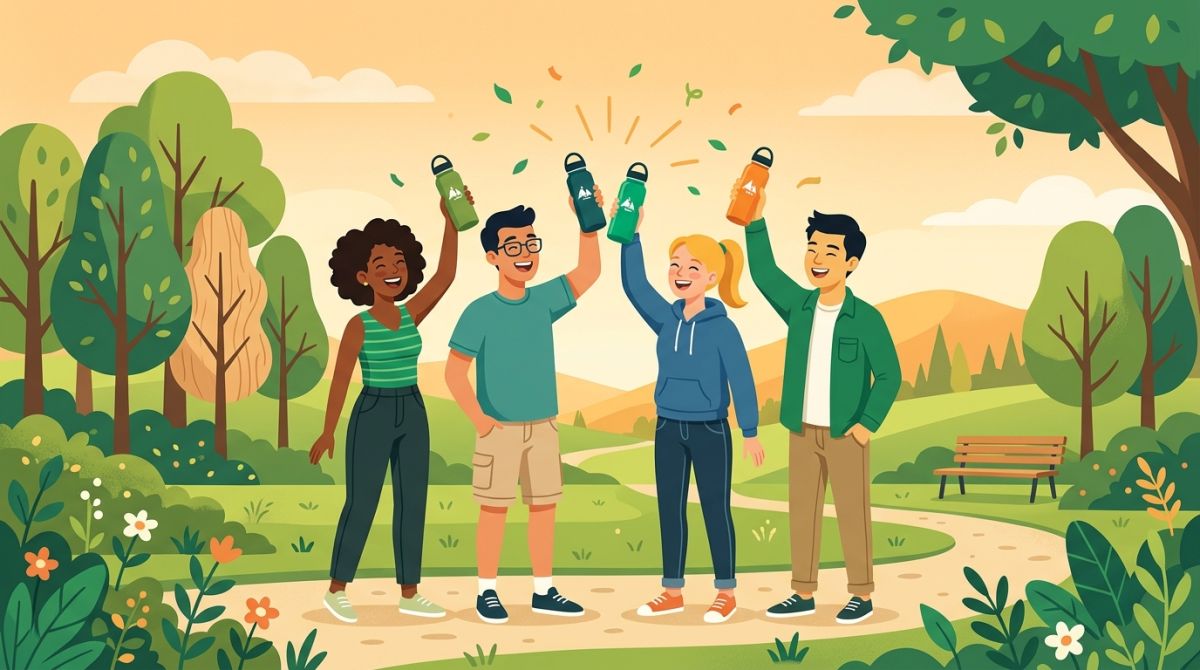
Accountability fixes this by adding the missing ingredient: someone who cheers the glass you did drink. Not an audit, not pressure, just a small group where today's checkin gets a reaction and your consistency is visible and celebrated. Hydration suits this unusually well because it is daily, simple, and easy to post about.
What makes the social version work:
- Small groups beat big communities. In a group of four, your checkin lands. In a group of four hundred, it scrolls away.
- Encouragement beats policing. People stay in systems that celebrate recovery, not perfection.
- Flexible standards help. A floor everyone can hit keeps the whole group moving on hard weeks.
Our guides to habit accountability and group accountability apps go deeper on setting this up. And if you want to try it with your own friends, a habit tracker with friends turns drink-more-water from a private chore into a shared one.
When the system breaks, repair it
Even a good setup breaks sometimes. Travel scrambles your timing, meetings erase your cues, motivation dips. The mistake is reading a disrupted week as proof the system failed.
| Problem | Bad response | Better response |
|---|---|---|
| Missed a day | Quit entirely | Restart the next morning |
| Ignored reminders | Add more reminders | Cut them and place them better |
| Logging feels tedious | Try harder | Simplify presets |
| Goal feels impossible | Force compliance | Lower the floor to match your real week |
The habit that survives is rarely the most intense one. It is the one you can resume quickly after disruption. Pick the app, the goal, and the people that make resuming easy, and the streak takes care of itself.
Ready to Build Habits With Friends?
Stop failing alone. Join thousands using the #1 habit tracker with friends for real accountability and lasting results.
Prefer mobile? App Store · Google Play
Related Guides
More Habit Huddle articles on building habits with accountability.
HabitShare Alternatives: 6 Apps for Tracking Habits With Friends (2026)
Looking for a HabitShare alternative? Six social habit trackers compared by model, price, platforms, and what happens on a missed day, plus how to switch wit...
What to Do When You Miss a Workout Day: The 5-Step Comeback Plan
Missed a workout day? What one miss does to your body and habit, according to research, plus a five-step plan for the next 24 hours, when to make it up, and...
Habit Streak App With Friends: 7 Apps Compared (2026)
Seven habit streak apps with friends compared: Habit Huddle, HabitShare, Daily Pact, Habitica, Streaks, Habit Streak duels, HabitStreak.io. What friends see,...