
Mastering Mental Health Habits: A Practical Guide
Build sustainable mental health habits. Our practical playbook offers tiny starts, flexible goals, and smart accountability to end the all-or-nothing cycle.
Most advice about mental health habits fails for a simple reason. It assumes your best day is your normal day.
That's why so many plans look impressive on paper and collapse in real life. They ask for a perfect sleep schedule, daily workouts, meditation, journaling, meal prep, gratitude practice, therapy homework, and a digital detox all at once. A routine like that doesn't build resilience. It creates a fragile checklist that breaks the moment stress rises, sleep drops, or life gets messy.
A better system starts with one truth: your energy changes. Your mood changes. Your capacity changes. Mental health habits need to survive bad days, not just fit good ones. That matters at scale, too. In 2025, the World Health Organization reported that more than 1 billion people worldwide are living with a mental health condition, roughly 1 in every 7 people, and noted that anxiety and depression carry major human and economic costs, according to this WHO-related summary of mental health statistics. This isn't a niche struggle. It's daily life for a huge share of the world.
The most useful habit system isn't the most ambitious one. It's the one you can keep.
Table of Contents
- Why Most Mental Health Routines Fail
- How to Choose Your First Keystone Habit
- Building Momentum with a Two-Tier Goal System
- The Power of Tracking and Group Accountability
- What to Do When Your Habit Plan Breaks
- Your 30-60-90 Day Sustainable Habit Plan
Why Most Mental Health Routines Fail
Most mental health routines fail because they're built like performance plans, not recovery systems.
They assume you'll have the same attention, time, and emotional bandwidth every day. You won't. If your routine only works when you feel motivated, rested, and organized, it doesn't really work. It's just a best-case script.
The checklist problem
A fragile routine usually has three features:
- Too many moving parts. You try to change sleep, food, exercise, mindfulness, screen time, and social habits at once.
- No low-energy version. If you can't do the full routine, you do nothing.
- Failure loaded into the design. One missed day feels like proof that you're inconsistent.
That last point matters more than people think. The emotional hit from “I blew it again” often does more damage than the missed walk, missed bedtime, or missed journal entry.
Practical rule: If a habit plan makes you feel behind after one hard day, the plan is too brittle.
Motivation is a poor foundation
People often blame themselves when routines break. In practice, the issue is usually bad architecture.
A strong mental health habit system accounts for fluctuation. Some mornings you can do a full workout and cook breakfast. Other days, getting dressed and stepping outside for a minute is the win. Both days count if the system is built correctly.
Here's the difference:
| Fragile list | Resilient system |
|---|---|
| Built for ideal days | Built for real days |
| Requires motivation | Uses cues and defaults |
| Miss one step, feel off-track | Adjusts without collapse |
| Measures perfection | Measures consistency |
What actually holds up
The routines that last usually share a few traits:
- They're small enough to repeat.
- They have a clear floor.
- They attach to existing parts of the day.
- They allow partial success.
- They make it obvious whether you showed up.
That's the shift. Stop asking, “What would the perfect mental wellness routine include?” Start asking, “What habit can I still do when my day goes sideways?”
When people build mental health habits that way, they stop treating consistency like a personality trait. They treat it like a system design problem. That's a much more useful frame, and it's far more compassionate.
How to Choose Your First Keystone Habit
Your first habit should do more than look healthy. It should make other good decisions easier.
That's what makes something a keystone habit. It creates spillover. A stable bedtime can improve your mornings. A short walk can reduce friction around focus and mood. A nightly phone cutoff can support sleep, attention, and stress at the same time.
Use three filters
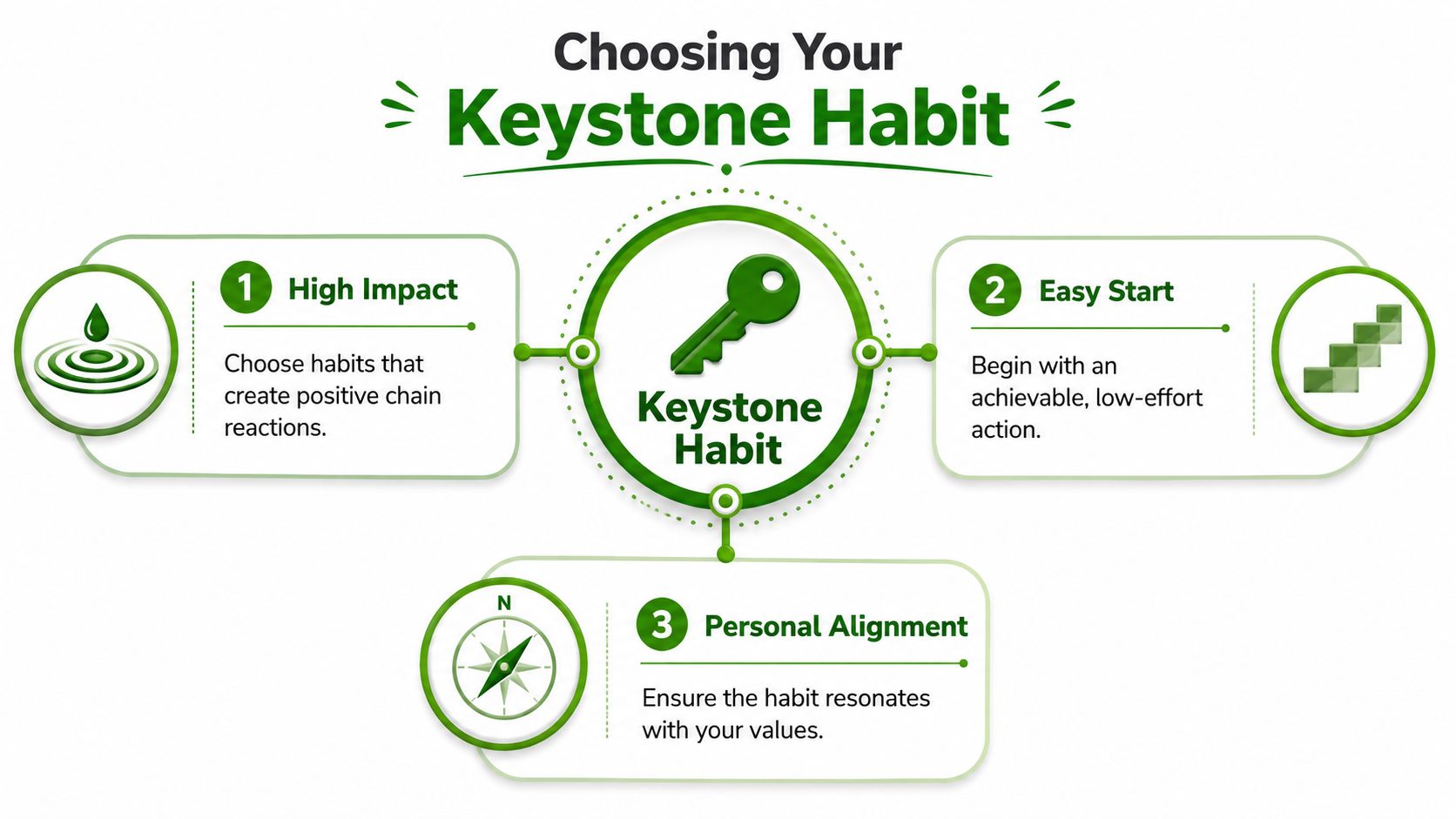
A good first habit passes three tests.
High impact
Pick a habit that affects more than one area of your day. Good candidates include:
- Sleep anchors. A consistent lights-out time or wake-up time.
- Movement. A short walk, stretching, or ten minutes of activity.
- Mindfulness. One brief breathing practice at the same time daily.
- Social contact. A quick supportive text or conversation ritual.
The American Psychiatric Association recommends small, sustainable habits across physical activity, diet, mindfulness, sleep, and social connection because these behaviors can help prevent and treat common mental health conditions. It also emphasizes that adherence, not intensity, is the key benchmark in this APA guide to lifestyle support for mental health.
Easy start
If the habit takes too much setup, it's a poor first choice.
“Go to the gym five days a week” sounds admirable. “Walk for five minutes after lunch” is more likely to happen. The early goal isn't to maximize benefit. It's to minimize friction so repetition becomes normal.
Personal alignment
Choose something that fits your current life, not your fantasy life.
If evenings are chaotic, don't start with an elaborate nighttime routine. If mornings are rushed, don't promise yourself a long meditation before work. A habit only counts as realistic if it matches your actual schedule, energy, and environment.
The best keystone habit isn't the one with the highest upside. It's the one you'll still do during a rough week.
A quick decision method
Use this simple screen:
| Question | If yes | If no |
|---|---|---|
| Does it help mood or stress directly? | Keep considering it | Drop it |
| Can I do it in a few minutes? | Good sign | Shrink it |
| Can I attach it to a stable cue? | Strong candidate | Redesign it |
| Does it fit my worst weekday? | Start here | It's too big |
If you need help attaching a habit to an existing routine, these habit stacking examples for daily routines show the logic well.
Good first-habit examples
Instead of broad goals, use tight versions:
- Sleep: get in bed at the same time each night.
- Movement: walk to the end of the block and back.
- Mindfulness: take five slow breaths after brushing your teeth.
- Connection: send one honest message to a friend each afternoon.
- Screen boundary: charge your phone outside the bedroom.
Start with one. Not three. Not “a balanced system.” One habit that has impact and doesn't ask for heroics.
Building Momentum with a Two-Tier Goal System
Most people don't need more ambition. They need a system that prevents a hard day from becoming a lost week.
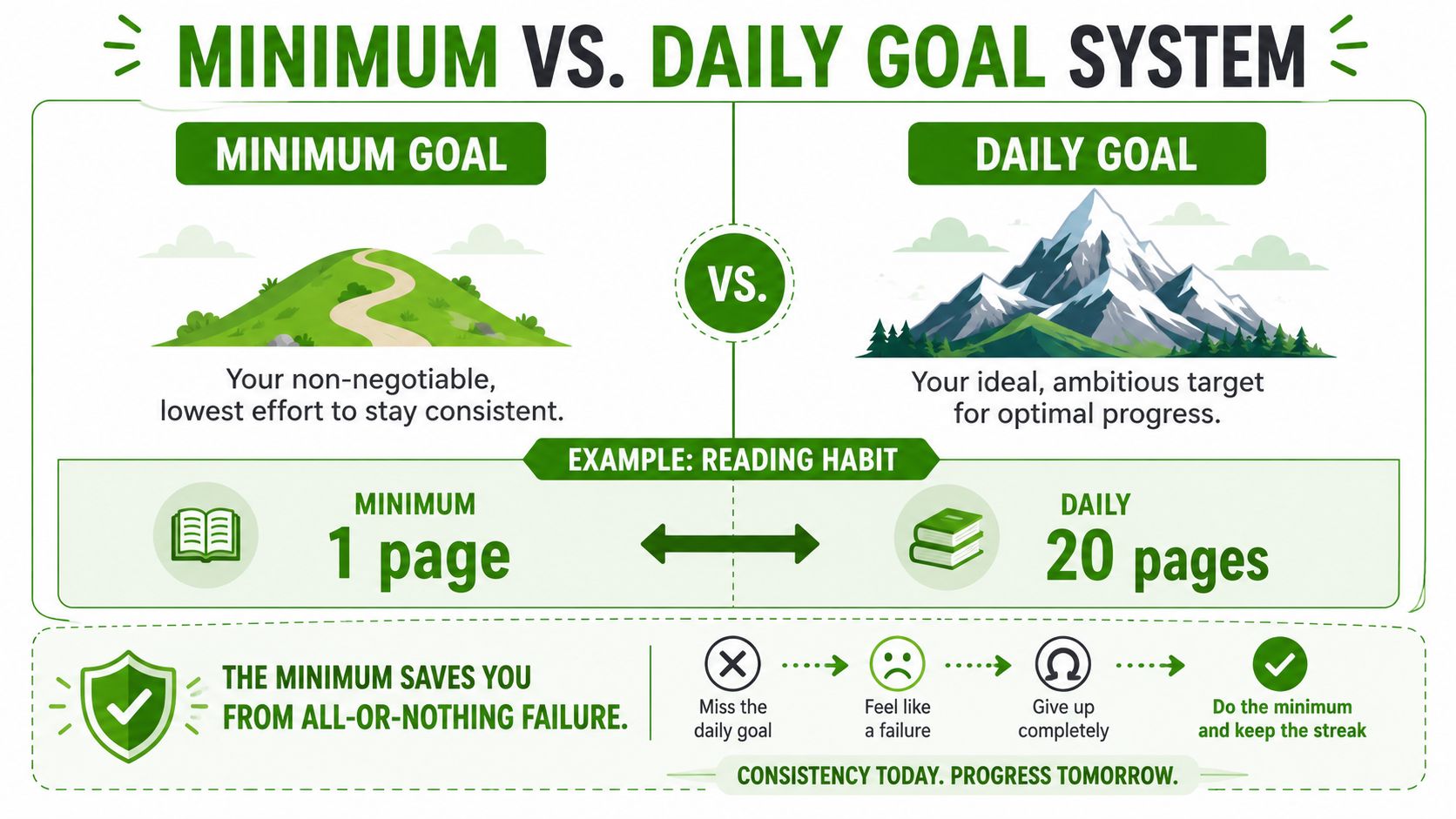
That's where the Minimum vs. Daily Goal framework helps. It replaces all-or-nothing thinking with a two-tier standard. One goal protects consistency. The other goal drives progress.
Early in the section, it helps to see the split visually.
What each goal means
The Minimum Goal is the smallest version of the habit that still counts. It should feel almost too easy.
The Daily Goal is the version you aim for when your day is reasonably stable. It should move you forward without being extreme.
This distinction matters because many people secretly treat “not my best” as “failed.” That's how one missed meditation turns into abandoning mindfulness entirely. A two-tier system fixes that.
Examples that work in real life
Here's what the framework looks like across common mental health habits:
| Habit | Minimum Goal | Daily Goal |
|---|---|---|
| Mindfulness | 1 slow breath | 10 minutes of guided meditation |
| Movement | 5 minutes of walking | Full workout or longer walk |
| Sleep routine | Put phone away before bed | Full wind-down routine and fixed bedtime |
| Journaling | Write 1 sentence | Write a full page |
| Social connection | Send 1 message | Have a real conversation |
| Mood tracking | Log mood with one word | Log mood and note triggers |
Notice the pattern. The minimum is not symbolic. It's still the habit. It keeps the identity intact.
Key distinction: The minimum goal is not a backup plan. It is the plan for low-capacity days.
Why this protects momentum
When people miss habits, they often lose more than the action. They lose trust in themselves.
The two-tier system rebuilds that trust because it creates repeated proof that you can still show up under imperfect conditions. That's far more valuable than occasional perfect days followed by collapse.
A few practical effects show up quickly:
- Less shame because the day isn't labeled a failure.
- More streak continuity because small actions still count.
- Faster recovery because habits stay psychologically “alive.”
- Better self-awareness because you stop guessing and start seeing patterns.
If you use shared goals with others, these team goal examples and structures can help you adapt the same logic for a group.
You already know you can change.
You just need to take the first step. Habit Huddle helps you build habits around your goals, alongside friends who keep you accountable.
How to set the right minimum
Individuals often set their minimum too high. If you need motivation, free time, and ideal conditions to complete it, it's not a minimum.
A good minimum has these traits:
- It takes almost no setup.
- You can do it while tired, busy, or emotionally flat.
- It keeps the habit recognizable.
- It avoids negotiation.
Bad minimum: “Do a 20-minute yoga flow.”
Better minimum: “Do one stretch while the kettle boils.”
Here's a short walkthrough of the idea in action:
Common mistakes with two-tier goals
A few patterns break the system:
- Turning the daily goal into the only goal. Then you're back in all-or-nothing mode.
- Using the minimum every day forever. The minimum protects consistency, but the daily goal still matters on good days.
- Changing the rules based on guilt. Decide both tiers in advance.
- Stacking too many habits at once. Run the framework on one habit first.
The best mental health habits aren't fragile because they don't depend on feeling inspired. They give you a low floor, a clear target, and a way to stay in motion.
The Power of Tracking and Group Accountability
A habit you only measure in your head usually feels more chaotic than it is.
Tracking fixes that. Not because it makes you “disciplined,” but because it turns vague effort into visible evidence. On low-confidence days, that matters. You stop relying on mood to judge progress.
The need is large. In 2024, 23.4% of U.S. adults, about 61.5 million people, experienced any mental illness, and WHO defines mental health as the capacity to cope with stress and contribute to community. That combination makes consistency-focused support tools especially relevant, as summarized in this mental health statistics overview citing U.S. prevalence and WHO's definition.
Track behavior, not worth
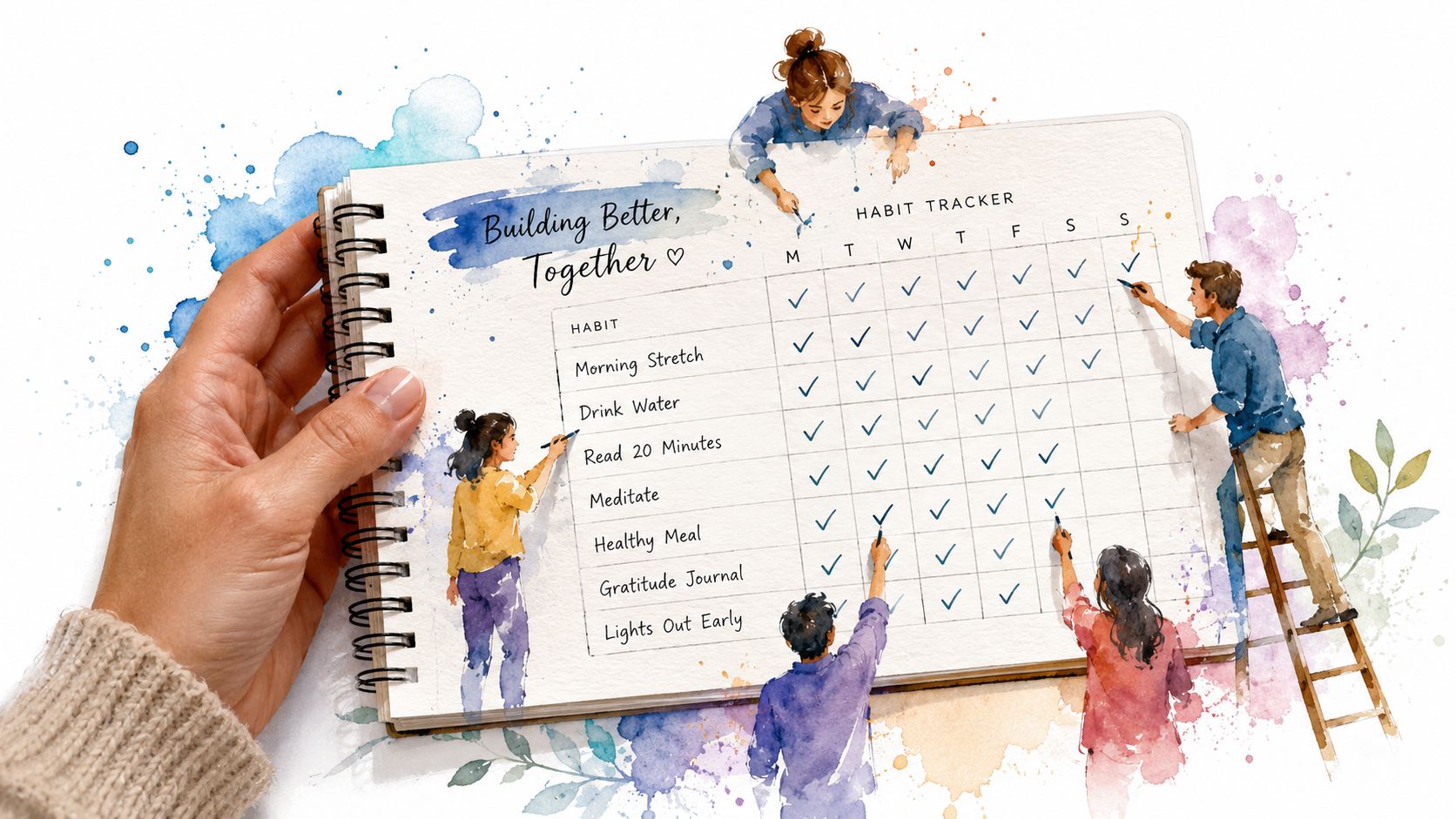
Many people avoid habit tracking because they think it will become another tool for self-criticism. That happens when the tracker is used like a report card.
Use it like a dashboard instead.
A useful tracker answers a few plain questions:
- Did I do my minimum?
- Did I reach my daily goal?
- What time did I do it?
- What tends to block it?
That's enough. You don't need a giant spreadsheet, ten mood categories, and a color-coded scoring system unless you enjoy that. A notes app, paper calendar, or simple app can work.
Track first for awareness. Motivation usually follows after you can see the pattern.
Why groups help when motivation drops
Solo habits depend heavily on self-generated momentum. Some days you have that. Some days you don't.
Small-group accountability changes the equation. It lets you borrow momentum from other people. When someone else posts a checkin, follows through, or asks how your habit went, your own resistance often drops. You're no longer carrying the whole system alone.
That's different from pressure or public shaming. Good accountability has a few features:
| Weak accountability | Strong accountability |
|---|---|
| Vague promises | Specific daily checkins |
| Large, passive audience | Small, active group |
| Judgment after failure | Fast reset after misses |
| Motivation speeches | Clear visible follow-through |
If you want to explore digital support for this kind of structure, this accountability partner app guide is a practical place to compare what makes a tool helpful rather than noisy.
What to share with an accountability group
Keep it tight. Over-sharing can create friction and avoidance.
A useful daily checkin might include:
- The habit you're working on.
- Your minimum for tough days.
- Your daily goal for normal days.
- A quick status such as minimum done, daily done, or missed.
- One line of context if needed, like “travel day” or “rough sleep.”
This format works because it lowers emotional load. People don't need to craft a narrative every night. They just need to show up honestly.
For many people, that's the missing piece in mental health habits. Not more information. More structure around repetition, visibility, and support.
What to Do When Your Habit Plan Breaks
Your habit plan will break. Assume that from the start.
The useful question isn't, “How do I avoid all setbacks?” It's, “What adjustment does this setback point to?” That shift matters because broken routines are often treated like moral failures when they're usually feedback.
There's also a broader reality behind this. The AAMC notes that in the U.S., more than one-fifth of adults had a mental illness in 2020, while care remained out of reach for many because of provider shortages, high costs, and fragmented care, as explained in this AAMC review of barriers to mental health care in the U.S.. When support is limited, personal systems have to be practical enough to hold under pressure.
Four common breakdowns and the fix
I forgot
This usually means the habit has no reliable cue.
Attach it to something that already happens. After brushing your teeth, do the breathing practice. After lunch, take the walk. After plugging in your phone, write the journal sentence. Memory improves when the behavior has a home.
I was too tired
Don't abandon the habit. Drop to the minimum.
If your daily goal was a longer meditation, do one minute. If your daily goal was a walk outside, stand on the porch and breathe. Low energy is not the moment to test character. It's the moment to use the floor you built.
I missed a day and now I feel off-track
Use the never miss twice rule.
One miss is disruption. Two misses often becomes a new pattern. The next day's job isn't to compensate. It's to reappear. Keep the restart small and immediate.
Missed habits become dangerous when you add drama to them. Reset faster than you explain.
I stopped because I felt behind
This happens when the routine evolved into a scoreboard.
Remove any feature that makes the habit feel expensive. Reduce the number of steps. Shorten the duration. Stop trying to “make up” for lost days. The fastest way back is almost always the lightest one.
A simple debugging checklist
When a mental health habit stalls, review these questions:
- Cue problem. Did I know exactly when to do it?
- Size problem. Was the daily version too demanding?
- Environment problem. Was something in the room, schedule, or device setup working against me?
- Emotion problem. Did I start associating the habit with guilt?
- Isolation problem. Was nobody else aware I was trying to keep it going?
That last one gets underestimated. A habit hidden from everyone else is easier to abandon undetected.
A broken plan doesn't mean you're bad at habits. It usually means the system needs one cleaner cue, one smaller minimum, or one layer of support.
Your 30-60-90 Day Sustainable Habit Plan
Long-term change usually fails when people try to install the whole lifestyle at once.
A better approach is phased. Build one habit until it feels normal. Then strengthen it. Then add carefully. That creates a routine you can carry into ordinary life, not just a short burst of enthusiasm.
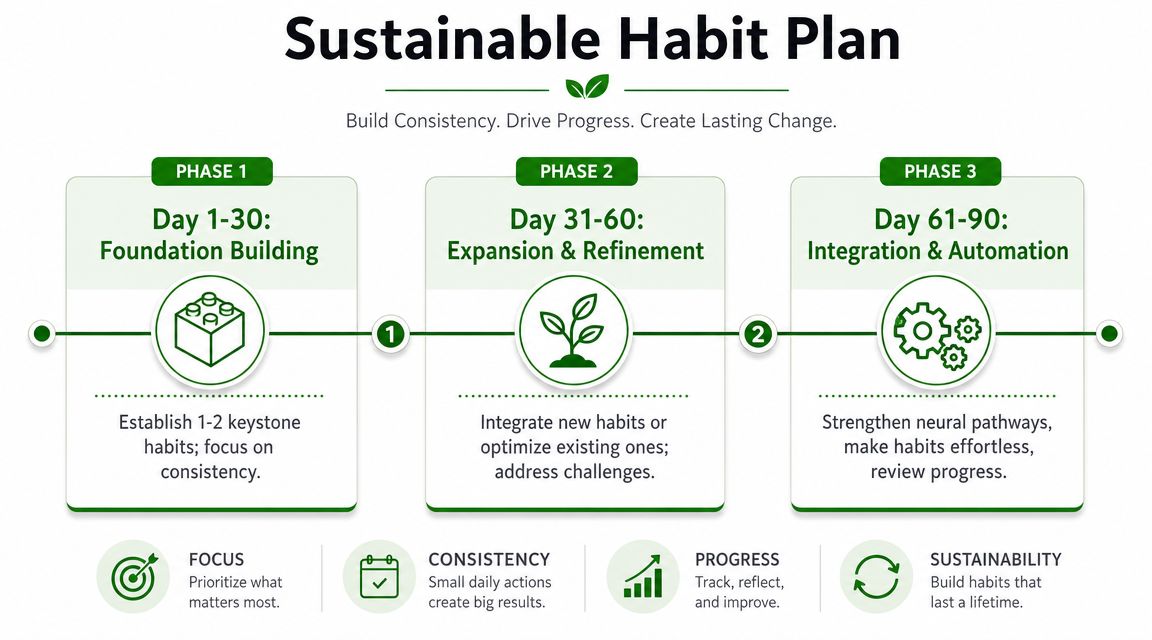
Days 1 to 30 build the floor
Pick one keystone habit only.
Define both tiers before you start. Your minimum should be doable on your worst weekday. Your daily goal should be realistic on a normal weekday. Track it every day, even if the entry is just “minimum done.”
Focus points for this phase:
- Lock the cue so the habit happens at the same point in your day.
- Reduce setup friction by preparing the environment.
- Learn your failure pattern instead of trying to avoid every imperfect day.
- Protect repetition over intensity.
If you want an example, a sleep-focused plan might look like this: minimum goal is putting the phone away before bed, daily goal is full wind-down plus a consistent bedtime. A movement-focused plan might be five minutes minimum, longer walk or workout as the daily target.
Days 31 to 60 add precision
Keep the first habit. Don't replace it.
This phase is about tightening what already exists. Move the cue if timing has been sloppy. Lower the minimum if you keep skipping it. Raise the daily goal only if adherence is stable and the habit feels grounded.
You can also add a second habit here, but only if the first one feels durable. Good second habits are usually complementary:
| First habit | Strong second habit |
|---|---|
| Bedtime routine | Morning light exposure |
| Short daily walk | Mood tracking |
| Brief meditation | Screen cutoff at night |
| Journaling | Daily social checkin |
The point isn't to create a perfect wellness stack. It's to build a sequence that supports itself.
Days 61 to 90 make it part of your identity
This is the stage where people often get careless because the habit feels familiar. Don't drift.
Keep tracking. Review misses without emotion. If you've added a second habit, make sure both still have a genuine minimum and not a disguised daily goal.
A useful weekly review can be very short:
- What did I complete consistently?
- Where did I drop to minimum most often?
- What situation triggered misses?
- What one change would make next week easier?
Sustainable mental health habits don't ask you to be the same person every day. They give each version of you a way to keep showing up.
By the end of this period, the win isn't perfection. The win is that your habits no longer depend on a motivational surge. They have cues, floors, tracking, and a reset mechanism. That's what makes them durable.
If you want a simple way to put this into practice, Habit Huddle is built around the exact structure that helps habits survive real life. You can track one habit at a time, use a Minimum and Daily Goal checkin system, and stay accountable inside a small group instead of trying to rely on willpower alone. It's a practical fit for anyone who wants mental health habits that hold up on both good days and hard ones.
Ready to Build Habits With Friends?
Stop failing alone. Join thousands using the #1 habit tracker with friends for real accountability and lasting results.
Prefer mobile? App Store · Google Play
Related Guides
More Habit Huddle articles on building habits with accountability.

HabitShare Alternatives: 6 Apps for Tracking Habits With Friends (2026)
Looking for a HabitShare alternative? Six social habit trackers compared by model, price, platforms, and what happens on a missed day, plus how to switch wit...
What to Do When You Miss a Workout Day: The 5-Step Comeback Plan
Missed a workout day? What one miss does to your body and habit, according to research, plus a five-step plan for the next 24 hours, when to make it up, and...
Habit Streak App With Friends: 7 Apps Compared (2026)
Seven habit streak apps with friends compared: Habit Huddle, HabitShare, Daily Pact, Habitica, Streaks, Habit Streak duels, HabitStreak.io. What friends see,...