
Sore Thighs After Squats: How Long It Lasts and What Actually Helps
Sore thighs after squats are usually DOMS, peaking 24-72 hours. How to tell injury apart, which recovery tactics have real evidence, and how to prevent it.
📺 Related Video: How to Relieve Muscle Soreness and Recover FAST (4 Science-Based Tips)
Video by: Jeremy Ethier · Watch on YouTube
Sore thighs after squats are almost always delayed onset muscle soreness, DOMS: a normal response to training stress that shows up 12 to 24 hours after your session, peaks around days one to three, and fades on its own. It is not a sign you damaged something, and it is not a requirement for progress either.
The job over the next few days is simple. Confirm it is ordinary soreness and not an injury, use the handful of recovery tactics with actual evidence behind them, and adjust your training so the next squat day does not ambush you the same way.
DOMS or injury: how to tell the difference
The question is not whether your thighs hurt, it is what kind of pain you are dealing with. DOMS is diffuse, achy, and slow to arrive; an injury is sharp, localized, and usually tied to one specific rep.
DOMS comes from training stress your muscles were not fully adapted to yet: more volume, deeper range, slower lowering, a new variation, or a return after time off. Your quads do heavy work controlling the descent, your adductors stabilize more than most people realize at depth, and when the dose exceeds what those tissues are used to, the result is that deep, wide ache that makes stairs feel athletic.
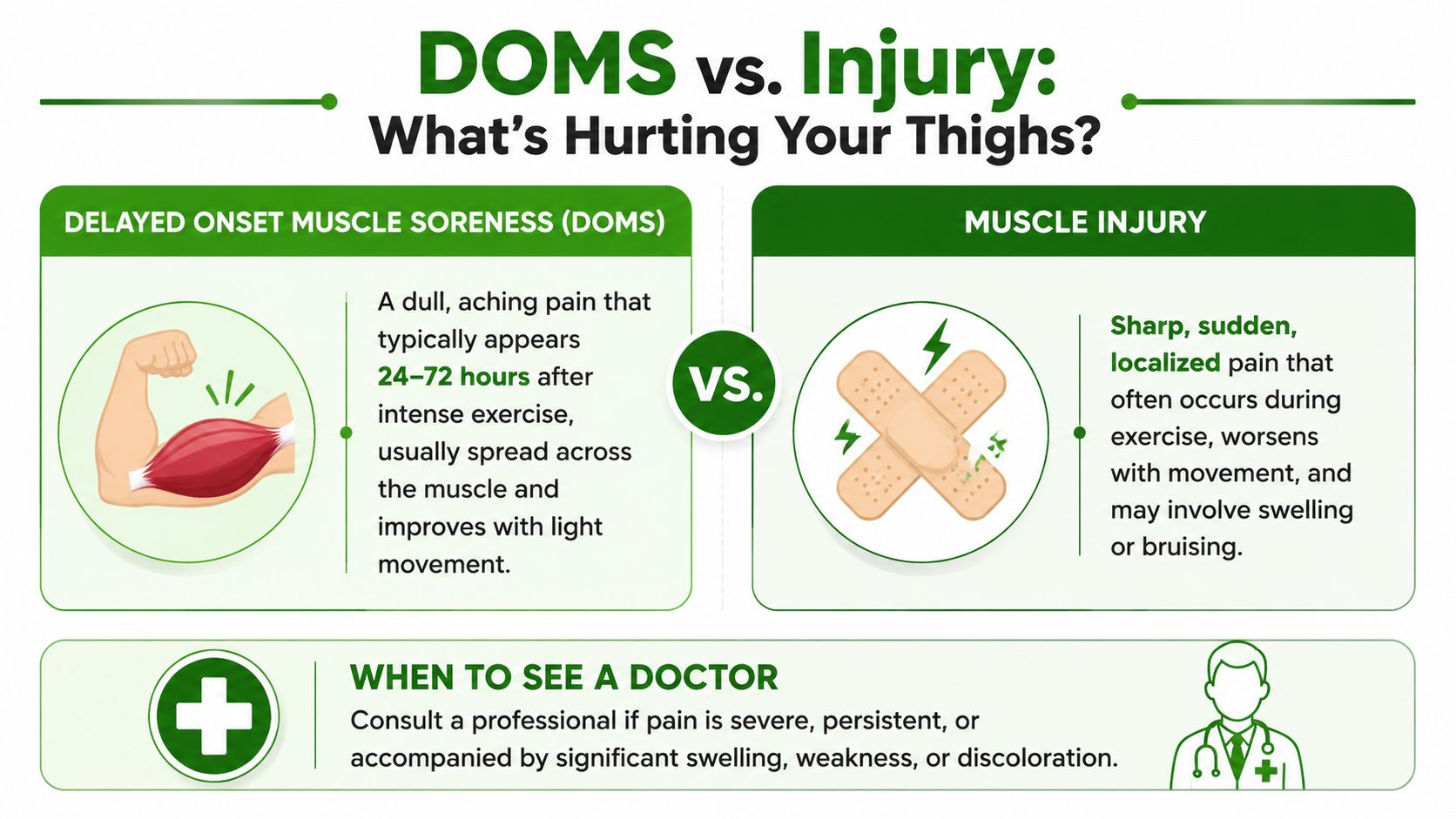
| Symptom | DOMS (normal soreness) | Injury (red flag) |
|---|---|---|
| Onset | Starts hours later, often next morning | Starts during the workout or right after |
| Feeling | Dull, achy, stiff, spread through the muscle | Sharp, catching, or clearly localized |
| Movement | Often loosens slightly with light activity | Often worsens with movement or load |
| Location | Broad soreness across trained muscles | One spot, joint line, or a distinct pull |
| Timeline | Improves steadily over a few days | Stalls, worsens, or stays unpredictable |
| Warning signs | Tenderness without alarming symptoms | Swelling, heat, bruising, weakness, instability |
The practical filter: if you can point to the pain with one finger, remember the exact rep it started on, or your leg cannot produce force normally, stop treating it like ordinary soreness. Pain with swelling, redness, heat, or true weakness deserves a professional look, as does soreness that is still getting worse past day three.
What actually speeds up recovery (per the evidence)
Most DOMS advice is folklore; the recovery research points to a short list. A 2018 meta-analysis in Frontiers in Physiology comparing recovery techniques found massage the most effective at reducing soreness and fatigue markers, with active recovery, compression garments, and cold-water immersion also showing meaningful effects.
Two popular tactics earn honest asterisks:
Stretching does not fix DOMS. A Cochrane review concluded that stretching before or after exercise produces no meaningful reduction in muscle soreness. Gentle mobility can make you feel less locked up, and that is a fine reason to do it, but aggressive stretching of a sore muscle buys you nothing.
Painkillers and ice are comfort, not repair. Reviews of DOMS treatment, like Cheung and colleagues in Sports Medicine, find most single interventions inconsistent. Nothing erases DOMS; the goal is to keep moving comfortably while your body adapts.
What the evidence supports day to day: easy movement (walking, light cycling), a normal amount of protein and fluids, real sleep, and massage or a foam roller if you enjoy it. Boring, cheap, and effective.
The first 24 hours
Day one is damage control, and the two extremes both slow people down: forcing a make-up workout, or camping on the couch all day.
Walk a little, several times. Easy walking is the most reliable way to feel less wooden, and if the first minutes loosen you up, you are on the right track. Add gentle mobility, bodyweight squats to a comfortable depth, and unhurried hip and knee bends.
Eat like you plan to recover: meals built around protein, fluids through the day rather than a catch-up chug at night. Heat tends to help stiff, guarded muscles move; cold can soothe an especially irritated spot. Use whichever feels better, since the evidence does not crown one.
What not to do: chase a PR to "loosen up," grimace through long stretches, sit motionless for hours, or ignore a pain pattern that does not behave like broad muscle soreness.
The 3-day recovery plan
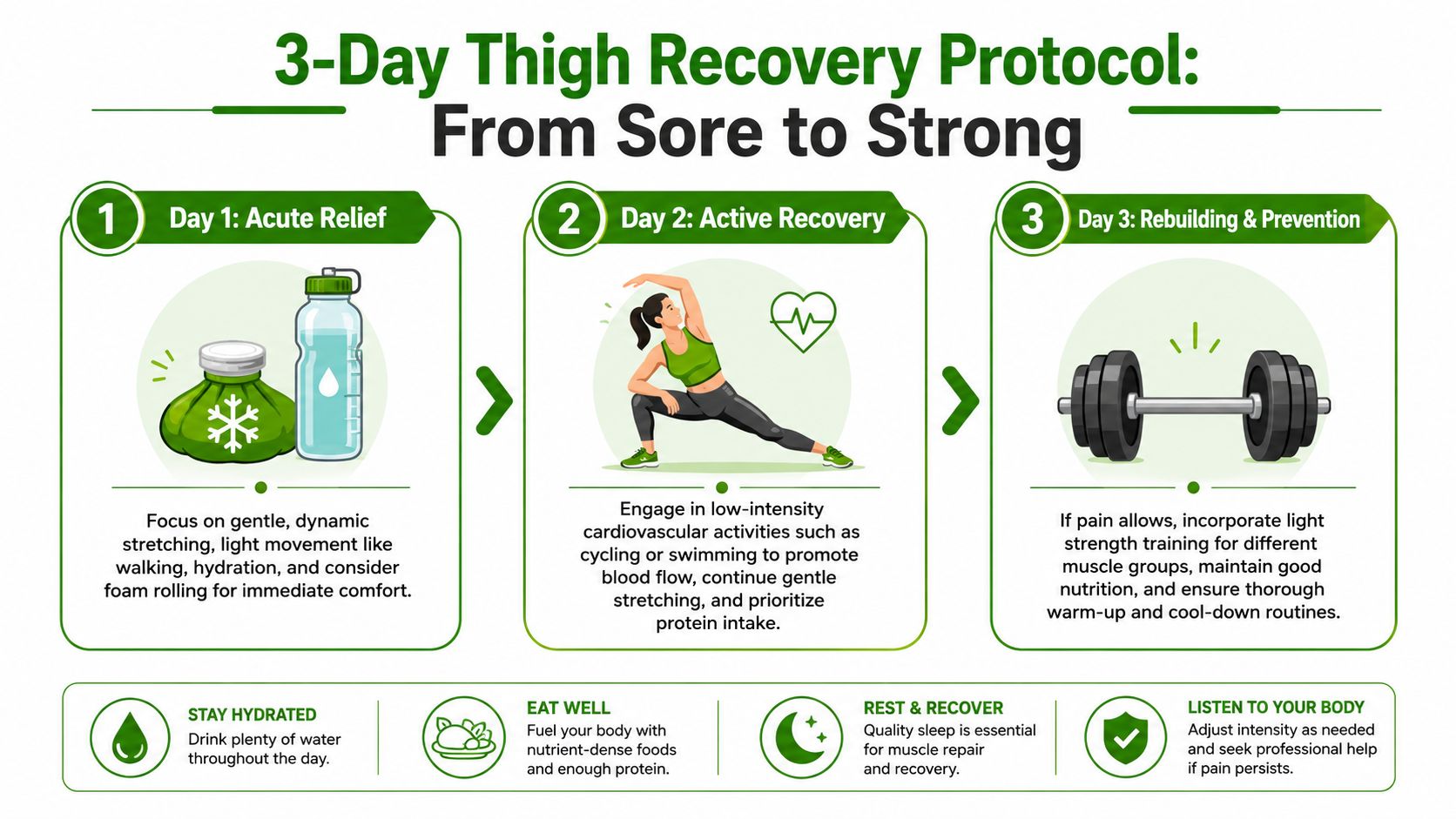
Day 1: survive. Short walks, easy mobility, simple protein-forward meals, light foam rolling if it feels good. Do not test your squat depth under load out of impatience.
Day 2: revive. Walking usually frees up first while stairs still complain. Low-intensity cardio, easy cycling, swimming, or a brisk walk, helps without adding much stress, and foam rolling often feels better today than it did yesterday.
Day 3: thrive. The question changes from "how do I get through the day?" to "am I ready to train again?" Test with function, not ego: unloaded squats should feel controlled, and sitting, standing, and stairs should feel close to normal. Train upper body or core if your legs still complain, and when you do squat again, use lighter loads and less volume than the session that wrecked you.
If day three still feels awful, or the pain is behaving like the injury column above, get it looked at instead of pushing through.
Preventing the next ambush
Some soreness after hard training is normal; getting wrecked every squat day means your programming or technique is asking for more than your body has adapted to.
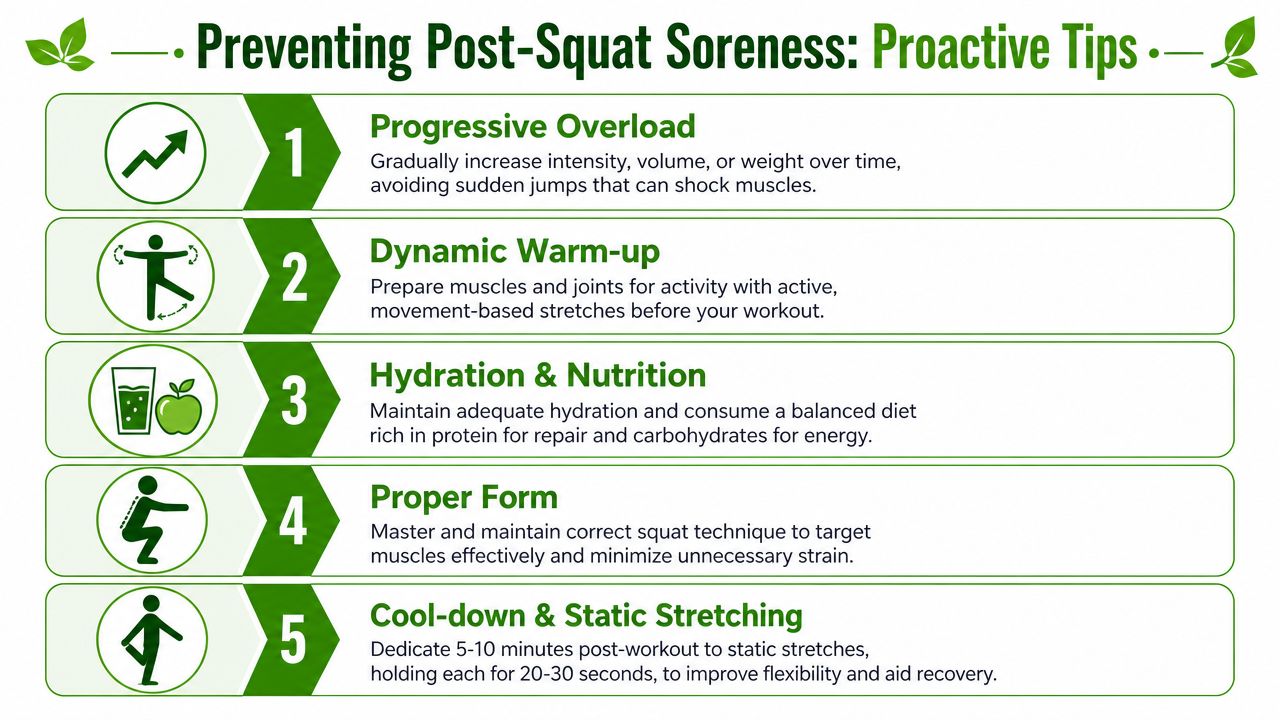
Progress one variable at a time. Sudden combined jumps in load, depth, volume, or tempo are the fastest route to crippling DOMS. Your body tolerates challenge well and hates surprises.
Warm up with movement that matches the session. Dynamic drills, unloaded squats, and a few build-up sets, so your first work set feels familiar instead of shocking.
Read your soreness pattern. If your quads get hammered every session while glutes and hamstrings barely notice, film a few reps and look at knee travel, torso position, and depth control; a knee-dominant pattern concentrates the stress. Inner-thigh soreness often means your adductors are doing extra stabilizing work, common when mobility is limited or a stance does not fit your build.
Manage the whole week. Most lifters do not get destroyed by one hard session; they get destroyed by a hard session landing on poor sleep, skipped meals, and a rushed warm-up.
Make recovery a habit, not an afterthought
Recovery fails less from missing information than from skipped basics: the walk that does not happen, the warm-up that gets shortened, the water bottle that stays full. The fix is treating recovery like training, with a few behaviors you repeat without negotiation.
Pick a short list: a five-minute daily mobility practice, a post-leg-day walk, a hydration target, a protein-focused meal after training. Then make it visible. Tracking these as daily habits, ideally where a friend or two can see your checkins and cheer them, turns invisible maintenance into something you actually do.
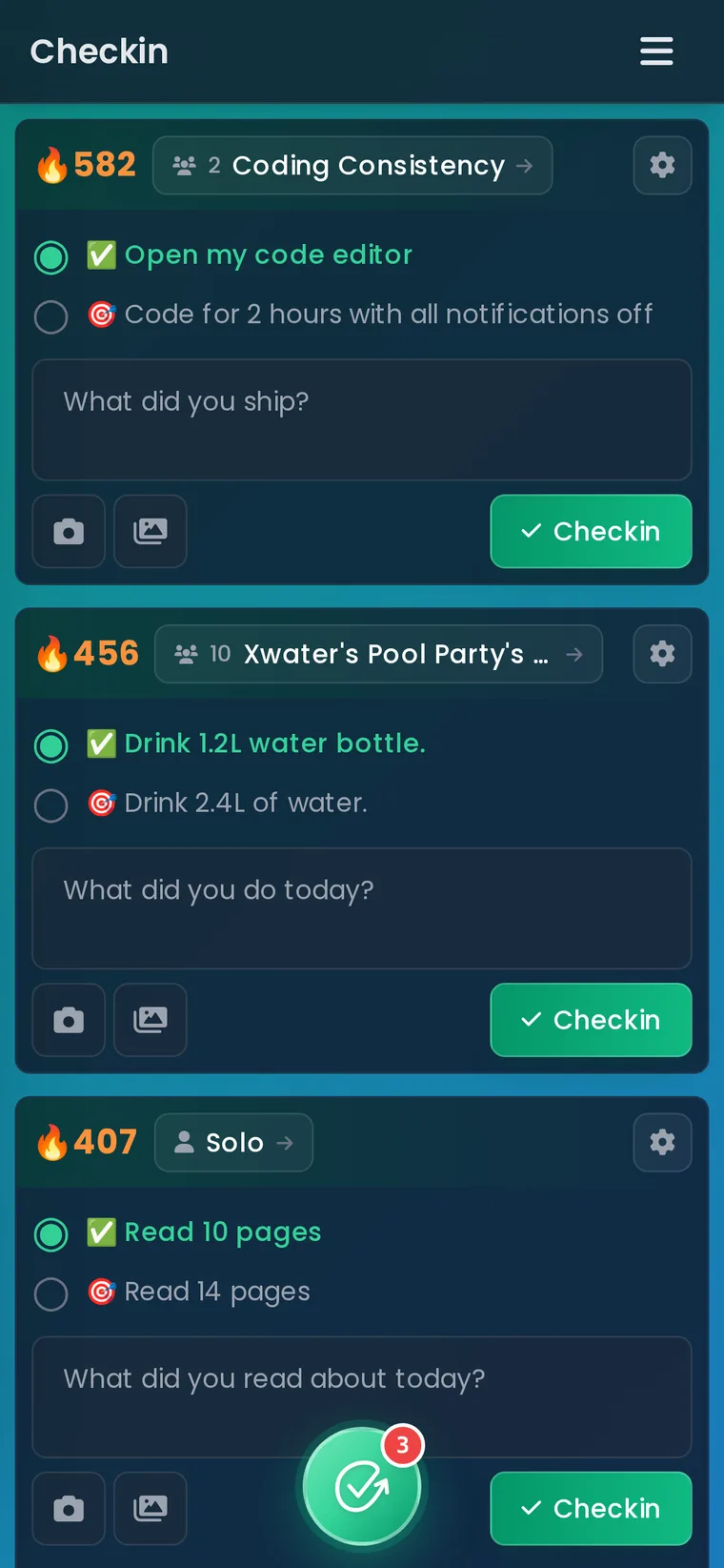
This is what Habit Huddle is built for: set a Floor, the minimum recovery work that counts on a chaotic day, and a Ceiling to burst through on good ones, then checkin daily with friends who notice you showing up. On rough days you step on the Floor and the momentum survives; the brutal post-squat episodes fade because the boring basics finally happen every week. Our guides on how to work out consistently and how to hold yourself accountable to work out go deeper on that system.
You already know you can change.
You just need to take the first step. Habit Huddle helps you build habits around your goals, alongside friends who keep you accountable.
Frequently asked questions
How long do sore thighs last after squats?
Typically two to four days. DOMS usually appears 12 to 24 hours after training, peaks between 24 and 72 hours, and resolves on its own. Soreness that worsens past day three, or comes with swelling, bruising, or weakness, is worth a professional look.
Should I squat again while my thighs are still sore?
Not at full intensity. Light movement helps recovery, so easy walking, cycling, or unloaded squats are fine and often make you feel better. Save heavy squatting until daily movements feel near normal, then return with lighter loads and less volume than the session that caused the soreness.
Does stretching help sore thighs?
Not meaningfully. A Cochrane review found stretching before or after exercise does not reduce muscle soreness. Gentle mobility is fine for feeling less stiff, but massage, easy movement, protein, and sleep have better evidence for actual recovery.
Do sore thighs mean my squats worked?
No. Soreness measures unfamiliarity, not effectiveness. It is common when you are new, returning from a break, or changing your program, and it fades as your body adapts even while strength keeps improving. Progress in load and reps over weeks is the real signal.
When should I see a doctor about thigh pain after squats?
See a professional if the pain started sharply during a rep, stays pinpoint-localized, comes with swelling, heat, bruising, or visible weakness, or keeps worsening after day three. Those patterns fit injury, not normal post-squat soreness.
Ready to Build Habits With Friends?
Stop failing alone. Join thousands using the #1 habit tracker with friends for real accountability and lasting results.
Prefer mobile? App Store · Google Play
Related Guides
More Habit Huddle articles on building habits with accountability.

HabitShare Alternatives: 6 Apps for Tracking Habits With Friends (2026)
Looking for a HabitShare alternative? Six social habit trackers compared by model, price, platforms, and what happens on a missed day, plus how to switch wit...
What to Do When You Miss a Workout Day: The 5-Step Comeback Plan
Missed a workout day? What one miss does to your body and habit, according to research, plus a five-step plan for the next 24 hours, when to make it up, and...

Habit Streak App With Friends: 7 Apps Compared (2026)
Seven habit streak apps with friends compared: Habit Huddle, HabitShare, Daily Pact, Habitica, Streaks, Habit Streak duels, HabitStreak.io. What friends see,...