
The Social Benefits of Fitness: Connect & Thrive
Discover the powerful social benefits of fitness: built-in accountability, improved mental health, and a stronger support network. Stay motivated!
Most fitness advice still sells the solo grind. Put in your headphones. Stay disciplined. Push harder. That image works for some people, but it breaks down for many more when real life shows up. Energy dips, schedules change, and motivation fades faster when nobody notices whether you showed up.
That matters more than people realize. The World Health Organization reports that 31% of adults worldwide, about 1.8 billion people, are physically inactive, and that inactivity rose by 5 percentage points between 2010 and 2022 according to the WHO physical activity fact sheet. If a plan depends only on willpower, it often won't last.
The missing piece usually isn't a more punishing routine. It's a support system. The social benefits of fitness aren't just a nice extra after the workout. For many people, connection is the reason the workout happens at all.
Table of Contents
- Why Your Fitness Journey Shouldn't Be a Solo Mission
- The Five Pillars of Social Fitness
- The Science Behind a Shared Sweat Session
- Finding Your Fitness Tribe in 2026
- Your Blueprint for Building a Fitness Support System
- Overcoming Common Barriers to Social Fitness
Why Your Fitness Journey Shouldn't Be a Solo Mission
Going solo sounds strong. In practice, it often makes fitness harder than it needs to be.
A solo plan asks one person to do every job at once. You have to decide what to do, remember to do it, talk yourself into starting, and recover when life interrupts the plan. That is a heavy cognitive load for a habit that already competes with work, family, stress, and fatigue.
Behavior is social, and fitness follows that rule closely. A routine becomes easier to repeat when it lives partly outside your own head. A friend waiting at the park, a walking group that notices your absence, or a simple checkin text after work all change the moment of choice. What felt optional now feels shared.
That shift matters because habits usually break in ordinary moments, not dramatic ones. You miss one workout after a long meeting. Then another after a poor night of sleep. Then the plan starts to feel like evidence that you are failing, when the bigger issue is that the system had no support built into it.
Fitness lasts longer when it becomes part of a relationship, a rhythm, or a group expectation instead of a daily test of willpower.
The social benefits of fitness often appear before visible physical changes. People feel less isolated. They get encouragement at the exact moment motivation dips. They also gain structure. Structure is what helps a routine survive a stressful month, not just an ideal week.
What usually goes wrong alone
- Every workout requires a fresh decision. That creates decision fatigue, especially after a busy day.
- Skipping is easy to rationalize. If no one is expecting you, "I'll do it tomorrow" can become a pattern.
- Progress feels emotionally flat. Repetition is easier to sustain when it includes connection, feedback, or shared effort.
What changes when other people are part of the plan
- Starting takes less mental effort. A scheduled meet-up or checkin reduces the need to negotiate with yourself.
- Follow-through improves. People are more likely to keep commitments that involve another person.
- Exercise feels more rewarding. Shared effort adds enjoyment, meaning, and a sense of belonging.
This does not mean everyone needs a crowded class or a high-energy trainer. Social fitness works more like scaffolding around a building. The structure supports the habit while it is being built. For one person, that might be a weekly pickleball game. For another, it is two neighbors who text, "Walk at 7?" Quiet support still counts.
That is why community matters in fitness. It helps convert good intentions into repeatable action, and it gives people a practical system they can return to when motivation drops.
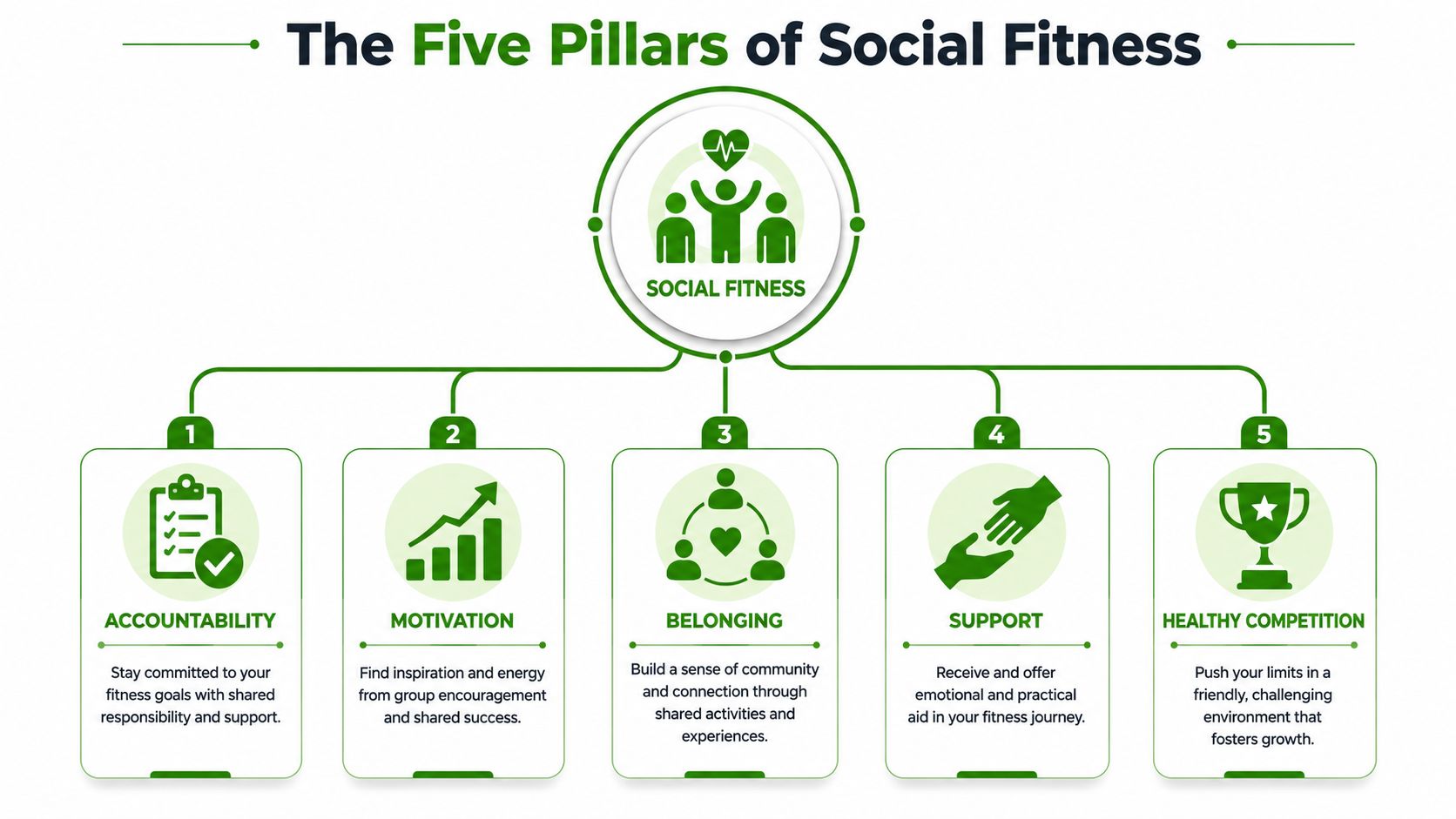
The Five Pillars of Social Fitness
Social fitness means using connection, accountability, and shared experience to make movement easier to start and easier to sustain.
What social fitness means in daily life
This doesn't require becoming a “group workout person.” Social fitness can be a walking partner, a family routine after dinner, a small lifting group, a local dance class, or a private online checkin with two friends. The format matters less than the pattern. You move, someone else knows, and the interaction supports the habit.
Many readers get stuck here because they assume social fitness must be extroverted. It doesn't. Quiet support still counts. A simple “Done with my walk” text can be enough to create follow-through.
Five pillars that make it work
Accountability
This is the pillar people notice first. Good accountability isn't nagging. It's a gentle social contract. If you tell your cousin you'll meet every Tuesday for a walk, that plan now exists outside your head, which makes it harder to ignore.
Motivation
Energy spreads. One person's consistency often lifts the group. Think of the person in your yoga class who always arrives early and unrolls their mat without drama. Their steadiness becomes its own kind of encouragement.
Belonging
Exercise feels safer when you don't feel judged. Belonging is the sense that you're not performing for approval. You're participating with people who expect beginners, off days, modifications, and imperfect progress.
Support
Support is both emotional and practical. A friend who says, “Let's do twenty minutes instead of skipping,” is offering emotional support. A neighbor who shares a free walking route, a child-friendly class, or a ride to the community center is offering practical support.
Healthy competition
For some people, a little challenge helps. Friendly competition can nudge effort upward without turning movement into a status contest. The key word is healthy. It should make you curious and engaged, not embarrassed.
Practical rule: If a group makes you dread being seen, it's not supporting your fitness. If it makes it easier to return after a bad week, it probably is.
These five pillars explain why the social benefits of fitness feel so powerful. They don't just add fun. They change the conditions around behavior.
The Science Behind a Shared Sweat Session
People often say they work out better with others because it's “more fun.” That's true, but it's also incomplete. Something more specific happens when exercise includes social support.

Why exercise feels different with other people
Independent exercise research found a direct pathway from social support to better performance. People who exercised with friends or family, or felt integrated into a group, reported higher enjoyment and energy, and those higher-energy states predicted faster 5 km run times in the study published in the National Library of Medicine.
That's a useful finding because it explains a common experience. A workout with other people doesn't just distract you from discomfort. It can change how you interpret the effort itself. Fatigue feels more manageable when the experience includes encouragement, shared goals, or a sense of group identity.
The same research suggests that social reward and perceived support can buffer fatigue and pain while increasing achievement and engagement. In plain language, support helps the workout feel more doable, and that changes what people can sustain.
How support turns into performance
A few mechanisms help explain this.
- Attention shifts outward. You spend less time negotiating with yourself and more time following the session.
- Effort gets normalized. If everyone is breathing hard on the last interval, your own effort feels appropriate rather than alarming.
- Mood improves the experience. Better mood changes whether you want to come back tomorrow.
Public-health guidance points in the same direction. The CDC notes that physical activity can reduce short-term feelings of anxiety in adults and improve thinking, learning, and judgment, as described on the CDC page about the benefits of physical activity. If exercise lowers anxiety and sharpens mental function, the social setting can become easier too. You may feel more willing to speak to others after the walk than before it.
That creates a loop. You feel better, so the interaction feels easier. The interaction feels easier, so you're more likely to return. If you're also trying to build routines that support mood and consistency, these mental health habits that fit real life connect well with a social approach to movement.
Shared exercise works partly because it changes perception, not just behavior. The workout can feel less lonely, less threatening, and more rewarding at the same time.
That's why “find a workout buddy” isn't throwaway advice. Under the right conditions, it's a behavior design strategy.
You already know you can change.
You just need to take the first step. Habit Huddle helps you build habits around your goals, alongside friends who keep you accountable.
Finding Your Fitness Tribe in 2026
The right social format depends less on what's trendy and more on what you'll repeat without resentment. Some people thrive in a weekly class. Others need low-pressure checkins and flexible timing. The best choice is the one that matches your energy, budget, and comfort level.
Choose the format that fits your life
A walking buddy is often the easiest place to start. It's low cost, easy to schedule, and friendly for beginners. If you're rebuilding fitness after time away, this format keeps the social stakes low.
A group class works well for people who like structure. You don't have to invent the workout, and the repeated schedule creates a rhythm. The downside is that fixed times, travel, or class fees can make consistency harder.
A team sport or recreational league suits people who enjoy shared goals and playful competition. It can be motivating, but it may feel like too much if you're new, managing pain, or already overloaded.
An online accountability group helps when schedules don't line up. Asynchronous checkins are useful for parents, shift workers, remote workers, and anyone who wants support without constant live interaction. If you want a list of flexible options, these free internet accountability apps show how different tools handle group checkins and routine tracking.
Comparing social fitness formats
| Format | Best For | Commitment Level | Typical Cost |
|---|---|---|---|
| Walking buddy | Beginners, busy adults, people who want low pressure | Low to medium | Usually free |
| Group class | People who want instruction and routine | Medium | Free to paid |
| Recreational team | People who enjoy group identity and challenge | Medium to high | Varies |
| Family fitness routine | Parents, couples, households with uneven schedules | Low to medium | Usually free |
| Online checkin group | Introverts, remote workers, irregular schedules | Low to medium | Free to paid |
A simple way to decide
Ask yourself three questions.
- What kind of contact feels comfortable. Live conversation, text checkins, or a mix?
- What friction can I tolerate. Travel, fees, fixed class times, or none of the above?
- What would make me return next week. Fun, structure, companionship, or visible progress?
Your tribe doesn't need to look impressive. It needs to feel repeatable. A lot of fitness plans fail because people choose the socially ideal option instead of the personally realistic one.
Your Blueprint for Building a Fitness Support System
The need isn't for a giant community, but for a small system that makes the next workout easier than skipping it.

There's a larger reason this matters. Sport England estimates the social value of sport and physical activity in the UK at over £100 billion, and reports wellbeing value of about £2,500 per person per year for adults who do more than 150 minutes of activity per week, with active lives helping prevent 1.3 million depression cases, 600,000 diabetes cases, and 57,000 dementia cases in the Sport England social value analysis. Your small support system won't change the whole country on its own, but this is what large-scale health value is built from. Repeated, ordinary participation.
Start smaller than you think
Begin with one person or one tiny group. Ask someone a specific question instead of making a vague plan.
- Good ask: “Want to walk with me on Wednesday and Friday at 7?”
- Too vague: “We should work out sometime.”
If you don't have a partner in mind, test a local option once. Look for signs of a good culture. People greet newcomers. Modifications are normal. The instructor doesn't use shame as motivation. You leave feeling invited back, not ranked.
A strong support system lowers the cost of restarting. That matters more than having perfect momentum.
If you prefer digital support, one option is Habit Huddle's explanation of what an accountability partner does. The core idea is simple: make the habit visible to another person so consistency has some social weight.
Set up a system people can actually follow
Use light structure. Heavy systems die fast.
Pick one shared activity
Start with walking, strength training, stretching, or class attendance. Don't launch five goals at once.Choose a checkin rule
Use a text thread, a shared note, a calendar invite, or an app. The rule can be as simple as “send a check mark after you finish.”Create a minimum version
On rough days, your group still needs a fallback. Ten minutes counts. A short mobility session counts. Momentum survives when the standard is flexible.
After you've got a basic rhythm, this short video is a useful reminder that accountability works best when the system is simple enough to repeat.
Review what's getting in the way
If people keep missing, don't blame motivation first. Check the time, place, cost, and expectations.Protect the tone
Encouragement works better than surveillance. The point is to help people return, not make them hide after one missed session.
The blueprint is basic on purpose. Fitness support systems work when they reduce friction and make consistency visible.
Overcoming Common Barriers to Social Fitness
The social benefits of fitness aren't automatic. Public-health research shows that access matters. Without intentional design for cost, scheduling, and ability, the same group setting that helps one person connect can exclude another, as discussed in this public health review on physical activity and underserved groups.
If you're introverted or anxious
You don't need a loud class or a competitive team. Start with the smallest social unit possible. One walking partner. One family member. One private online checkin. Low-exposure formats still provide accountability without overwhelming your nervous system.
If you're worried about being the beginner, choose activities where conversation happens naturally and performance isn't the center of attention. Walking, easy cycling, or a beginner-friendly class usually feels less intense than a competitive group workout.
If money, time, or access are the real issue
Cost is a real barrier, not an excuse. Free options often work well: park walks, bodyweight sessions at home with a friend on video, community-center programs, or neighborhood meetups. If childcare or transportation makes live attendance hard, use asynchronous support instead of abandoning the social piece entirely.
A few practical adjustments help:
- Reduce travel by choosing a route or location within your normal routine.
- Lower the social pressure with shorter sessions and smaller groups.
- Build for ability by agreeing up front that pacing, breaks, and modifications are expected.
Social fitness works best when the setup fits your actual life. Not the life you wish you had, and not the one fitness culture assumes you have.
If you want a simple way to turn checkins into momentum, Habit Huddle lets you create a small group, track one habit together, and make consistency visible without overcomplicating the process. It's one practical option for friends, couples, teams, or online communities who want fitness accountability built around showing up.
Ready to Build Habits With Friends?
Stop failing alone. Join thousands using the #1 habit tracker with friends for real accountability and lasting results.
Prefer mobile? App Store · Google Play
Related Guides
More Habit Huddle articles on building habits with accountability.
HabitShare Alternatives: 6 Apps for Tracking Habits With Friends (2026)
Looking for a HabitShare alternative? Six social habit trackers compared by model, price, platforms, and what happens on a missed day, plus how to switch wit...
What to Do When You Miss a Workout Day: The 5-Step Comeback Plan
Missed a workout day? What one miss does to your body and habit, according to research, plus a five-step plan for the next 24 hours, when to make it up, and...
Habit Streak App With Friends: 7 Apps Compared (2026)
Seven habit streak apps with friends compared: Habit Huddle, HabitShare, Daily Pact, Habitica, Streaks, Habit Streak duels, HabitStreak.io. What friends see,...