
How to Get to Work on Time: A 5-Part System That Works
Tired of being late? Learn how to get to work on time with a step-by-step system for your commute, sleep, and routines. Build consistency that lasts.
You wake up late, rush the bathroom routine, spill coffee while looking for your keys, then open your maps app and realize traffic is worse than usual. By the time you sit in the car or step onto the platform, the day already feels lost. Those in that situation often blame themselves. They decide they need more discipline, a louder alarm, or a harsher morning.
That diagnosis is usually wrong.
If you struggle to get to work on time, the problem often isn't character. It's design. A fragile evening, an unmeasured morning, a commute with no backup plan, and sleep that keeps getting traded away will beat motivation almost every time. The fix is to build a punctuality system that can survive real life, including snooze-button impulses, bad traffic, and tired decisions.
Table of Contents
- Why Being on Time Is a System Not a Skill
- Win Tomorrow Tonight Your Evening Reset
- Engineer Your Morning Launch Sequence
- Master Your Commute and Beat the Chaos
- Protect Your Sleep for Consistent Mornings
- Make It Stick with Social Accountability
Why Being on Time Is a System Not a Skill
The alarm goes off. You hit snooze because you went to bed too late, then traffic is worse than usual, then one small delay turns into a late arrival and a stressed start. That pattern feels personal, but it usually comes from a system that breaks under normal life pressure.
Punctuality is not a trait some people were born with. It is a repeatable setup. People who get to work on time consistently are usually not more disciplined minute to minute. They have fewer failure points between waking up and walking in.
That distinction matters because late mornings rarely start in the morning alone. They usually start with unfinished work at night, poor sleep, missing items, optimistic timing, or no buffer for traffic, weather, kids, transit delays, or a second round with the snooze button. If your routine only works on low-stress days, it is not a reliable routine.
Practical rule: If getting out the door on time depends on motivation, you will be late on the days you are tired, overloaded, or distracted.
A working system has a few clear parts. It closes the day so your brain is not still working at 11 p.m. It gives you a morning sequence that is realistic, not aspirational. It protects your departure time instead of treating it as flexible. It also leaves enough room for sleep, because arriving on time by grinding yourself down is not a win you can repeat for long.
This is the trade-off many people miss. Waking up earlier can help for a week. Chronic sleep loss usually makes mornings less predictable, not more. The goal is not to squeeze harder. The goal is to remove friction and make the routine hold up on ordinary bad days.
That is also why accountability helps. A good system is visible. You can track whether you left on time, whether you built in a buffer, and whether your bedtime supported the next morning. If you want a simple way to make those patterns visible, use a habit tracker planner for daily routines and follow-through.
A good punctuality system does four things. It reduces decisions, protects departure time, plans for commute variability, and supports enough recovery that you can do it again tomorrow. If one part keeps failing, fix the system at that point instead of calling yourself bad at mornings.
Win Tomorrow Tonight Your Evening Reset
The most reliable way to get to work on time is to remove as much morning thinking as possible. Even competent people make poor choices when they're rushed, half-awake, or emotionally done with the day. Evening prep solves that by moving decisions to a time when your brain is steadier.
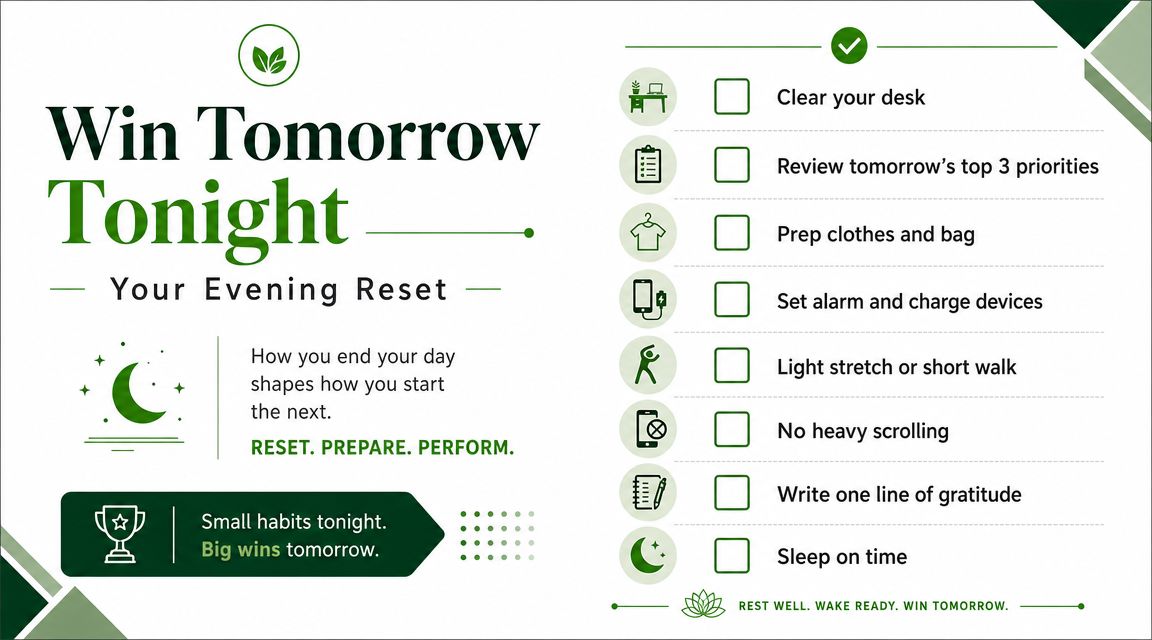
Treat evening prep as protected work
Time management helps, but not in a magical way. A meta-analysis found time management is moderately related to job performance, academic achievement, and wellbeing, with work-setting correlations around r = .25 in this research review on time management. That's the sweet spot for punctuality advice. Structure matters. It just won't rescue a chaotic routine unless you use it consistently.
The strongest move here is time blocking. Don't tell yourself you'll “get ready later.” Put a fixed evening reset block on your calendar. If that block never gets scheduled, it usually gets replaced by scrolling, unfinished admin, or low-value work.
A short video can help you think about the reset as a deliberate routine rather than a vague good intention.
Evening prep works because it cuts decision fatigue before the day starts. You're not becoming more disciplined in the morning. You're needing less discipline there.
What to reset before bed
Your checklist should be boring and specific. That's a compliment. Boring systems survive rough weeks.
- Clothes: Set out the full outfit, including shoes, outerwear, badge, and anything weather-dependent.
- Work bag: Pack laptop, charger, notebook, lunch, medication, and anything that tends to get forgotten near the door.
- Calendar review: Look at your first commitments, travel requirements, and whether tomorrow has anything unusual.
- Food and drink: Prep breakfast basics and whatever you'll carry out the door.
- Launch zone: Put keys, wallet, transit pass, headphones, and bag in one visible place.
A simple way to think about this is below.
| Night-before task | Why it matters in the morning |
|---|---|
| Outfit ready | Removes indecision and last-minute changes |
| Bag packed | Prevents the “I forgot one thing” delay |
| Calendar checked | Avoids surprise timing conflicts |
| Breakfast prepped | Reduces kitchen drift |
| Essentials staged | Stops key-hunting and door-side chaos |
If evenings are inconsistent, don't start with a perfect routine. Start with a minimum version you can do even when you're tired. Clothes out. Bag packed. Keys staged. Calendar checked. That alone changes the feel of the next morning.
Engineer Your Morning Launch Sequence
Individuals often estimate their morning badly. They remember the fastest version of the routine, not the normal one. They think showering takes ten minutes, breakfast takes five, and getting out the door takes “basically no time.” Then one small delay stacks onto another, and the whole plan collapses.

Measure the routine you actually live
A better approach is to treat the morning like a time-study. In work measurement, you define the scope, break the process into tasks, record cycle times over multiple days, then add allowances for real-world variation. That's how industrial engineers move from observed time to a usable standard, and 6Sigma's guide to time study analysis explains why one best-case run gives you a biased estimate.
For punctuality, that means you stop asking, “How long should this take?” and start asking, “How long does this take on ordinary days?”
Use a simple list for a week or two:
- Wake up
- Bathroom
- Shower
- Get dressed
- Breakfast
- Final packing
- Shoes and coat
- Leave home
Write down the actual time each step starts and ends. Don't clean up the data. Don't use your heroic version. The slow-but-stable version is more valuable than the ideal one.
Coach's note: If your commute varies a lot, measure more days before locking in your target departure time.
This is also where habit chaining helps. When one action always cues the next, mornings get smoother. If you want examples of how to connect one action to another without overcomplicating it, these habit stacking examples are useful.
Build backward from departure time
Start with a firm departure time, not a work start time. Departure is the controllable event. Arrival is partly affected by traffic, transit, and random delay.
Then build backward.
- Set your leave time first: Pick the time you need to be out the door.
- Add a buffer before departure: Protect a small gap between the last required task and leaving.
- Place fixed tasks next: Shower, dressing, breakfast, medication, school drop-off, dog walk.
- Remove weak links: If one task repeatedly causes delay, either move it to the night before or simplify it.
Here's the difference between weak and strong scheduling:
| Fragile plan | Resilient plan |
|---|---|
| “Leave around 8” | “Shoes on by 7:48, out the door at 7:50” |
| Assumes best-case timing | Uses observed routine time plus allowance |
| Last task ends at departure | Last task ends before departure |
| No backup if one step slips | Has slack built in |
The point isn't to run your home like a factory. The point is to stop pretending your morning is more predictable than it is. Once you have a repeatable launch sequence, anxiety drops because guesswork drops.
You already know you can change.
You just need to take the first step. Habit Huddle helps you build habits around your goals, alongside friends who keep you accountable.
Master Your Commute and Beat the Chaos
You leave the house on time, then a fender bender clogs the highway, your train runs three minutes late, and the walk from the station takes longer because of rain. By 9:02, it feels like your whole morning failed. It didn't. Your route failed.
That distinction matters. Chronic lateness is often treated like a character flaw when the actual problem is exposure to unstable conditions. Traffic, transit delays, parking backups, weather, and one badly timed connection can break an otherwise solid morning. Analysts at INRIX found that congestion continues to cost drivers significant time in many urban areas, as detailed in the INRIX Global Traffic Scorecard. The practical takeaway is simple. Commutes need contingency plans, not optimism.
Use decision rules before stress takes over
Once people feel behind, judgment gets worse. They wait too long to switch routes, gamble on a shortcut they have not tested, or keep refreshing an app hoping the problem will disappear. That is not a discipline issue. It is a bad system under pressure.
Decision rules reduce that pressure because the choice is already made.
- Check live conditions before the point of no return: Look at your maps or transit app while you still have time to adjust, not after shoes are on and your bag is in hand.
- Choose a backup route in advance: Pick the route you trust most when your default route slows down.
- Identify the part of the commute that usually breaks: One merge, one transfer, one parking garage entrance, one school-zone bottleneck.
- Set an early-leave trigger: Rain, transit alerts, roadwork, and local events should change your departure plan automatically.
A rule like “if the bus is delayed more than five minutes, I switch to the subway” works better than “I'll see how it looks.”
Build a three-layer commute plan
A dependable commute has three parts.
Your default route is what you use on normal days. Your backup route is the option with the highest reliability when the default route gets messy. Your cut-loss rule tells you when to stop trying to rescue the original plan.
That last part is where many people lose time. They stay committed to the failing route because switching feels annoying. Then they arrive late anyway. A cut-loss rule removes that debate. If traffic is already backing up before a certain intersection, take route B. If the train app shows disruption by a set time, drive or book the alternate ride.
This is less about speed and more about protecting consistency.
The goal is not a perfect commute. The goal is to keep one disruption from turning into a late arrival.
If your commute changes day to day, track it for two weeks. Note your departure time, arrival time, and what caused the delay. Patterns show up quickly. You may find that leaving ten minutes earlier on Tuesdays saves twenty minutes of stress, while leaving earlier every day just cuts into sleep for no real gain.
That trade-off matters. A punctuality system should lower friction without asking you to live tired and tense. Treat the commute as a designed part of the system, then add accountability to it. Habit Huddle is useful here because it lets you report the behavior that predicts punctuality, such as leaving by your target time or following your backup-route rule, instead of waiting to explain another late arrival after the fact.
Protect Your Sleep for Consistent Mornings
You set the alarm with good intentions, hit snooze twice, rush through the kitchen, and still leave behind schedule. For many people, that pattern is not a motivation problem. It is what happens when the morning asks for more energy than last night allowed.
A punctuality system that depends on chronic sleep loss will break under ordinary life. Traffic gets worse. A meeting runs late. Your brain wants the extra 20 minutes in bed because it needs recovery.
Why earlier is not always better
Adults need 7 or more hours of sleep per night, according to the CDC's sleep recommendations for adults. If getting to work on time regularly costs you sleep, you are borrowing against the very capacity that helps you wake up, move with urgency, and make good decisions under pressure.
I see this mistake often. Someone decides the answer is a 5:30 a.m. alarm, but they keep the same bedtime, the same late phone use, and the same overloaded evenings. It works for three days. Then they sleep through the alarm, move slowly, or start negotiating with the snooze button every morning.
Discipline matters. Sleep debt still wins if the plan ignores biology.
If you need more time before work, remove tasks from the morning first. Do not assume the answer is always a harsher wake-up time.
Build a bedtime that supports punctuality
Protecting sleep starts with accepting a real trade-off. An earlier departure can help punctuality. A later bedtime can undo it. The goal is to arrive on time without turning weekdays into a fatigue cycle that spills into the rest of your life.
Use a short, repeatable sleep-support plan:
- Set an end time for work and problem-solving: If your brain stays in task mode until bed, you will pay for it at wake-up.
- Keep a consistent bedtime window: Waking on time gets easier when sleep timing stops swinging all over the week.
- Make the phone less available at night: Charge it away from bed if snoozing and late scrolling are part of the pattern.
- Finish your evening reset early enough to protect lights-out time: Prep should reduce stress, not push bedtime later.
A simple comparison makes the trade-off clearer:
| Strategy | Short-term effect | Long-term effect |
|---|---|---|
| Wake much earlier without changing evenings | Creates extra time for a few days | Increases fatigue and makes mornings less reliable |
| Move prep to the night before | Reduces morning pressure | Easier to repeat without extra strain |
| Protect a steady bedtime | Improves wake-up consistency | Supports better mood, focus, and follow-through |
If your sleep schedule slips easily, add one form of accountability to the bedtime side of the system, not just the morning side. A simple checkin with an accountability partner who helps you stay consistent can catch the late-night drift before it turns into another rushed morning.
Getting to work on time should not require feeling wrecked by Thursday. Build a system your tired, real-life self can still follow.
Make It Stick with Social Accountability
Most punctuality systems fail after the first motivated week. Not because the ideas are bad, but because nobody notices when the routine starts slipping. A missed prep night becomes two. Departure drifts by a few minutes. Then the old pattern is back.
Accountability changes that. Not the fake kind where you make a grand announcement and disappear. Real accountability means someone can see whether you did the small behaviors that make punctuality possible.
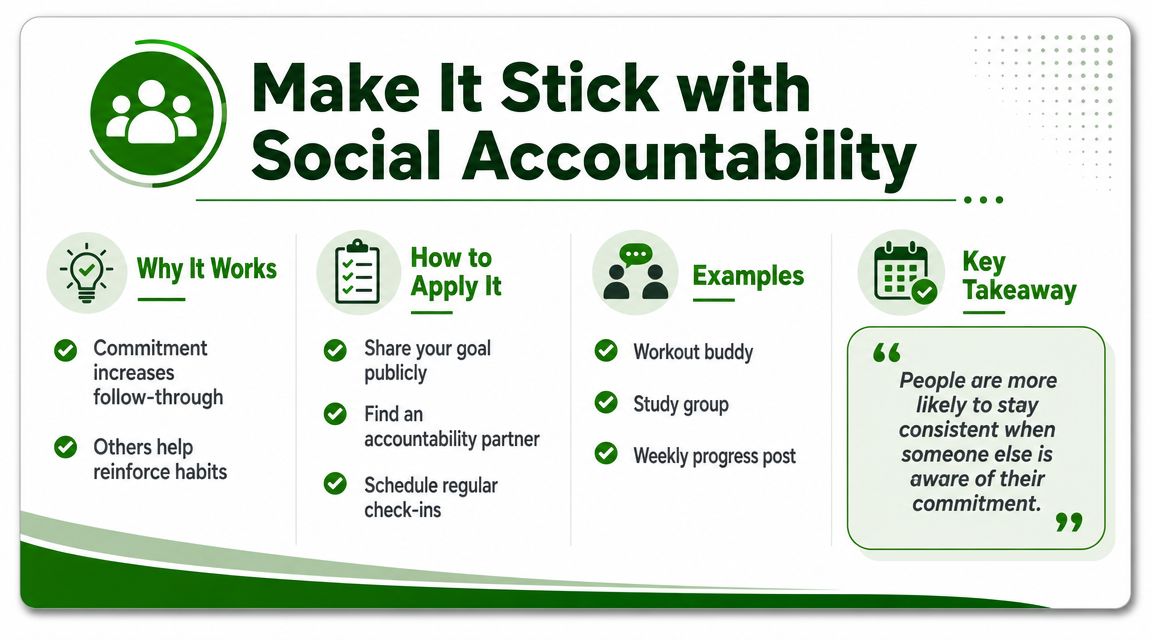
Accountability changes the follow-through
A good accountability setup tracks actions, not self-criticism. You're not logging “I'm a punctual person now.” You're checking whether the system ran.
That can be as simple as sharing one daily status with a friend, partner, colleague, or small group:
- Evening reset done
- Launched on time
- Commute backup used if needed
- Sleep window protected
If you've never used an accountability structure before, this guide on choosing an accountability partner gives a practical starting point.
What to track each day
Keep the scorecard narrow. Too many variables and you won't keep it up.
A useful daily review might ask:
- Did I finish my evening reset?
- Did I leave within my target window?
- If I was late, where did the system break?
- What gets adjusted tonight?
That last question matters most. Chronic lateness improves when people stop moralizing and start troubleshooting. If the launch sequence was too tight, widen it. If the commute keeps failing at one spot, change the decision rule. If bedtime keeps sliding, protect the hour before sleep harder.
Punctuality sticks when the system is visible, reviewable, and shared often enough that drift doesn't hide.
If you want help making this routine consistent, Habit Huddle gives you a simple way to track the behaviors that determine whether you get to work on time. You can create one small huddle for your evening reset or departure target, post a daily checkin with a minimum goal on rough days, and let visible group consistency keep the routine alive after motivation fades.
Ready to Build Habits With Friends?
Stop failing alone. Join thousands using the #1 habit tracker with friends for real accountability and lasting results.
Prefer mobile? App Store · Google Play
Related Guides
More Habit Huddle articles on building habits with accountability.

HabitShare Alternatives: 6 Apps for Tracking Habits With Friends (2026)
Looking for a HabitShare alternative? Six social habit trackers compared by model, price, platforms, and what happens on a missed day, plus how to switch wit...

What to Do When You Miss a Workout Day: The 5-Step Comeback Plan
Missed a workout day? What one miss does to your body and habit, according to research, plus a five-step plan for the next 24 hours, when to make it up, and...

Habit Streak App With Friends: 7 Apps Compared (2026)
Seven habit streak apps with friends compared: Habit Huddle, HabitShare, Daily Pact, Habitica, Streaks, Habit Streak duels, HabitStreak.io. What friends see,...