
The Ultimate Habit Tracker Planner for 2026 Success
Master your habits with our habit tracker planner guide. Create lasting routines, design layouts, and use accountability to stay consistent.

Most advice about a habit tracker planner is backwards. It tells you to pick a prettier layout, buy better pens, and commit harder. That sounds motivating for about a week. Then real life shows up, you miss a day, the page looks broken, and the planner starts feeling like evidence against you.
The problem usually isn't discipline. It's design. A rigid tracker turns one bad day into a verdict. A useful tracker does the opposite. It lowers the cost of showing up, makes recovery obvious, and gives you a reason to keep going when motivation drops.
That matters because habit tracking isn't a niche obsession anymore. One industry overview says the global habit-tracking app market was valued at $1.7 billion in 2024 and is projected to reach $5.5 billion by 2033, implying 14.2% annual growth, while also noting that habit formation takes around 66 days on average rather than the old 21-day myth, according to the same overview's cited research and meta-analysis summary (habit-tracker market growth and formation timeline). The practical takeaway is simple. If behavior change takes weeks and months, your planner has to survive imperfect weeks, not just ideal ones.
A habit tracker planner works best when it has two things most templates ignore: a flexible checkin system and social accountability. Without those, even the nicest spread becomes another abandoned productivity artifact.
Table of Contents
- Why Your Perfect Planner Is Probably Set Up to Fail
- Choosing What to Track and What to Ignore
- Designing a Layout That Fits Your Habits
- The Rules of Engagement for Real Consistency
- Supercharge Your Plan with Social Accountability
- Troubleshooting When You Inevitably Fall Off Track
- Habit Tracker Planner FAQs
Why Your Perfect Planner Is Probably Set Up to Fail
A beautiful planner can still be a bad system.
The internet loves the fantasy version of habit tracking. Crisp boxes. Color-coded categories. Every day marked cleanly. It looks organized, but it often trains the wrong behavior. You start optimizing the page instead of the habit.
Individuals often abandon their tracking efforts because the tool teaches all-or-nothing thinking. If the only mark that counts is full completion, then low-energy days become automatic losses. Miss two or three boxes and the planner stops feeling supportive. It starts feeling accusatory.
Practical rule: If your tracker makes a missed day feel like failure, the tracker is flawed.
The common checkbox grid is especially risky when it treats every habit the same way. “Read,” “sleep well,” “work out,” and “drink water” don't behave the same in real life. Yet many planner templates force them into one identical pass-fail box. That mismatch creates friction before consistency has a chance to form.
Pretty layouts create hidden pressure
A rigid page creates a hidden contract: keep this neat, keep this complete, keep this streak perfect.
That pressure works for a short burst. Then work gets busy, a child gets sick, travel disrupts your rhythm, or your energy dips. A planner built for ideal conditions collapses under normal life. The more decorative it is, the more intimidating it becomes to re-enter after a lapse.
That's why I'm skeptical of advice that focuses on aesthetics first. A habit tracker planner should be judged by one standard: does it make the next checkin easier?
The real job of a planner
A planner isn't there to prove that you're disciplined. It's there to reduce friction between intention and action.
Useful trackers do three things well:
- They normalize imperfect days. Missing once doesn't end the habit.
- They make the next step obvious. You shouldn't need a reset ritual to continue.
- They reward consistency over intensity. Repetition matters more than heroic effort.
The planners that last aren't the prettiest ones. They're the ones built for ordinary Tuesday energy, not peak January motivation.
Choosing What to Track and What to Ignore
The fastest way to ruin a habit tracker planner is to stuff it with ambitions.
People write down “get healthy,” “be more productive,” “read more,” “sleep better,” and “stress less,” then wonder why the page feels impossible. Those aren't habits. They're categories of life. A tracker can only work with behaviors you can check off or measure.
James Clear recommends limiting focus to one to four key habits and recording completion immediately after the habit occurs. He also recommends shrinking a habit to a two-minute version on hard days so consistency doesn't depend on ideal motivation (James Clear on habit tracking and the two-minute rule).
Start with the habit that changes other habits
You don't need the most ambitious habit first. You need the one that stabilizes the rest of your day.
For many people, that's something like:
- A wake-up anchor: getting out of bed and opening the curtains
- A movement anchor: putting on walking shoes after lunch
- A focus anchor: sitting down for the first study block
- A shutdown anchor: plugging the phone in outside the bedroom
Those habits matter because they trigger other decisions. They don't solve everything, but they make good choices easier.
Filter out goals that can't be tracked cleanly
A simple filter works well here.
Ask three questions:
Can I observe it today?
“Lose weight” fails this test. “Walk after dinner” passes.Can I mark it in one line?
If you need a paragraph to explain whether you did it, the habit is too vague.Would I still do a tiny version on a rough day?
If the answer is no, the habit is oversized.
Track behaviors, not hopes.
A lot of abandoned planners are full of outcome goals disguised as habits. The page says “read more,” but the actual behavior might be “open the book after making tea.” That's what belongs in the tracker.
Build a short list you can actually sustain
A strong starting set is small and specific. Not because you lack ambition, but because attention is finite.
A practical shortlist usually looks like this:
One habit for body Example: take a walk, stretch, or prepare a simple breakfast
One habit for mind Example: read, journal, meditate, or review notes
One habit for work or study Example: start the first focused block before checking messages
One habit for recovery Example: shut down screens, prep tomorrow's clothes, or tidy the desk
If you're tempted to track more, that's usually a sign to narrow harder.
Shrink each habit before you scale it
Most planner setups improve immediately. Don't track the ideal version first. Track the smallest version you'll still respect.
Examples:
- Workout becomes put on training clothes
- Reading becomes read one page
- Journaling becomes write one sentence
- Studying becomes open the notes and review one concept
That sounds almost too small. Good. Tiny habits are easier to repeat, and repetition is what gives the planner value.
Designing a Layout That Fits Your Habits
A habit tracker planner should fit the behavior, not force the behavior to fit the page.
A common reason people abandon trackers is a mismatch between the habit and the tracking format. Some habits only need a simple completed or not-completed mark, while others are better tracked by duration or quantity. Even a simple 1x1 table can be enough for many habits when the habit itself is clear (habit tracking formats and why mismatch causes abandonment).
Function beats decoration
The cleanest layout is often the one you'll keep using.
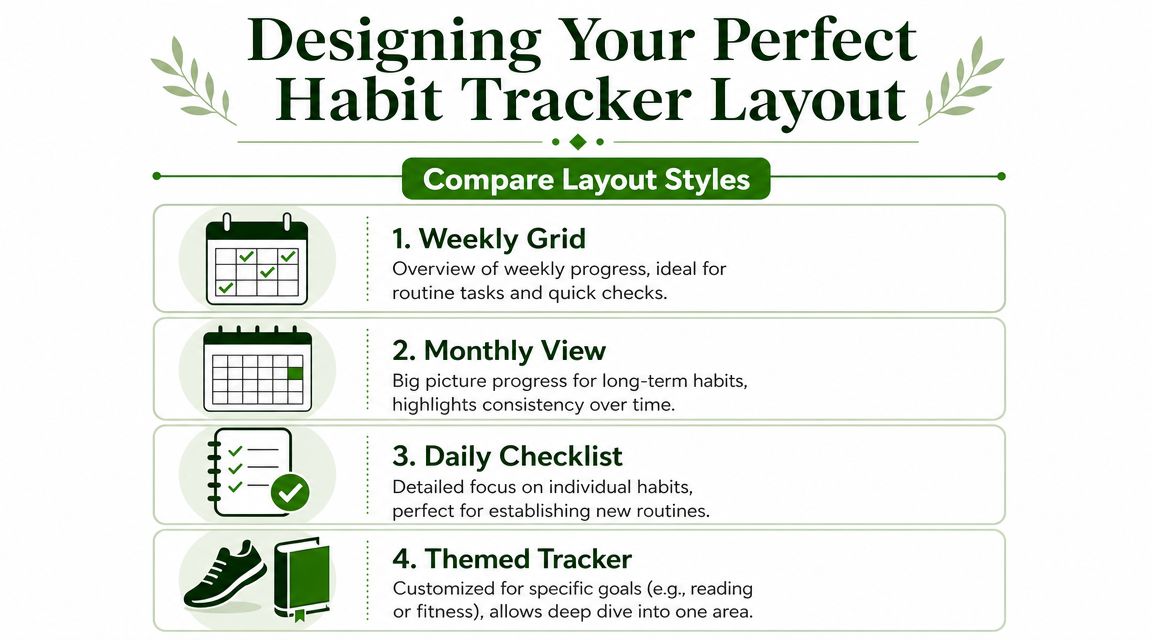
If you're building from scratch, choose based on decision speed. How quickly can you open the planner, log your checkin, and move on? If the answer is “after I redraw the page,” the layout is too demanding.
A good layout has visible constraints:
- Few enough rows that you don't feel buried
- Clear enough labels that you know what counts
- Enough white space that one imperfect day doesn't make the whole spread feel ruined
Analog and digital solve different problems
Paper and apps each work. They just fail in different ways.
| Feature | Analog (e.g., Bullet Journal) | Digital (e.g., Habit Huddle) |
|---|---|---|
| Speed of capture | Fast if the notebook is already open | Fast if the phone is already in hand |
| Flexibility | Easy to sketch custom spreads | Easy to edit, duplicate, and revise |
| Visual satisfaction | Strong for people who like handwriting | Strong for people who want reminders and portability |
| Friction after mistakes | Can feel messy after skipped days | Easier to reset without visual clutter |
| Best fit | Reflective users who enjoy manual planning | Users who need quick daily checkins across devices |
Neither is automatically better. Analog often creates stronger intentionality. Digital usually wins on convenience, reminders, and easier recovery after inconsistency.
If you already use habit stacking, pairing your checkin with an existing cue matters more than the medium. This guide to habit stacking examples for daily routines is useful if you need practical ways to attach tracking to actions you already do.
Match the format to the habit
Not every habit deserves the same type of mark.
Use binary tracking when the habit has a clear yes or no outcome:
- Meditated
- Took vitamins
- Practiced guitar
- Did bedtime shutdown
Use quantity tracking when progress matters in amount:
- Glasses of water
- Pages read
- Sets completed
- Minutes spent tidying
Use time-based tracking when duration is the signal:
- Study session
- Deep work block
- Walk
- Stretching
- Sleep
A checkbox is useful only when the habit itself is binary.
Monthly spreads are good for patterns. Weekly layouts are good for adjustment. Daily pages are best when the habit is new and still fragile.
A simple way to choose:
- Use daily tracking for habits you're trying to install
- Use weekly tracking for habits you already understand but want to stabilize
- Use monthly tracking for habits where trend matters more than daily emotion
If your current planner feels exhausting, the fix usually isn't more commitment. It's a format that asks for the right kind of evidence.
The Rules of Engagement for Real Consistency
The biggest upgrade you can make to a habit tracker planner is changing what counts as a win.
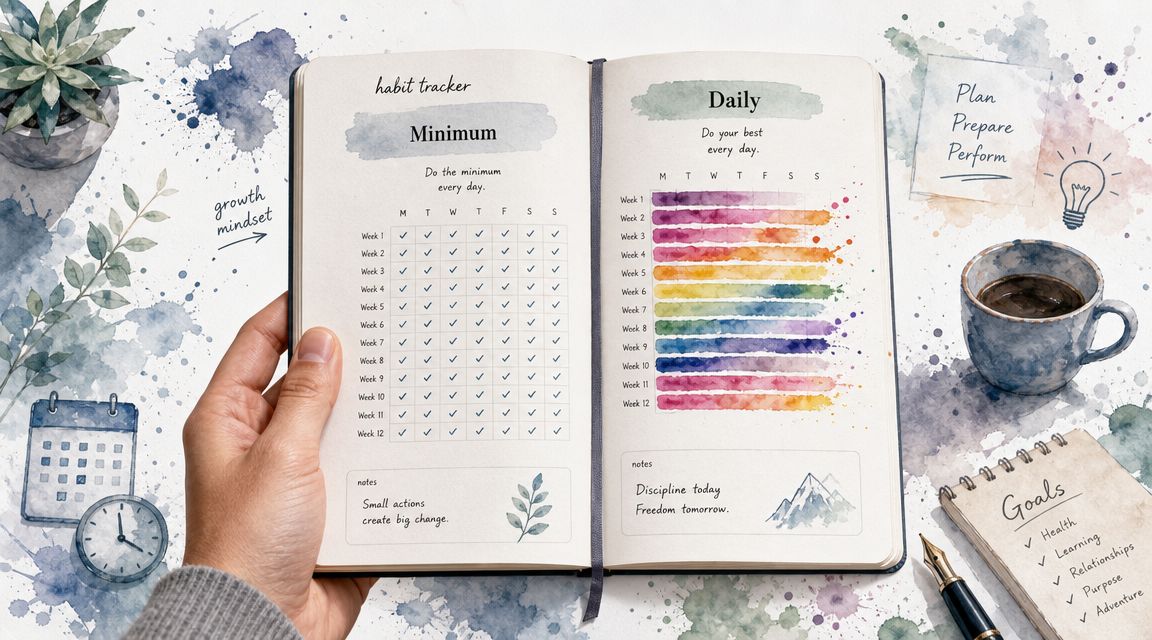
Most systems only have one standard: full completion. That's exactly why they break. A flexible planner uses two win conditions instead. One protects continuity. The other pushes growth.
A 2024 systematic review and meta-analysis found habit formation typically takes a median of 59 to 66 days, with mean estimates of 106 to 154 days and wide variability from 4 to 335 days. It also reported a significant pre/post improvement in habit scores with an overall standardized mean difference of 0.69 (95% CI 0.49–0.88) (meta-analysis on real habit formation timelines). That should kill the fantasy that a rigid streak for a couple of weeks is enough. Real habit formation needs a system that can survive boredom, travel, stress, and off days.
Use two win conditions
Call them Minimum and Stretch.
Your Minimum is the smallest action that keeps the identity of the habit alive. Your Stretch is the fuller version you do when energy and time are available.
Examples work better than theory:
Running
Minimum: put on shoes and step outside
Stretch: complete the planned runReading
Minimum: read one paragraph
Stretch: finish the chapter or sessionStudy
Minimum: review one note
Stretch: complete the full study blockMobility
Minimum: one minute of movement
Stretch: full session
This changes the psychology of the page. Instead of “I either crushed it or failed,” the planner says, “Did I maintain the behavior today?” That's a much better question.
Coaching lens: Minimum protects identity. Stretch builds capacity.
The Minimum mark prevents the habit from disappearing during rough patches. The Stretch mark keeps ambition alive without making ambition the only valid outcome.
You already know you can change.
You just need to take the first step. Habit Huddle helps you build habits around your goals, alongside friends who keep you accountable.
Protect the streak without worshipping it
Streaks help because they make repetition visible. They fail when people treat them like glass.
If one missed day erases your sense of momentum, the streak has become too fragile. I prefer streaks that answer two separate questions:
- Did you show up at all?
- Did you hit the fuller target?
That distinction matters. A person who completes the Minimum for several difficult days is still practicing consistency. The old planner model would label that week mediocre. A smarter model recognizes it as successful maintenance.
This short walkthrough shows the idea in motion:
Recovery rules matter more than motivation
Every durable system needs pre-decided recovery rules.
Use rules like these:
- Miss once, log a checkin the next day without reset drama
- After travel or illness, resume at Minimum
- If a habit slips repeatedly, reduce the Minimum before changing the goal
- If resentment is growing, the habit is too large or too vague
The point of a habit tracker planner isn't to document perfect behavior. It's to keep the loop alive long enough for the behavior to become more automatic.
Supercharge Your Plan with Social Accountability
Solo tracking works until your mood turns against you.
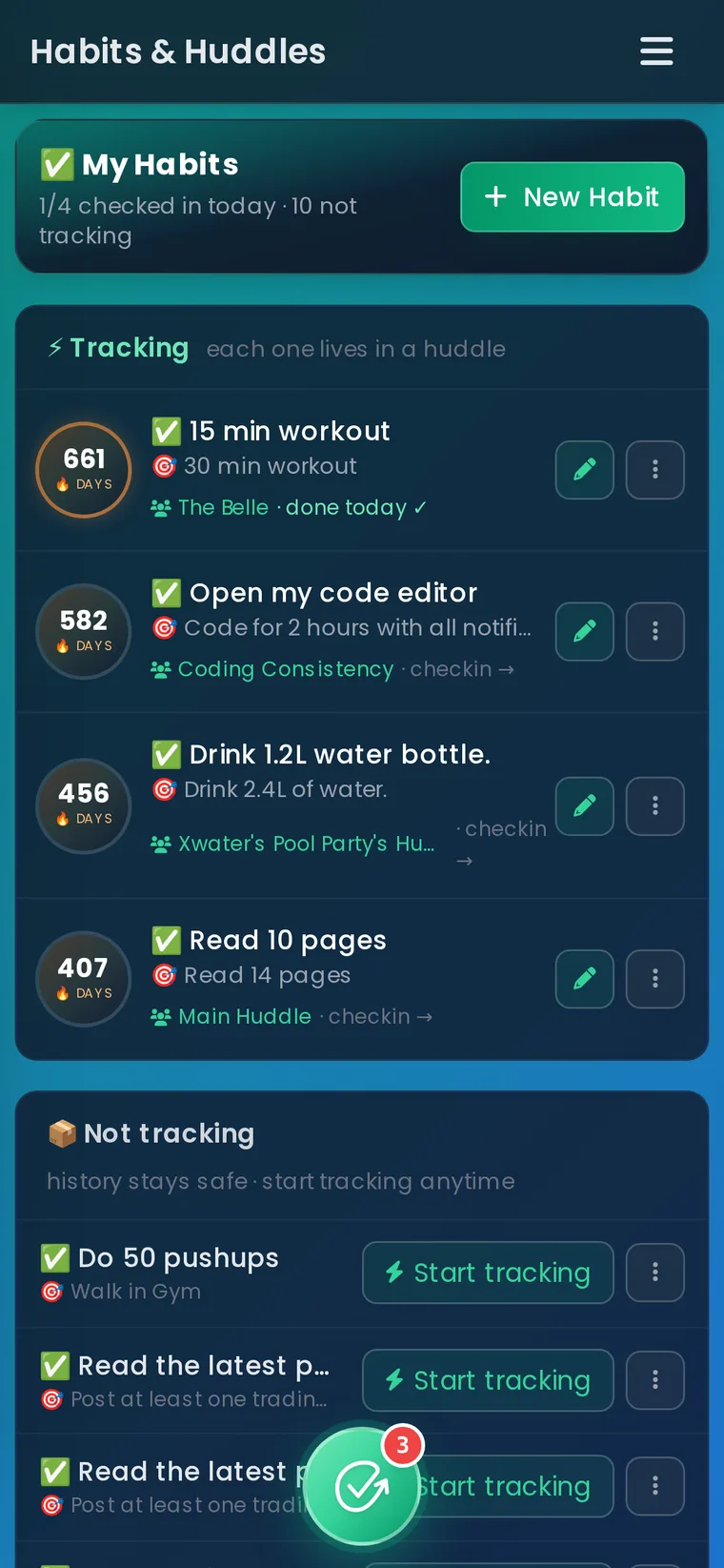
That's the hidden weakness of most planners. On the days you most need reinforcement, you're alone with a blank box and a negotiation. Social accountability changes the negotiation. Other people don't do the habit for you, but they make your effort visible, and visibility raises the odds that you'll follow through.
What changes when other people can see the pattern
Consider three friends trying to build a workout routine.
When they track alone, each person interprets a missed day privately. One says, “I'm busy.” Another says, “I'll restart Monday.” The third feels guilty and avoids opening the planner. Nothing interrupts the slide.
When they track together, the logic changes. A missed checkin is no longer just a private thought. It becomes a moment someone else notices. Not to shame you. To bring you back before one missed day turns into a lost month.
That's why accountability works best in small groups with one shared habit category. A fitness group can quickly see who checked in, who is coasting on the minimum, and who might need encouragement. A study group can do the same for review sessions. A writing group can use it for daily drafting.
Other people don't create discipline for you. They remove your ability to quietly disappear.
A simple group setup that actually gets used
Group accountability fails when it gets too complicated. The setup should be light enough that people will still use it on a tired Thursday.
A practical setup looks like this:
- One shared focus: everyone tracks one habit in the same area, such as workouts, study, or reading
- One daily checkin: no essays, no over-reporting
- A visible minimum: everyone knows what counts on a hard day
- A weekly review: short and honest, focused on consistency rather than performance theater
If you want a tool specifically built around that accountability model, this guide to choosing an accountability partner app for shared habit tracking is a useful starting point.
The best part of social accountability isn't pressure. It's continuity. Even when your motivation drops, the group keeps the habit socially alive. That often makes the difference between a temporary dip and a full abandonment.
Troubleshooting When You Inevitably Fall Off Track
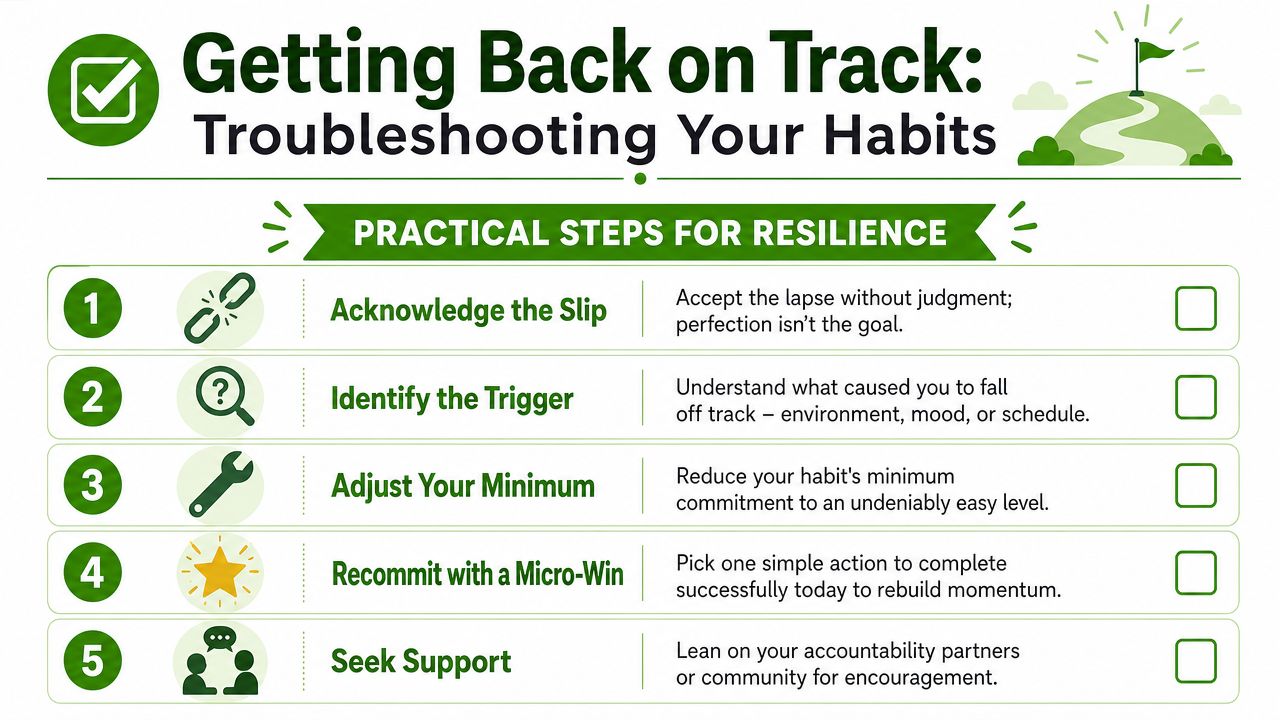
You will miss days. You may miss a week. That doesn't mean the habit tracker planner failed. It means you're using it in real life.
The test of a planner isn't whether you slip. It's whether the system tells you what to do next.
When you forget to track
This usually isn't a motivation problem. It's a placement problem.
If the planner lives in a drawer, or the app sits in a folder you never open, your checkin depends on memory. Memory is weak when routines are new. Attach tracking to an existing action instead. Log your checkin after brushing your teeth, after lunch, or right after the habit itself.
Use these fixes:
- Move it into view: leave the notebook open or pin the app where your thumb naturally goes
- Attach it to a cue: track immediately after the action, not hours later
- Reduce the logging burden: one mark is enough
When the empty boxes start judging you
People abandon otherwise good intentions when they open the spread, see gaps, feel behind, and avoid the page entirely.
Don't fill missed days retroactively just to make the planner look complete. That turns the tracker into fiction. Instead, restart with the smallest honest action available today.
Missed boxes are data. They're not a character assessment.
A blank patch can tell you the habit was too vague, the cue was weak, the timing was unrealistic, or the format asked too much. Use that information. Don't personalize it.
When motivation disappears
Motivation always drops. That's why the Minimum matters.
On low-interest days, reduce the habit to the version that feels almost laughably easy. You're not trying to impress yourself. You're trying to keep the loop from breaking.
When momentum fades, do three things in order:
Lower the entry point
Return to the smallest version of the habit.Make the win visible
Mark the checkin immediately.Bring in support
Tell a friend, partner, or group what you're trying to maintain.
The recovery sequence is simple because it has to work when your energy is low. Complexity is seductive when you plan. Simplicity is what saves you when you wobble.
Habit Tracker Planner FAQs
Should I use a daily, weekly, or monthly habit tracker planner?
Use daily for fragile new habits, weekly for routines you're stabilizing, and monthly for pattern spotting. Choose the view that makes checkins feel easiest.
How many habits should a beginner track?
Start small. One to four is usually sufficient. More than that usually turns the planner into a wish list.
What if I miss an entire week?
Don't backfill it. Start again with today's smallest version of the habit. Then ask what made the old setup too hard to maintain.
Is paper better than digital?
Neither is automatically better. Paper works well if you like writing things down. Digital works well if you need portability and lower-friction resets.
What if a habit no longer feels relevant?
Remove it. A habit tracker planner should reflect your current priorities, not preserve old ambitions. If the habit still matters in theory but not in practice, shrink it or replace it.
For a digital option, this guide to using a habit tracker online can help you compare what works best for your routine.
If you want a habit tracker planner that goes beyond pretty layouts, Habit Huddle is built around the two things that keep people consistent: flexible Minimum vs. Daily Goal checkins and visible social accountability. You can create a small group, build a Checkin Chain together, and keep your streak alive even on low-energy days without pretending every day has to be perfect.
Ready to Build Habits With Friends?
Stop failing alone. Join thousands using the #1 habit tracker with friends for real accountability and lasting results.
Prefer mobile? App Store · Google Play
Related Guides
More Habit Huddle articles on building habits with accountability.

HabitShare Alternatives: 6 Apps for Tracking Habits With Friends (2026)
Looking for a HabitShare alternative? Six social habit trackers compared by model, price, platforms, and what happens on a missed day, plus how to switch wit...

What to Do When You Miss a Workout Day: The 5-Step Comeback Plan
Missed a workout day? What one miss does to your body and habit, according to research, plus a five-step plan for the next 24 hours, when to make it up, and...

Habit Streak App With Friends: 7 Apps Compared (2026)
Seven habit streak apps with friends compared: Habit Huddle, HabitShare, Daily Pact, Habitica, Streaks, Habit Streak duels, HabitStreak.io. What friends see,...