
10 Best Social Fitness Apps of 2026, Ranked by Motivation Style
The best social fitness apps of 2026, sorted by what keeps you going: competition, small-group accountability, or coaching. Includes group apps, niche sports...
📺 Related Video: Lindsays Guide To 2025's Best Fitness Apps
Video by: Garage Gym Reviews Everything · Watch on YouTube
You set the goal, bought the gear, and had all the motivation in the world for about a week. Then work got messy, sleep slipped, one missed session became three, and the plan started to feel like a character test. That is not a willpower problem. It is a system problem, and it is exactly the problem social fitness apps exist to solve.
The short answer: the best social fitness app depends on which kind of social pressure keeps you going. If rankings and segments pull you forward, use Strava. If you stick with plans when an instructor tells you what to do next, use the Peloton App or Nike Run Club. If you do better when a small group cheers you for showing up today, use a group accountability tool like Habit Huddle. The rest of this guide sorts ten apps by those motivation styles so you can pick the one you will still be using in March.
First, pick your motivation style
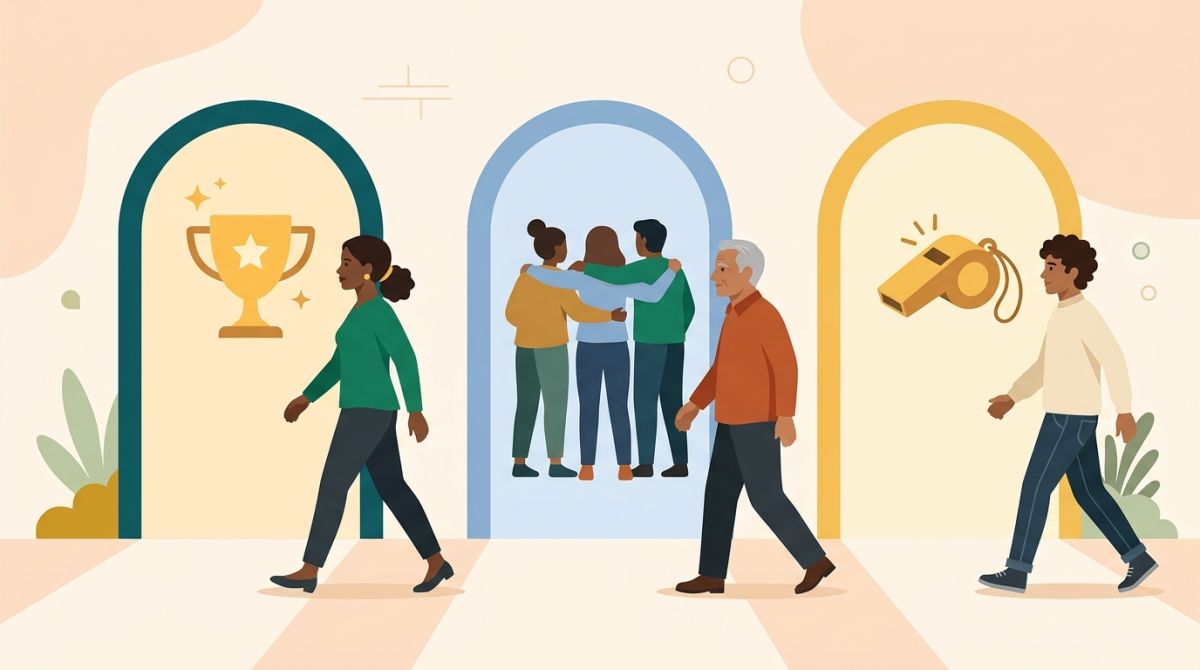
Most people fit one of three patterns:
- Competition. You train harder when rankings, segments, and races give you someone to chase.
- Collaboration. You stay consistent when a small group notices your checkins and encourages you.
- Coaching. You follow through when a trainer, instructor, or guided program removes the "what should I do today" decision.
Pick the wrong style and even a great app becomes friction. A competition feed quietly drains people who hate comparison. A cozy accountability group bores people who need a leaderboard. The research backs this up: a nationwide survey study on fitness app use found that social features work through two distinct pathways, social support and social comparison, and the comparison pathway can help or hurt depending on the person. Know which pathway feeds you before you download anything.
1. Habit Huddle
Full disclosure: Habit Huddle is our app, so judge the reasoning, not the placement.
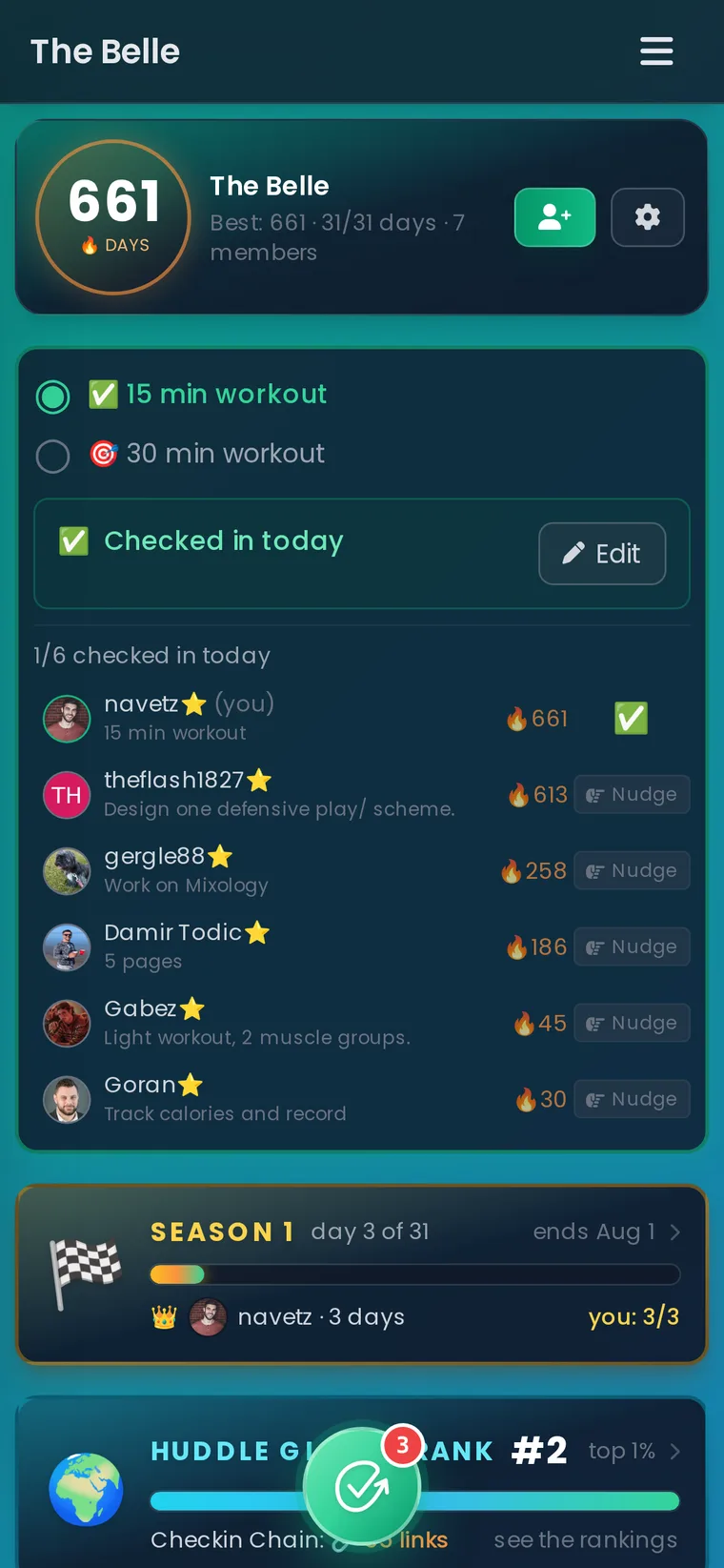
Habit Huddle is the collaboration-first pick. It is a social habit tracker built around small groups called huddles. Every member keeps a personal streak in days, and the group builds a Checkin Chain together, measured in links: one link for every member who checks in that day. The loop stays narrow on purpose. Your group agrees on what counts, everyone checks in, and everyone can see who showed up.
The design choice that matters most for fitness is the two-level checkin. Each habit has a Floor, the minimum that counts on a low-capacity day, and a Ceiling, the goal for stronger days. You step on the Floor, you burst through the Ceiling. This fixes the most common failure pattern in workout routines: someone misses the ideal session, decides the whole plan is broken, and disappears for a week. With a Floor like "10 minutes of movement," a bad day costs you ten minutes instead of your momentum. Why visibility changes follow-through is covered in more depth in our post on the social benefits of fitness.
The other standout is the Discord bot. Many groups already live in Discord, and asking them to move to a separate app is where most group fitness plans die. Habit Huddle lets checkins happen inside the server the group already uses.
The trade-offs are real:
- It is an accountability tracker, not a training log. No GPS, no sets-and-reps analytics, no route maps. Pair it with a sport app if you want both.
- Quiet groups weaken the effect. Social accountability only works when people actually show up, so start with two or three committed friends, not twenty maybes.
- The free plan covers one active habit with full checkins, replies, applause, and leaderboards. Running several habits at once requires a paid plan.
Best for small groups, couples, coaches, and communities where the win condition is "did it today," not "optimized every metric." You can start a huddle at Habit Huddle.
2. Strava
Strava is the default pick for people who want social fitness to feel competitive, public, and performance-oriented. Segments and leaderboards turn ordinary routes into recurring events: you do not just log a run, you see where you stood and whether the next outing has a target built in.
For runners, cyclists, and multisport athletes who like GPS tracking, route discovery, clubs, and challenges, the social density is unmatched. Most active users can find local routes and rivals without any setup.
The downside is the same feature set. Competitive visibility is not equally motivating for everyone, and in mixed-ability groups the leaderboard can quietly discourage the people who need consistency most. Strava works best when competition energizes you and worst when rankings drain you. The most useful analysis tools also sit behind the premium subscription. Find it at Strava.
3. Zwift
Zwift stops acting like a tracker and starts acting like a multiplayer game. Indoor cyclists and runners ride through live virtual worlds with group rides, races, structured workouts, drafting, and meetups. The draw is presence: other people are there at the same hour, moving through the same course, which makes a trainer session feel like a shared workout instead of a solitary one.
It fits competition types, but it also works for collaboration types who want scheduled group sessions, because a booked group ride feels like an appointment rather than an option.
The trade-off is cost and setup. You will get far more from Zwift with a smart trainer or compatible sensors, plus the subscription and stable internet. Without the hardware, the experience loses most of what makes it compelling. Find it at Zwift.
4. Peloton App
Peloton is the clearest coaching-style pick. It has leaderboards, streaks, and challenges, but its core offering is energy transfer: a strong instructor, a clear class format, and a session that removes the friction of deciding what to do. The app works without Peloton hardware, with classes across cycling, running, strength, yoga, and rowing.
Its social layer is broad rather than intimate. You get app-wide momentum, tags, and class culture more than tight small-group accountability. If your group wants class energy plus a tighter follow-through loop between classes, pair it with an accountability group app.
Watch the tier limits: the value depends heavily on which membership level you choose. Find it at the Peloton App.
5. Nike Run Club
Nike Run Club is the easiest recommendation for runners who want coaching without another subscription. Guided audio runs, training plans, badges, challenges, and friend cheers, all free. Some people need rankings to move; others just need a voice in their ear and a few friends who care whether they ran today. NRC serves the second group well.
The lighter touch is also the limitation. The friend feed is thin, and there is no deep multisport identity or public competition scene. For newer and returning runners, that restraint is usually the point. Find it at Nike Run Club.
6. Garmin Connect
Garmin Connect is for people who want social motivation attached to serious training data. Follow friends, join challenges, share live activities with LiveTrack, and stack all of it on top of training load, sleep, and performance metrics. If Strava is the public square, Garmin Connect is the training desk with a community board.
The pressure here is lower-drama than open-feed platforms, which suits data-driven users and quiet competitors. The obvious catch is ecosystem lock-in: the app only makes sense if you own Garmin hardware. Find it at Garmin Connect.
7. adidas Running
adidas Running suits people who show up more consistently when a challenge has a name, a date, and a visible community behind it. The app centers brand campaigns, shared challenges, and adidas Runners groups, with a social tone closer to "join us this month" than "prove you are fastest." That makes it friendly for beginners and returning exercisers.
The trade-off: it creates momentum better than it serves analysis. Users who want segment status or detailed performance breakdowns usually outgrow it. Find it at adidas Running.
You already know you can change.
You just need to take the first step. Habit Huddle helps you build habits around your goals, alongside friends who keep you accountable.
8. Hevy
Hevy understands what lifters actually want to share: workouts, routines, sets, and small signs that someone noticed the session happened. It pairs a detailed strength log with a lightweight social feed, like a gym notebook with a community attached. The free tier is genuinely generous.
The caveat applies to every feed-based product: if posting becomes the goal, the workout starts serving the app. Hevy keeps the social layer close to the training, which is why it works. Best for gym regulars who want a social logbook, not a social network. Find it at Hevy.
9. JEFIT
JEFIT is for structured lifters who stay engaged when they can tinker with programming. A large exercise database, plan builders, analytics, and a community layer that feels more like a training forum than a feed. If comparing routines and following programs keeps you moving, JEFIT gives you room to do it.
The downside is density. The app can feel busy, and people who mainly need someone to notice whether they trained today will find it more tool than they need. Find it at JEFIT.
10. MapMyRun
MapMyRun is the practical middle ground: a familiar activity feed, comments, recurring challenges, and broad device integrations, without adopting a full performance culture. It works for casual runners, walkers, and people returning to fitness who want enough social accountability to stay engaged without every workout becoming a public contest.
If you want deep competition loops it will not hold you long, and that restraint is exactly what some users need. Find it at MapMyRun.
Social fitness apps compared
| App | Best for | Social layer | Free version | Watch out for |
|---|---|---|---|---|
| Habit Huddle | Small-group accountability for any habit | Huddles, streaks, Checkin Chain, Discord bot | Yes, one active habit | Not a training log; our app, so weigh accordingly |
| Strava | Competitive runners and cyclists | Segments, leaderboards, clubs | Yes, core tracking | Best analysis is paid; comparison pressure |
| Zwift | Live indoor group training | Multiplayer rides and races | Trial only | Needs smart trainer plus subscription |
| Peloton App | Coached class energy | Classes, tags, challenges | Limited free tier | Value depends on membership tier |
| Nike Run Club | Free guided running | Challenges, friend cheers | Yes, fully free | Thin friend feed |
| Garmin Connect | Data-driven training plus challenges | Connections, challenges, LiveTrack | Yes, with device | Requires Garmin hardware |
| adidas Running | Community campaigns and events | Campaigns, local groups | Yes, with ads | Light on analysis |
| Hevy | Lifters who want a social logbook | Follow and comment feed | Yes, generous | Gym-culture feed will not suit everyone |
| JEFIT | Structured program followers | Forums, shared plans | Yes, with ads | Busy interface |
| MapMyRun | Simple social tracking | Feed, branded challenges | Yes | Shallow competition loops |
Best social fitness apps for a group, not a feed
A social fitness app and a group fitness app are not the same product. A feed app connects you to everyone; a group app connects you to five specific people, and for most beginners the second one works better.
The distinction matters because feed apps scale participation down as they scale reach up. On Strava you are one post among hundreds. In a group of five, your checkin is a quarter of the day's activity, and somebody notices when you show up.
Three group-shaped options from the list above:
- Habit Huddle for a small crew keeping daily habits together, with a Checkin Chain the group grows one link at a time.
- Stridekick for a step challenge across mixed devices, free for friend and family groups.
- Zwift for scheduled group rides, when the appeal is training at the same hour as other people rather than posting afterward.
For challenge formats built specifically around groups, including apps that count workouts or money stakes instead of steps, see our group fitness challenge app guide. If the group is a workplace, step challenge apps for work covers the free and paid options separately.
Niche sports: cycling, hiking, swimming, and climbing
Cyclists and hikers get the best social coverage of any niche, because Strava and Garmin Connect both treat them as first-class sports with clubs, segments, and route sharing. Komoot adds route discovery and tour sharing for hikers and gravel riders specifically.
Swimmers, climbers, and rowers have it harder. The tracking exists inside Garmin Connect and Apple Fitness, but the community layer thins out fast, and no dedicated social app has reached critical mass.
The workaround is to separate the two jobs. Track the sport in whatever app measures it best, then run accountability separately as a daily checkin on "did the session happen," which works for climbing and physio exercises exactly as well as for running. That separation is also the fix when your sport is seasonal and your consistency is not.
How to choose in five minutes
- Name your motivation style. Chasing, belonging, or being coached. Your history answers this: which apps did you actually keep using?
- Match the app to one behavior. "Get fit" is not trackable. "Run three times a week" is. Roundups of workout accountability apps consistently show that specific commitments outlast vague ones.
- Count your people. Solo by preference? Competition or coaching apps work fine. Have two or more friends in? A collaboration tool will beat a feed.
- Check the free version first. Every app on this list except Zwift has a usable free tier. Prove the habit before paying for the tooling.
- Beware streak anxiety. If a broken streak has ever made you quit an app entirely, pick a tool with a recovery mechanism. We wrote about this pattern in our guide to Streaks app alternatives.
Make it stick: put checkins where your group already talks
The app matters less than the workflow around it. Most people download a tool, invite one friend, and expect motivation to appear. It usually does not, because the checkin lives in a place nobody visits.
Social accountability works when it fits where your group already talks. That is why Discord is such a strong home base: plenty of groups already use it for gaming, study, coaching, or friend chats. Habit Huddle's Discord bot puts checkins inside that existing rhythm, so a #fitness or #daily-checkin channel becomes active without any admin work. In practice:
- One huddle, one behavior. Start with walk, lift, run, or stretch, not "exercise more."
- Set a Floor that survives bad weeks. If the minimum only works on perfect days, participation collapses on the first busy one.
- Keep the group small enough to notice each other. In a group of five, every checkin gets cheered. In a group of fifty, nobody's win registers.
- Post where conversation already happens. Do not split the routine across five tools.
If you want a structured way to kick this off, steal a format from our list of group fitness challenge ideas.
FAQ
Which fitness apps have the best challenges and leaderboards? Strava and Garmin Connect have the strongest traditional leaderboards, and Zwift adds live races. If you want group challenges without a ranking system, Habit Huddle tracks a shared Checkin Chain instead, so the group wins together rather than against each other.
Is there a completely free social fitness app? Nike Run Club is fully free. Garmin Connect is free with a Garmin device, Hevy's free tier is generous for lifters, and Habit Huddle's free plan covers one active habit with a full group checkin loop. Strava, adidas Running, JEFIT, and MapMyRun are free with paid upgrades.
What is the best social fitness app for beginners? Pick low-pressure social features: Nike Run Club for guided runs, adidas Running for community events, or a small accountability group in Habit Huddle. Avoid leaderboard-heavy apps at the start. Being ranked last in week one is where most beginners quit.
Do social features actually help you exercise more? Research says yes, with a catch. A nationwide survey study of fitness app users found benefits flow through social support and social comparison, and comparison can backfire for some people. Support-based features are the safer default; competition works when you already like competing.
What about niche sports like rowing, swimming, or hiking? Garmin Connect and Strava both track a wide range of sports with community features attached, and cycling and hiking are especially well served, with Komoot adding route sharing for both. If your sport is not well served by any tracker, run the accountability layer separately: a habit tracker records "did the session happen" for any activity, from rowing to climbing to physio exercises.
What is the difference between a social fitness app and a group fitness app? A social fitness app connects you to a broad feed of other users, like Strava or MapMyRun. A group fitness app connects a specific small group around a shared challenge or habit, like Stridekick, GymRats, or Habit Huddle. Feeds are better for discovery and competition; groups are better for consistency, because a small group notices your wins in a way a feed cannot.
Willpower gets you through week one. A social system gets you through month three. If your motivation style is collaboration, grab two friends, pick one habit, set a Floor you can hit on your worst day, and start a huddle on Habit Huddle. The free plan is enough to prove it works.
Ready to Build Habits With Friends?
Stop failing alone. Join thousands using the #1 habit tracker with friends for real accountability and lasting results.
Prefer mobile? App Store · Google Play
Related Guides
More Habit Huddle articles on building habits with accountability.
HabitShare Alternatives: 6 Apps for Tracking Habits With Friends (2026)
Looking for a HabitShare alternative? Six social habit trackers compared by model, price, platforms, and what happens on a missed day, plus how to switch wit...
What to Do When You Miss a Workout Day: The 5-Step Comeback Plan
Missed a workout day? What one miss does to your body and habit, according to research, plus a five-step plan for the next 24 hours, when to make it up, and...
Habit Streak App With Friends: 7 Apps Compared (2026)
Seven habit streak apps with friends compared: Habit Huddle, HabitShare, Daily Pact, Habitica, Streaks, Habit Streak duels, HabitStreak.io. What friends see,...