
Behavior Change Psychology: Why Willpower Fails You
Learn the science of behavior change psychology. Stop relying on willpower and discover evidence-based models and techniques to build habits that stick.
Most habit advice still sells the same story: if you want change badly enough, you'll do the work. That story is popular because it feels simple. It's also why so many people feel ashamed when their routines collapse after a few hard days.
Behavior change psychology points in a different direction. The better question isn't "Why am I so unmotivated?" It's "What mechanism is driving this behavior, and what mechanism is missing?" A 2022 review on behavior-change techniques argues that change works through external resources, internal reflective resources, and internal affective resources. In plain English, people don't change through motivation alone. They change when support, planning, tools, rewards, cues, and follow-through line up.
That shift matters. It turns failed habits from a character judgment into a design problem. And design problems can be solved.
Table of Contents
- Why Your Habits Fail and How Psychology Can Fix It
- The Core Models of Behavior Change
- Key Levers The Psychology of Lasting Habits
- From Theory to Action A Practical Toolkit
- How to Engineer Habits with Social Tracking
- Measuring Progress and Avoiding Common Pitfalls
Why Your Habits Fail and How Psychology Can Fix It
Big habit overhauls usually fail for a predictable reason. They ask one person to perform five hard behaviors in an environment built for the opposite.

Willpower is a weak operating system
A plan can look sensible on Sunday and fall apart by Wednesday. The problem often sits in the mechanics: too many decisions, poor timing, too much friction, weak cues, no social support, and no backup plan for stressful days.
I see this constantly in coaching. Someone sets a goal that sounds reasonable, then ties it to conditions that rarely hold. The workout needs an hour of free time. The meal plan needs a fully stocked kitchen. The bedtime routine assumes they will resist a phone that is charging on the nightstand. Under pressure, the system breaks where it was always weakest.
That does not mean the person is lazy or unserious.
It means the behavior was harder to perform than it looked. Good psychology starts there. It treats repeated failure as useful information about context, effort, emotion, and support.
Practical rule: If a habit disappears under ordinary stress, the habit was not built for ordinary life.
What behavior change psychology does better
Behavior change psychology improves habit work because it shifts the question. Instead of asking how to feel more motivated, it asks what conditions make the action likely today.
That changes the coaching conversation in a useful way. If you keep skipping a walk, the issue might be timing, weather, embarrassment, unclear cues, or the hassle of changing clothes after work. If you keep checking your phone at night, the issue might be visibility, fatigue, boredom, or the fact that your environment keeps presenting the cue.
The trade-off is simple. Motivation-focused advice feels exciting but often fades fast. Mechanism-focused advice is less glamorous, but it holds up better in real life because it changes the odds of the behavior happening.
Three kinds of support matter again and again:
- External resources: prompts, tools, access, accountability, and a setup that reduces friction
- Reflective resources: planning, self-monitoring, coping strategies, and skill building
- Affective resources: enjoyment, relief, reward, and emotional safety
This framing helps because it replaces blame with diagnosis. A missed habit is not proof that you do not care. It is often a sign that the cue was weak, the cost was too high, the reward came too late, or the behavior depended on energy you did not have.
Self-criticism rarely fixes those problems. Better design does.
The Core Models of Behavior Change
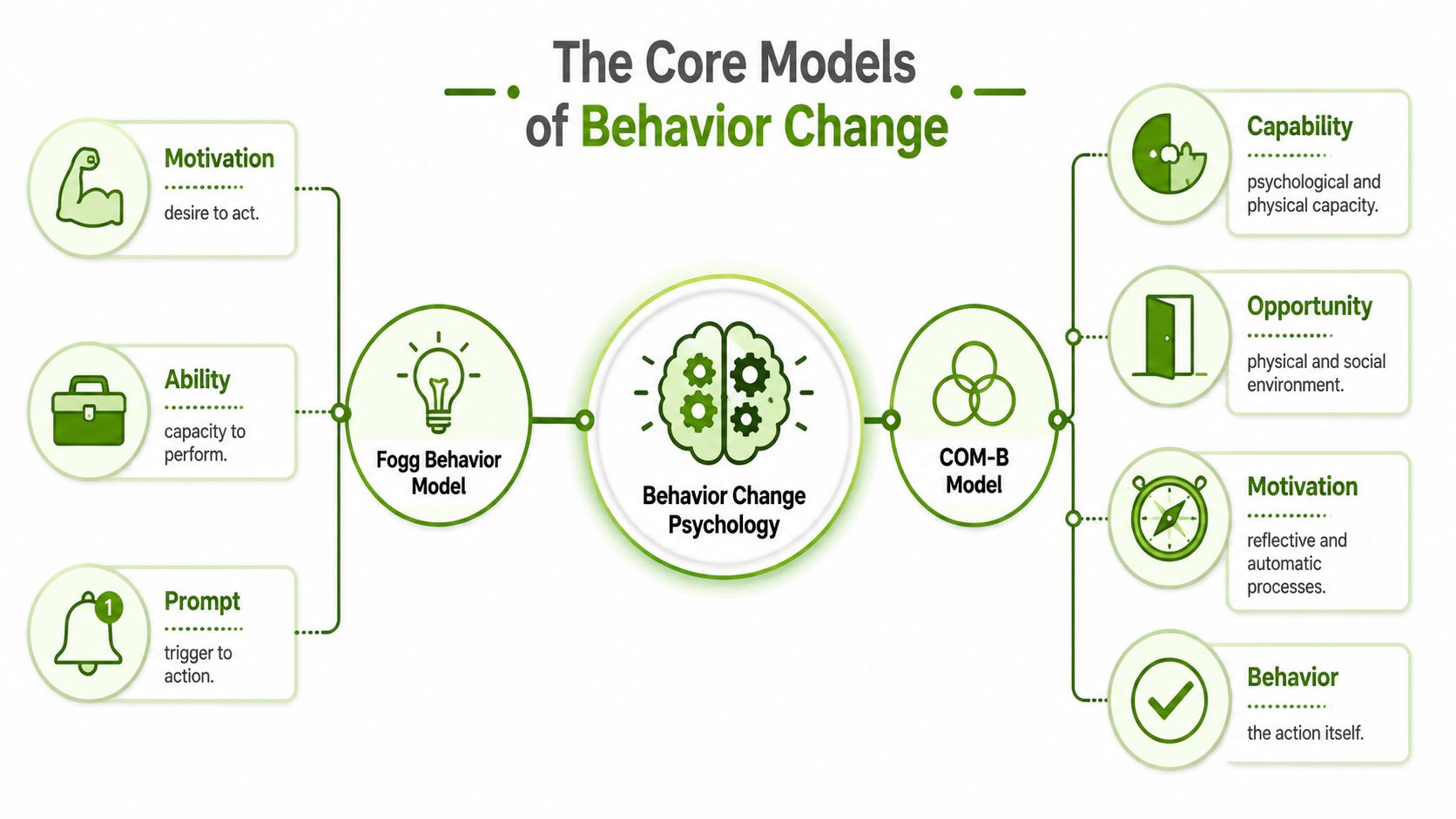
Behavior change psychology gets practical when you use models that explain why a behavior is or isn't happening. Two are especially useful because they turn a vague struggle into a concrete diagnosis.
The Transtheoretical Model as a readiness map
The Transtheoretical Model, often shortened to TTM, treats change as a staged process rather than a single decision. A behavior change overview from IDEA Health & Fitness describes five stages: precontemplation, contemplation, preparation, action, and maintenance. It also notes that maintenance means sustaining the behavior for more than 6 months, and that people in precontemplation aren't intending to change within the next 6 months.
Readiness isn't evenly distributed. The same source notes that only 20% of people are prepared to change health behaviors at a given time. Consequently, if you use action-stage tactics on someone who is still ambivalent, the advice won't land.
A quick way to use TTM is to match the strategy to the stage:
- Precontemplation: Focus on awareness, not pressure.
- Contemplation: Reduce ambiguity. Help the person weigh trade-offs thoroughly.
- Preparation: Make the first steps concrete, such as buying the shoes, joining the class, or setting the reminders.
- Action: Protect consistency with schedules, cues, and visible tracking.
- Maintenance: Prevent relapse by planning for boredom, travel, stress, and disruption.
The mistake isn't always "not trying hard enough." Sometimes it's using the wrong intervention for your current stage.
TTM is especially useful when people label themselves lazy. Often they're not lazy. They're undecided, underprepared, or trying to leap from intention to maintenance without building a bridge.
COM-B as a behavior diagnosis tool
The COM-B model is cleaner and more tactical. According to The Decision Lab's explanation of COM-B, behavior depends on Capability, Opportunity, and Motivation. If one of those is weak, the behavior becomes unreliable.
That gives you a fast set of diagnostic questions:
| Driver | What to ask | Common problem |
|---|---|---|
| Capability | Do I know how to do this, and can I do it consistently? | The habit requires skill, knowledge, or energy you don't yet have |
| Opportunity | Does my environment make this easy enough to happen? | Timing, access, tools, or social context are working against you |
| Motivation | Do I feel pulled toward this behavior often enough? | The action feels abstract, unrewarding, or disconnected from your values |
The power of COM-B is that it stops generic advice. If the problem is capability, "be more accountable" won't fix it. If the problem is opportunity, reading another motivational article won't help either. You need different tools for different failures.
A few examples make this clearer:
- Someone wants to cook at home but doesn't know simple recipes. That's a capability gap.
- Someone wants to walk daily but has no consistent time, no nearby route, and a packed commute. That's an opportunity gap.
- Someone can do the habit and has access, but the task feels stale and emotionally flat. That's a motivation gap.
Most habit struggles involve more than one of the three. But usually one is the main bottleneck. Find that first.
Key Levers The Psychology of Lasting Habits
Lasting habits don't come from one magical insight. They come from a few reliable levers that make repetition more likely. The most useful ones are cues, rewards, access, and social support.
Cues and rewards shape repetition
A habit becomes easier when the brain stops renegotiating it every time. That usually starts with a stable cue. The cue can be time-based, location-based, event-based, or social. After coffee, stretch. After lunch, walk. When you open your laptop, write one paragraph. When your study group checks in, review notes.
Rewards matter too, but many people wait too long to feel one. They choose habits with delayed benefits and no immediate payoff. That's hard to sustain. The body doesn't instantly reward "better cardiovascular health" tonight. It does respond to completion, relief, visible progress, and social acknowledgment.
A useful distinction:
- Immediate rewards help start and repeat the behavior.
- Delayed rewards help justify why the behavior matters.
If you rely only on delayed rewards, the habit stays fragile. That's why a visible checkmark, a streak, a short reflection, or a message from a friend can matter so much. They bring the reward closer to the action.
Why support beats pressure
Many people think accountability works because it creates pressure. Pressure can help in short bursts, but it often weakens once novelty wears off. Support is different. Support changes the environment around the person.
A large quantitative synthesis highlighted by the University of Pennsylvania found that interventions improving access and social support had the strongest effects on behavior. The same summary reported that sanctions and trustworthiness interventions had negligible effects, while norms and monitoring incentives produced only small effects.
That pattern matches what practitioners see all the time. People do better when the desired action is easier to start and socially reinforced. They do worse when the system leans on punishment, guilt, or passive visibility alone.
A check-in works best when it sits inside a supportive relationship, not when it feels like surveillance.
This has direct implications for habit design:
- Reduce friction before you increase pressure. Put the book on the pillow. Fill the water bottle in advance. Choose the gym next to work, not the one with the perfect branding across town.
- Use people as scaffolding. A walking partner, study group, coach, or small peer circle can carry the behavior through low-motivation days.
- Don't confuse being watched with being supported. Visibility helps some. Encouragement plus practical structure helps more.
The strongest habit systems usually combine both. They make the action easier, then make it socially harder to forget.
You already know you can change.
You just need to take the first step. Habit Huddle helps you build habits around your goals, alongside friends who keep you accountable.
From Theory to Action A Practical Toolkit
A habit system should answer one practical question. What is making this behavior hard to repeat in your actual life?
People often assume failure means they want the goal less than they claim. In practice, habit breakdown is usually easier to explain. The behavior is too big for the person's current capacity, the environment keeps cueing a competing action, or the reward arrives too late to hold attention. That is why psychology helps. It gives you a way to diagnose the problem before you prescribe a fix.
Start by diagnosing the primary bottleneck
Use COM-B as the first screen. Ask which driver is weakest right now: capability, opportunity, or motivation.
A short diagnosis usually gets you further than another promise to "try harder."
- Capability check: Do you know the exact action, and can you complete it even on a tired day?
- Opportunity check: Are the tools, timing, location, and surrounding cues already set up for the habit?
- Motivation check: Does the action feel worth doing now, not only in some distant future?
Each bottleneck necessitates a distinct response. If reading keeps failing, the answer may be to choose an easier book, move your phone out of the room, or attach reading to an existing evening cue. More pressure rarely fixes a design problem.
For a smaller starting version of almost any routine, this guide on how to start a habit can help you reduce the behavior until it becomes repeatable.
Techniques that make habits easier to repeat
Once you know the bottleneck, choose a technique that fits it. Behavior change works better when the method matches the mechanism.
Here are the tools I reach for most often because they hold up in ordinary life, not only in highly motivated weeks.
- Goal setting: Make the target specific enough that completion is obvious. "Walk for 20 minutes after lunch on workdays" beats "be more active."
- Action planning: Decide when, where, and how the habit will happen before the day gets noisy.
- If-then planning: Prepare for disruption in advance. "If my meeting runs late, then I do the 10-minute home version."
- Self-monitoring: Keep a visible record of completions so you can spot patterns before the habit slips.
- Environmental restructuring: Remove one step from the desired behavior and add one step to the competing behavior.
- Public commitment: Tell a supportive person or small group what you plan to do so the habit has social weight.
- Minimum viable version: Define the smallest acceptable version for low-energy days. Continuity matters more than intensity at the start.
Mapping Psychology to Practical Habit Techniques
| Psychological Principle | Behavior Change Technique (BCT) | Practical Example |
|---|---|---|
| Clarity reduces hesitation | Specific goal setting | "Write 200 words after breakfast" instead of "write more" |
| Plans protect behavior under stress | Action planning | Put gym clothes by the door and schedule the session before work |
| Cues trigger action | If-then planning | "If I make tea at night, then I read for 10 minutes" |
| Feedback supports adjustment | Self-monitoring | Mark each completed walk in an app or notebook |
| Environment shapes effort | Environmental restructuring | Keep fruit on the counter and move snacks out of reach |
| Social visibility raises commitment | Public commitment | Share the week's study target with a small group |
| Smaller wins preserve continuity | Minimum viable version | On low-energy days, do one stretch set instead of skipping entirely |
The trade-offs matter.
Specific goals help, but goals that are too rigid can produce all-or-nothing thinking. Public commitment can increase follow-through, but the audience has to feel supportive rather than judgmental. Tracking helps people notice patterns, but obsessive tracking can turn the metric into the goal.
Build a system that still works on a messy Wednesday.
A good toolkit stays small. Pick one cue, one plan, one way to track, and one form of support. Then keep it in place long enough to learn what changes your behavior.
How to Engineer Habits with Social Tracking
Willpower gets too much credit. In practice, habits stick more often when the behavior is easy to notice, easy to record, and hard to ignore socially.
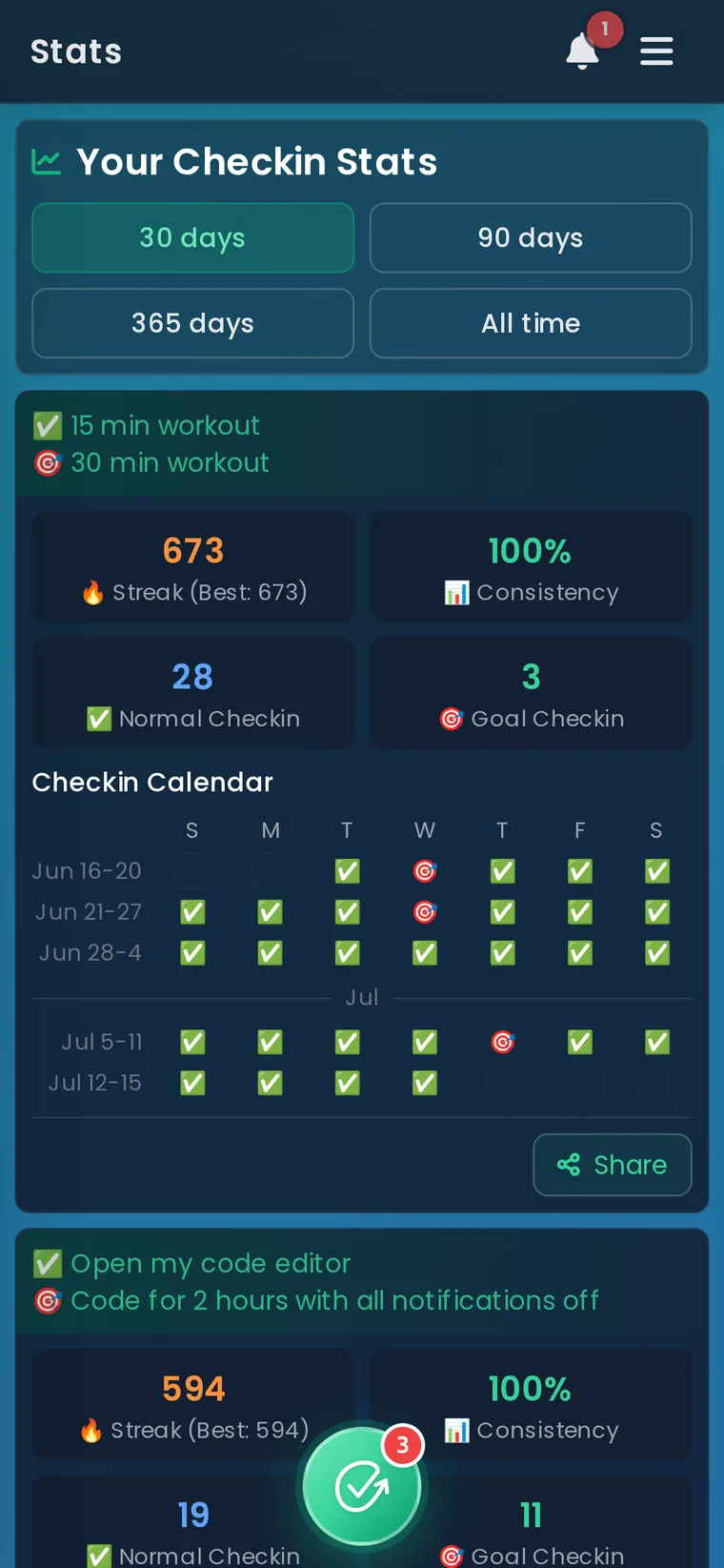
Social tracking works because it changes the conditions around a behavior. It adds a cue to act, a record of whether the action happened, and a small amount of interpersonal friction when you drift. That matters for people trying to meditate, study, exercise, or follow through on any routine that gets crowded out by work, family, or low energy.
The core benefit is mechanical, not moral. A shared check-in system reduces how often you have to rely on memory, mood, or a burst of motivation at the exact right moment. It also turns a private intention into something with a rhythm. You see the habit again tomorrow, not just when guilt reminds you.
What social tracking changes day to day
Used well, social tracking makes a habit more concrete. There is a defined action, a visible place to log it, and a small group that notices whether the pattern is holding. That changes behavior in ordinary moments. At 8 p.m., the question is no longer "Do I feel motivated?" It becomes "What is my version of the habit tonight, and am I checking in?"
That distinction matters. Many people interpret inconsistency as a character problem. More often, it is a design problem. The habit is too vague, the cue is weak, the effort is too high for tired days, or nobody would notice if it disappeared for a week.
For readers who want the accountability side explained in more detail, this guide to social accountability for habits shows why shared follow-through often beats solo intention.
How to set it up without creating pressure that backfires
Social systems help, but they can also create performative pressure if the setup is sloppy. I usually look for five features:
- One clear action: "Walk for 10 minutes after lunch" works better than "get healthier"
- One simple check-in: a yes or no, a streak mark, or a short note
- A minimum version: a fallback for stressful days, such as five flashcards instead of a full study block
- A small, responsive group: enough visibility to matter, not so many people that no one pays attention
- Supportive norms: encourage honesty and reset quickly after misses
The trade-off is real. More visibility can raise follow-through, but too much scrutiny makes people hide missed days or quit after a lapse. The goal is honest tracking, not social theater.
Here's a useful illustration of how these tools work in practice:
A good social tracking system also protects against all-or-nothing thinking. If the group accepts a minimum version and treats lapses as information, one bad day stays one bad day. That is one of the biggest advantages of this approach. It keeps habits alive through messy weeks, which is when old patterns usually return.
Used well, social tracking helps people stay consistent because the environment keeps prompting the behavior. The system does part of the work.
Measuring Progress and Avoiding Common Pitfalls
People often quit too early because they measure the wrong thing. They chase intensity instead of consistency, or they treat one disrupted week as proof that the whole approach failed.
Measure consistency before intensity
If you're building a habit, the first metric is usually simple: did the behavior happen as planned often enough to become normal? Until that answer is yes, optimization can wait.
A few guidelines help:
- Track the behavior, not just the outcome. If your goal is fitness, track workouts completed, walks taken, or meals prepared. Outcomes move slower.
- Use visible records. Memory is biased. Logs, check-ins, and streak views tell the truth more reliably.
- Review patterns, not isolated misses. One skipped session means little. Repeated misses at the same time or in the same context reveal the underlying constraint.
With data, behavior change psychology becomes less abstract. Data lets you ask whether the issue is timing, environment, difficulty, or support. If you want a practical way to do that, this guide on how to track progress shows how to notice trends without becoming obsessive.
Treat setbacks like feedback
Setbacks are not evidence that you can't change. They're evidence that the current design met a constraint.
A few traps show up again and again:
- All-or-nothing thinking: Missing one day becomes "I'm off track."
- Oversized habits: The routine only works in ideal conditions.
- Environment blindness: The plan ignores access, cues, distractions, and social context.
- Moralizing the struggle: You call it laziness when it's really poor fit.
A 2024 systematic review on health behavior interventions and inequality found that some interventions can unintentionally widen socio-economic health inequalities. That's an important reminder. Not every habit strategy works equally well for every person. Time, money, schedule control, caregiving load, stress, and living conditions all shape what is realistic.
The right question isn't only "Does this method work?" It's "Does this method work for me, in my actual conditions?"
That mindset changes everything. You stop trying to prove discipline and start running experiments. Shorter workout. Earlier cue. Simpler meal. Smaller target. Different support. Better location. That is how durable habits are built.
If you want a tool built around these principles, Habit Huddle gives you a practical way to turn accountability into daily follow-through. You can create a small group, track one habit at a time, use flexible check-ins, and make consistency visible without turning the process into a guilt machine.
Ready to Build Habits With Friends?
Stop failing alone. Join thousands using the #1 habit tracker with friends for real accountability and lasting results.
Prefer mobile? App Store · Google Play
Related Guides
More Habit Huddle articles on building habits with accountability.

Body Doubling App: 7 Options Compared, from Live Video to Daily Checkins (2026)
Seven body doubling apps compared: Focusmate, Flow Club, Focus101, Dubbii, Caveday, Flown and Habit Huddle, with free tiers, prices, and which format fits ta...

Easy Habit Challenge for Beginners: 20 Ideas You Can Actually Finish
20 easy habit challenges for beginners, each with a two-minute Floor and a stretch Ceiling, plus how long to run one, the four rules that get you past week t...
How Long Does It Take for Exercise to Become a Habit? What Five Studies Found
Exercise takes about six weeks to feel automatic and months to become reliable. What five studies of new gym members actually found, why exercise is slower t...