
Study Habits: Definition, Examples, and the Ones That Actually Work
Study habits defined in one sentence, with examples of good and bad ones, the techniques the evidence supports (self-testing, spacing), and how to make a goo...
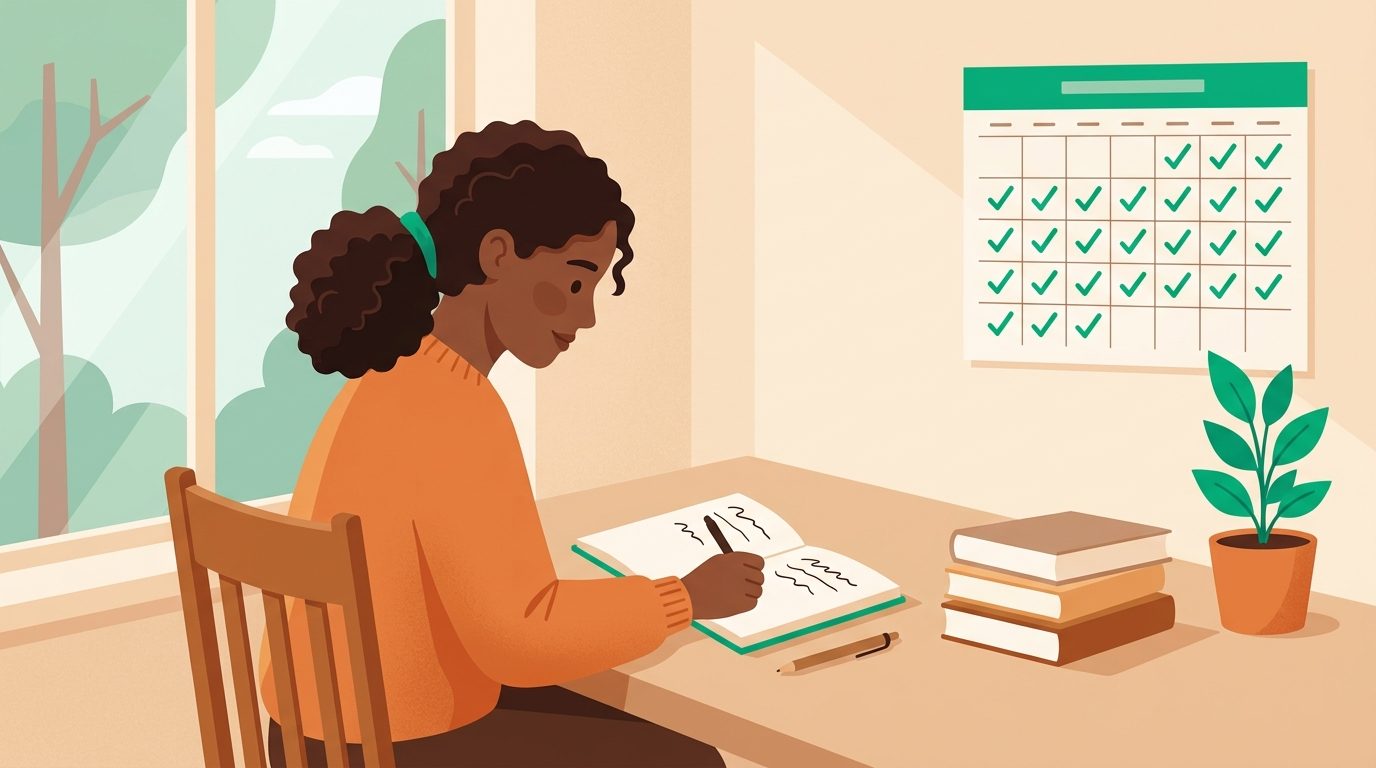
Study habits are the regular routines and techniques you use when you learn: when and where you study, how you engage with the material, and what you do when focus breaks. They matter because they compound. A student with average ability and strong habits reliably outperforms a talented student who studies on impulse, because learning responds to repetition and method more than to intensity.
This guide defines study habits in one sentence, lists concrete examples of good and bad ones, separates the techniques backed by evidence from the popular ones that quietly waste time, and covers the part most study advice skips: how to make a good technique into an automatic habit, so it still happens in week six when motivation is gone.
Study habits: a definition
A study habit is any studying behavior that has become your default, repeated regularly enough that it no longer takes a decision. Written as a dictionary would put it: study habits are the settled patterns of when, where and how a person studies, and how they respond when studying gets hard.
That covers logistics and technique:
- When you study: a fixed daily slot versus whenever a deadline forces it.
- Where you study: a consistent low-distraction spot versus wherever you happen to be.
- How you study: self-testing, summarizing from memory, working problems, rereading, highlighting.
- How you handle friction: what you do with your phone, what happens when you get stuck, how you restart after a lost day.
The word "habit" is doing real work in that definition. A technique you use once before a big exam is a tactic. The same technique performed every weekday at the same desk is a habit, and only habits deliver the compounding effect, because they remove the daily negotiation about whether studying will happen at all.
Examples of study habits
Concrete examples make the definition usable. These are study habits in the strict sense: behaviors that repeat on a schedule without a fresh decision each time.
Examples of good study habits
- Studying at the same time and desk every weekday
- Closing the notes and writing down everything you remember before rereading
- Doing practice questions before reviewing the chapter
- Splitting a topic across three or four short sessions in a week
- Starting with the hardest subject while energy is highest
- Leaving the phone in another room for the session
- Taking a real break, away from the screen, every 25 to 50 minutes
- Ending each session by writing tomorrow's first task
- Explaining the topic aloud to a study partner or an empty room
- Checking in with a study group each day you kept the habit
Examples of bad study habits
- Rereading and highlighting as the main method
- Cramming the night before
- Studying only when a deadline or a mood forces it
- Marathon sessions with no breaks
- Keeping the phone face down but within reach
- Switching subjects every few minutes
- Reviewing only the material you already know
Most people recognise themselves on both lists. The point is not to feel bad about the second list but to swap each item for its partner on the first, one habit at a time.
Good study habits vs bad ones
The most popular study methods are among the least effective, which is why effort and grades often refuse to line up. Students overwhelmingly default to rereading notes and highlighting, and large reviews of the learning research, most prominently Dunlosky and colleagues' analysis of ten learning techniques, rate exactly those methods at the bottom, with practice testing and spreading study over time at the top.
| Habit | Verdict | Why |
|---|---|---|
| Testing yourself from memory | Strong evidence | Retrieving information strengthens it far more than re-exposure |
| Spacing study across days | Strong evidence | Multiple shorter sessions beat one long one with the same total hours |
| Fixed time and place | Helpful | Removes the daily decision and builds an automatic cue |
| Rereading notes and chapters | Weak | Creates familiarity that feels like knowledge but fades fast |
| Highlighting | Weak | Marks text without processing it |
| Cramming the night before | Weak | Can pass tomorrow's test; the material is largely gone in a week |
| Studying with your phone in reach | Harmful | Each glance resets the focus the session was building |
The feels-like-learning trap explains most bad habits: rereading feels smooth and productive precisely because the material is familiar, while self-testing feels harder because it exposes what you do not know. That difficulty is the point. The methods that feel effortful in the session are the ones producing durable memory.

The study habits with the strongest evidence
Four habits carry most of the measurable benefit, and none of them require talent, apps, or extra hours.
Test yourself, constantly. Close the notes and write down everything you remember, answer practice questions, or explain the topic aloud as if teaching it. Cognitive scientists call this retrieval practice, and it is the single most consistently supported study technique in the literature. A useful rule: spend more time answering than reviewing.
Space it out. Two hours split across four days beats the same two hours in one sitting, for the same total effort. The forgetting that happens between sessions is productive, because each retrieval after partial forgetting strengthens the memory more than an immediate repeat.
Study in one place, at one time. A consistent slot and spot turns the environment itself into the cue, so starting stops requiring willpower. This is the habit that carries the techniques: the students who self-test daily are mostly the students with a daily slot in which to do it.
Remove the phone, actually. A study of university students' real study behavior found distraction while studying was significantly associated with worse exam performance, independent of which techniques students used. In reach but face down does not work; another room does.
For structuring a single session, the classic guidance in UNC's Studying 101 holds up: short focused blocks, active engagement, real breaks.
How to build a study habit that sticks
Knowing the right techniques changes nothing until they survive contact with a normal week, and that is a habit-formation problem, not an information problem. Research on how habits form puts the average at about 66 days of repetition before a behavior becomes automatic, which means the real project is keeping a study routine alive long enough for it to start carrying itself.
Three moves do most of that work:
- Anchor it to something that already happens. "After dinner, at my desk" beats "two hours every day" because the trigger arrives on its own. This is habit stacking, and it works as well for studying as for anything else.
- Set a Floor you can hit on your worst day. Fifteen minutes of self-testing counts as a kept day. The Floor is what keeps one exhausted Tuesday from becoming a broken week; ambitious sessions are what the good days are for. If you have never kept any daily habit before, an easy habit challenge for beginners is the right first month.
- Track kept days visibly. A chain of checkmarks on a calendar or in a tracker gives the habit a score, and a missed day costs the day, nothing more. The rule that saves study streaks is never miss twice.
Study habits are easier with other people

The least-used study habit is other people, and it addresses the failure mode techniques cannot: the days you simply do not start. A study partner or group that expects you to show up converts private intentions into small promises, which is why accountability partners work for studying just as they do for fitness. Study communities scale the same effect; entire Discord accountability servers exist around daily focus checkins, and body doubling apps put another person alongside you for the session itself.
The healthy version is structural, not surveillance: a group whose members post a checkin when they studied, and where showing up gets cheered. Habit Huddle, our app, is built on that loop, so weigh the recommendation accordingly: you and your study partners create a huddle for the daily study habit, set its Floor, and post a checkin each day you keep it. Streaks stay personal, the group grows a Checkin Chain one link per member per day, and nobody's missed day is announced to anyone. Starting one is free, and it works whether your group lives in a class, a group chat, or a Discord server.
You already know you can change.
You just need to take the first step. Habit Huddle helps you build habits around your goals, alongside friends who keep you accountable.
Frequently asked questions
What is the definition of study habits?
Study habits are the settled patterns of when, where and how a person studies, and how they respond when studying gets hard. A study habit is any studying behavior repeated regularly enough that it happens by default, without a fresh decision each time.
What are examples of good study habits?
Testing yourself from memory instead of rereading, spreading study over multiple days instead of cramming, keeping a fixed study time and place, starting with the hardest subject, taking real breaks, and studying with the phone in another room. The common thread is active engagement plus consistency: techniques that force retrieval, inside a routine that happens daily.
What are bad study habits?
Rereading and highlighting as primary methods, cramming, studying with the phone in reach, marathon sessions instead of spaced ones, and studying only when motivated. Most are popular because they feel productive: familiarity from rereading feels like knowledge, and a long cram session feels like commitment, but both fade within days.
How long should a study session be?
Twenty-five to fifty focused minutes, then a genuine break, is the range most evidence and practice guides converge on. The bigger lever is spacing: four one-hour sessions across a week reliably beat one four-hour block. Set a session Floor small enough to start on tired days; a fifteen-minute self-testing session keeps the habit alive.
How do I fix bad study habits?
Replace, don't just remove: swap rereading for closed-book recall of the same material, swap the cram for the same hours spread across the week, and give studying a fixed time and place so starting stops being a decision. Change one habit at a time, expect roughly two months before it feels automatic, and track kept days so a bad day ends at one.
Ready to Build Habits With Friends?
Stop failing alone. Join thousands using the #1 habit tracker with friends for real accountability and lasting results.
Prefer mobile? App Store · Google Play
Related Guides
More Habit Huddle articles on building habits with accountability.
Family Habit Tracker App: 8 Best Picks by Age, and How to Make It Stick (2026)
Family habit tracker apps compared by age: Joon, Family Rewards, Family Checklist, Kinly, Habit+ Family, HabitShare, Habitica, and Habit Huddle. Plus the hab...

Gamified Habit Tracker: 7 Apps Compared by What the Game Rewards (2026)
Gamified habit trackers compared: Habitica, Finch, Forest, Streaks, Habits Garden, HabitForge, and Habit Huddle, by what the game rewards, what free gets you...

Running Accountability App: 8 Picks Compared (Stakes, Streaks, and Friends)
Eight running accountability apps compared: Strava, Nike Run Club, Runkeeper, Oath, RunMatch, RunHawk, StickK, and Habit Huddle, with prices, how runs are ve...