
How to Learn to Read Music a Practical Step-by-Step Guide
Ready to unlock sheet music? Our guide on how to learn to read music covers theory, rhythm, and sight-reading with a daily plan that actually works.
You're probably staring at sheet music and seeing a mess of dots, stems, lines, and symbols that seem to ask for ten things at once. Which note is that? How long do I hold it? Why does everything fall apart the second both hands try to play together?
That frustration is common, and it usually has nothing to do with talent. Many struggle because they're taught to memorize isolated facts before they've learned how music works on the page. A better approach treats notation like a language. You don't become fluent by memorizing a dictionary in random order. You learn the rhythm of the language, the recurring patterns, and the small set of reference points that let everything else make sense.
If you want to learn how to read music without getting stuck in endless flashcards and slow note-by-note decoding, use a system that starts with pulse, landmarks, intervals, and daily repetition. That's how reading starts to feel less like cracking a code and more like understanding what the page is saying.
Table of Contents
- Why Most People Fail to Read Music and How You Can Succeed
- Decoding the Language of Music The Staff Clefs and Notes
- Mastering Rhythm and Timing Your Internal Clock
- From Notes to Music Reading Patterns and Scales
- The Daily Practice Plan for Building Your Reading Habit
- Essential Tools and Troubleshooting for Fluent Reading
Why Most People Fail to Read Music and How You Can Succeed
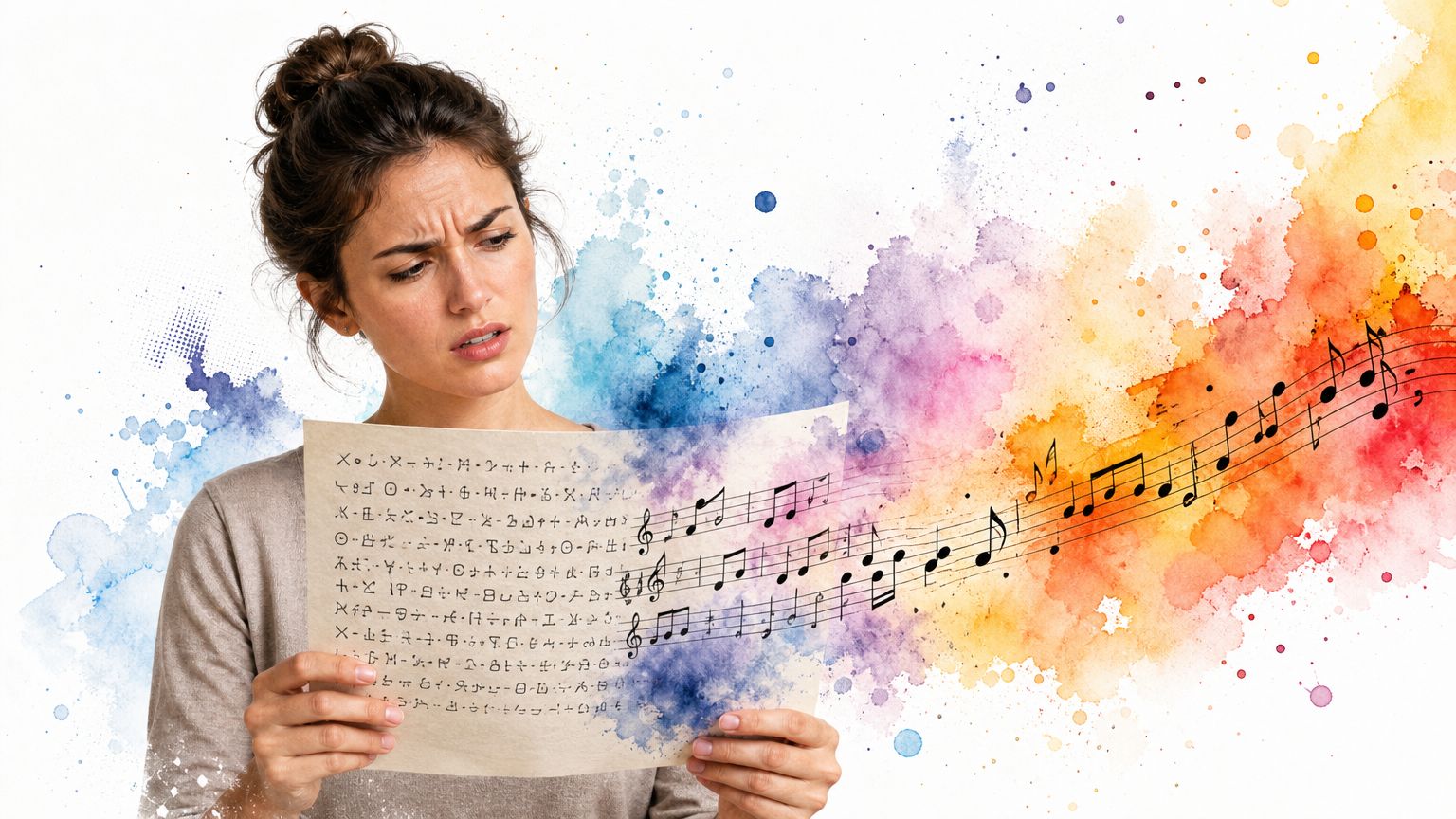
Most beginners think they're failing because they can't remember enough note names fast enough. That's rarely the problem. The problem is that they're trying to process pitch, rhythm, finger movement, and visual tracking as separate tasks instead of one connected skill.
The problem is usually the method
A lot of teaching starts with memorization tricks. Those can help at the very beginning, but they become a trap if you stay there. If every note has to be translated one by one, reading stays slow and fragile.
That's why some students can name notes on flashcards and still freeze when they open real music. The page moves in time. Reading has to move with it.
Practical rule: Don't judge your reading by how well you can recite note names away from the instrument. Judge it by whether you can keep going while the beat continues.
The same attention issue shows up in other kinds of reading too. If you tend to drift, reread, or lose your place, it helps to build better concentration habits outside music as well. Habit Huddle has a useful article on how to focus while reading that fits this part of the process.
Music reading is a language skill
The fastest readers in music don't decode everything as isolated symbols. They recognize relationships. They feel pulse. They see familiar shapes. They predict what's likely to come next.
That's why I teach music notation the way I'd teach a spoken language. First hear the beat. Then recognize a few common words. Then start seeing phrases. Fluency grows from pattern recognition, not from brute-force memorization.
A good reason to stick with it is that the skill reaches beyond your instrument. A 2024 study in Frontiers in Psychology found that learning to read music can strengthen the neural circuits used for reading words, suggesting the skill supports cognitive functions beyond music itself.
There's also a wider academic case for music learning. In a widely cited set of U.S. education statistics from the NAMM Foundation materials, schools with music programs had a 90.2% graduation rate and 93.9% attendance rate, compared with 72.9% graduation and 84.9% attendance in schools without music education. The same materials also report that students in top-quality musical programs scored 19% higher in English than students in schools without a music program.
That doesn't mean music reading becomes easy overnight. It does mean the work is worth doing, and it's learnable if you stop treating the page like a quiz and start treating it like communication.
Decoding the Language of Music The Staff Clefs and Notes
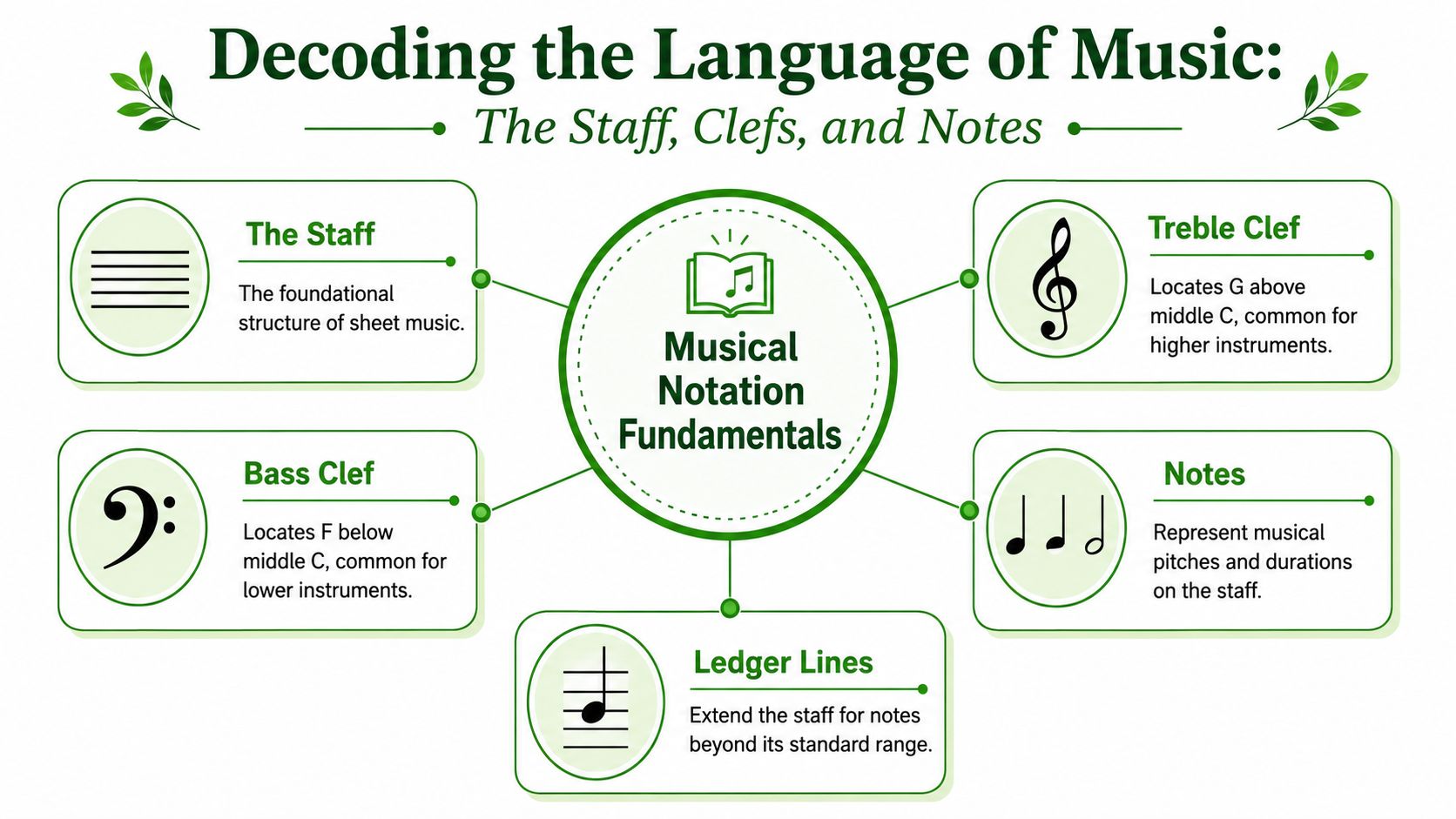
The page only stops looking mysterious once you understand what it's trying to show you. Sheet music is a map. The vertical position tells you pitch. The note shape helps tell you duration. Clefs tell you how to interpret the staff.
Start with the map not the trivia
The staff is five horizontal lines. Notes go on the lines and in the spaces. When notes extend above or below the staff, you use ledger lines.
The treble clef and bass clef are not decorations. They tell you where specific pitches live on the staff. Treble clef is common for higher instruments and the right hand of piano. Bass clef is common for lower instruments and the left hand of piano.
If you need a quick visual explanation before practicing, this short walkthrough helps:
Read by landmarks and distance
The mistake beginners make is trying to memorize every single staff position as a separate fact. That works slowly, if at all. Better instruction emphasizes converting notes into landmarks, intervals, and patterns rather than memorizing each note name in isolation, which can dramatically increase reading speed, as described in this expert note-reading lesson.
Here's the practical version of that idea.
| Reference point | Why it matters | What to notice next |
|---|---|---|
| Middle C | It connects both staves and gives you a central anchor | Whether the next note steps up, steps down, or skips |
| Treble G | It helps orient the upper staff quickly | The distance from G to nearby line and space notes |
| Bass F | It gives the lower staff a stable reference | Repeated interval shapes around it |
Once you know a few landmarks, stop asking “What note is this?” for every symbol. Start asking these better questions:
- Is it stepping or skipping
- Is the pattern rising or falling
- Is this a repeated shape I already know
- How far is this from my nearest landmark
Good readers don't solve the whole page from scratch. They identify a reference note and read outward from it.
What to learn first
Keep the order simple. Don't jump into hard repertoire before the basics are stable.
- Learn the staff and clefs. You need to know what system you're looking at.
- Learn note values and rests. Duration matters as much as pitch.
- Memorize a few landmark notes. Middle C, one or two treble anchors, one or two bass anchors.
- Practice intervals visually. Seconds, thirds, repeated notes, and simple skips.
- Read short examples on the page without staring at your hands. The eye needs to stay with the score.
That last point matters more than most beginners realize. If your eyes keep dropping to your fingers, the reading loop breaks. You stop decoding and start guessing from touch and muscle memory.
Mastering Rhythm and Timing Your Internal Clock
You sit down to play a simple line. The notes are familiar enough, but by the third measure the beat slips, you stop, and the whole thing feels harder than it should. That is a rhythm problem first, not a note problem.
Students can get through a beginner piece with a few wrong pitches. They rarely get through it if the pulse keeps breaking. Music reading works more like language than flashcards. The beat gives the sentence its flow, and rhythm gives every note a place to land.
Why rhythm should come first
A practical method is to train rhythm first and pitch recognition second.
I teach it this way because rhythm is easier to feel, repeat, and check. You can clap it, count it, walk it, or tap it on the music stand. Pitch takes longer because it depends on staff reading, hand position, and coordination. If both skills are weak at the same time, beginners overload fast.
Rhythm-first practice lowers that load. It gives the brain one clear job.
The basic note values are still the foundation:
- Whole note equals 4 beats
- Half note equals 2 beats
- Quarter note equals 1 beat
- Eighth note equals 1/2 beat
Rests count too. A silent beat still has shape, length, and placement.
One trade-off matters here. If students rush to add pitches because it feels more musical, they often build hesitation into their reading. If they spend a few minutes getting the rhythm solid first, the actual playing goes faster and sounds better sooner.
A simple rhythm routine
Start away from the instrument.
That may feel slower at first, but it saves time because it separates reading from finger problems. Use this order:
- Clap the rhythm while counting aloud.
- Keep a steady beat with your foot or hand so pulse and pattern stay separate.
- Use a metronome at a tempo that feels controlled, not impressive.
- Speak the count before playing so the rhythm is clear in your ear.
- Add pitches last after the timing stays steady for the full line.
This is how students build an internal clock. They stop treating rhythm as decoration and start treating it as structure.
A good test is simple. If you can clap and count a measure evenly, you understand it. If you can only play it after several guesses, you do not own it yet.
If the beat falls apart, the exercise is too hard for today. Slow it down and keep the pulse intact.
Another common mistake is stopping every time something goes wrong. That habit trains interruption. Reading requires continuity. Keep the beat going, finish the line, then return to the spot that caused trouble and fix it in isolation.
I tell students to protect the pulse at all costs in early reading work. A wrong note with steady time is recoverable. A broken beat usually causes the next mistake too.
One more practical tip helps. Count out loud longer than you think you need to. Silent counting sounds mature, but beginners usually drift when the voice disappears. Audible counting keeps the body honest and gives the eye something steady to follow.
You already know you can change.
You just need to take the first step. Habit Huddle helps you build habits around your goals, alongside friends who keep you accountable.
From Notes to Music Reading Patterns and Scales
Fluent readers don't see twenty unrelated notes. They see a scale fragment, a repeated rhythm, a broken chord, a sequence moving down by step. That's the shift that turns decoding into reading.
Stop reading one note at a time
If you name every note individually, your brain gets overloaded before your hands even start moving. Pattern reading reduces that load. Instead of five separate decisions, you make one.
A more nuanced view of music reading emphasizes pattern recognition and reading by genre or ensemble context, rather than only line-by-line note naming, especially for learners who want practical reading skills rather than full notation fluency. That perspective comes through clearly in this sight-reading discussion on functional music reading.
That matters because real-world reading changes with context. A choir singer, a guitarist reading charts, and a pianist reading a sonatina all use slightly different survival skills.
Patterns that show up everywhere
Start training your eye to catch shapes you'll meet constantly.
Scale motion
Notes move step by step, usually climbing or descending in a smooth line. Your eye should spot that contour immediately.Arpeggios
These are chord tones spread out one after another. On the page, they often look like skip-based shapes rather than smooth stepwise motion.Repeated rhythmic cells
If one bar's rhythm appears again, don't recalculate it. Recognize it and reuse it.Chord patterns
Stacked notes or familiar accompaniment figures often repeat with small changes.
The page gets easier the moment you stop seeing notes as separate dots and start seeing them as shapes with direction.
Use context to read faster
Key signatures help because they narrow the field. If you know the piece lives in a certain tonal area, fewer notes feel surprising. You don't need advanced theory to benefit from that. You just need to notice the musical environment before you start.
Ask these questions before playing:
| Question | Why it helps |
|---|---|
| Is the line mostly stepwise or full of skips | It tells your hands what kind of motion to expect |
| Are there repeated measures or sequences | Repetition reduces processing time |
| What style is this | Style hints at common rhythms and phrasing |
| Where are the difficult leaps | You can prepare visually before they arrive |
Another high-value skill is looking ahead. Your eyes should be slightly in front of your hands. One useful drill is to cover one bar at a time and force yourself to prepare the next bit mentally before it arrives. That reduces lag and builds predictive reading instead of reactive scrambling.
The Daily Practice Plan for Building Your Reading Habit
A student sits down on Sunday for forty minutes, works hard, then avoids the page for the next four days. By the next lesson, the note names are still there, but the reading feels stiff and slow again. That pattern is common because music reading is a language skill. It grows through frequent contact, not occasional effort.
Short daily sessions work better because they train recognition, timing, and eye movement together. The goal is not to memorize more isolated notes each day. The goal is to make the page feel familiar enough that your brain starts reading groups, rhythm shapes, and simple patterns without panic.

A short daily routine that works
When learning to read music, a repeatable structure is more effective than improvising each session.
Use a routine like this:
Two minutes of pulse work
Clap or tap one rhythm pattern at a time with a metronome. Keep it simple enough that you can stay steady without guessing.Three minutes of quick note orientation
Review a few landmark notes, then read by steps and skips from those anchors. This keeps note reading connected to direction, not flashcard-style memorization.Five minutes of easy sight-reading
Choose music below your playing level. If you are stopping every measure, the material is too hard for reading practice.One minute of repair work
Revisit one trouble spot after the read-through. Limit the fix. Reading improves faster when the session stays in motion.
That is enough for a productive beginner session. As your stamina improves, extend the easy reading portion first. Many students make the mistake of adding harder material instead, which turns a reading session back into a decoding session.
A practical weekly rotation
Use the same basic structure each day, but give each day a slightly different center of gravity. That keeps practice fresh without forcing you to invent a new plan every time you sit down.
| Day | Main emphasis | Secondary emphasis |
|---|---|---|
| Monday | Rhythm reading away from the instrument | Steady counting |
| Tuesday | Landmark notes and interval reading | Slow hands-separate reading |
| Wednesday | Short easy excerpts | Keeping the eyes moving forward |
| Thursday | Metronome reading at a calm tempo | Clean pulse through rests |
| Friday | Review of weak spots from the week | One fresh example |
| Saturday | Longer easy reading session | Enjoyable, familiar styles |
| Sunday | Light review or rest | Silent score study |
Consistency improves when the routine is visible and small enough to repeat on tired days. A simple planning system helps many students protect the habit before the day gets crowded. If you want a low-friction way to track sessions, this guide to choosing a habit tracker planner can help.
What Consistent Practice Looks Like
Set two practice targets.
Minimum session
The smallest version that still counts. That might be clapping rhythms, naming landmarks, and reading four measures.Full session
Your normal routine when you have time and focus.
Missed days usually come from oversized expectations, not lack of interest. A five-minute session still keeps the reading habit alive. In my teaching, students who protect the minimum improve more steadily than students who wait for the perfect thirty-minute window.
Choose material that feels easy enough to read forward. That can bruise the ego at first, especially for players who can perform harder music from memory. But reading fluency is built on continuity. If the page constantly forces you to stop, fix, and restart, you are practicing recovery, not reading.
Keep the bar low enough that you can succeed tomorrow too.
Essential Tools and Troubleshooting for Fluent Reading
At some point, many learners hit a strange plateau. They know the note names. They understand counting. Yet they still lose their place, restart constantly, or drift into playing from memory instead of from the page. That's where tools and troubleshooting matter.
Useful tools that support real reading
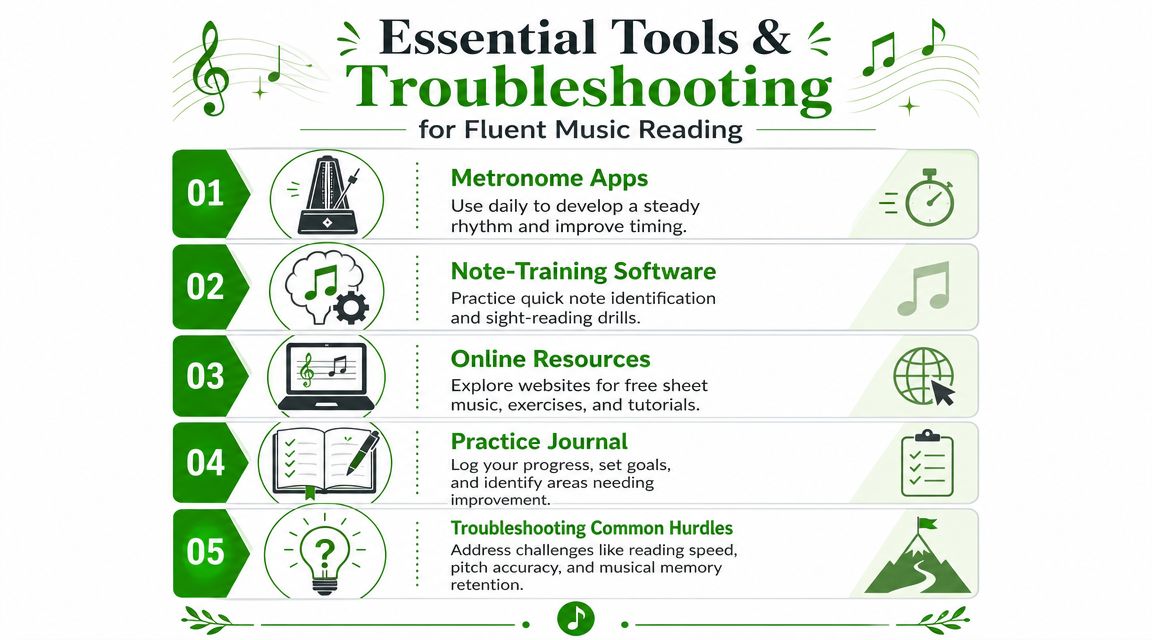
Not every tool is worth your time. Use tools that reinforce pulse, recognition, and repetition.
- Metronome apps help you build steady timing and stop unintentional rushing.
- Note-training software is useful for quick recognition drills, especially around landmarks and interval reading.
- Free sheet music libraries and graded exercise books give you easy material for daily reading.
- A plain notebook or digital practice journal helps you track what keeps breaking down.
What matters isn't novelty. It's whether the tool helps you read in real time.
When the issue is visual tracking not note knowledge
A major overlooked problem in music reading is that some struggles come from visual-perception and oculomotor difficulties, not from lack of musical understanding. A specialist perspective on visual music reading difficulties notes that generic advice like “go slower” often doesn't solve the problem for learners who lose their place, backtrack, or depend on muscle memory instead of decoding.
Signs this might be happening:
- You can name notes correctly but still can't stay on the line
- Your eyes jump backward even in easy examples
- You feel lost in dense notation
- You play better from memory than from the score almost immediately
Sometimes the bottleneck isn't knowledge. It's tracking.
What to do when you keep breaking flow
Use physical supports first. They're simple and often effective.
| Problem | Practical fix |
|---|---|
| Losing your line | Use a notecard or window card to reveal only one staff at a time |
| Backtracking repeatedly | Cover earlier measures so your eyes can't retreat |
| Looking down at your hands too often | Practice very easy material and force your gaze to stay on the score |
| Freezing after mistakes | Keep going to the end of the phrase, then isolate the error |
If you want added accountability while building any daily practice routine, including music reading, Habit Huddle's guide to choosing an accountability partner app offers a practical way to think about consistency and follow-through.
Fluent reading grows from small corrections repeated often. Better rhythm. Better landmarks. Better visual tracking. Better follow-through after mistakes. None of that is glamorous, but it works.
If you want a simple way to make music reading practice stick, Habit Huddle gives you a clear daily check-in, a Minimum goal for busy days, and built-in accountability with other people. That's useful when your biggest challenge isn't knowing what to practice, but showing up often enough for the skill to compound.
Ready to Build Habits With Friends?
Stop failing alone. Join thousands using the #1 habit tracker with friends for real accountability and lasting results.
Prefer mobile? App Store · Google Play
Related Guides
More Habit Huddle articles on building habits with accountability.

HabitShare Alternatives: 6 Apps for Tracking Habits With Friends (2026)
Looking for a HabitShare alternative? Six social habit trackers compared by model, price, platforms, and what happens on a missed day, plus how to switch wit...
What to Do When You Miss a Workout Day: The 5-Step Comeback Plan
Missed a workout day? What one miss does to your body and habit, according to research, plus a five-step plan for the next 24 hours, when to make it up, and...
Habit Streak App With Friends: 7 Apps Compared (2026)
Seven habit streak apps with friends compared: Habit Huddle, HabitShare, Daily Pact, Habitica, Streaks, Habit Streak duels, HabitStreak.io. What friends see,...