
Habit Tracker Online: The 7 Best Browser-Based Options (2026)
Compare the 7 best online habit trackers of 2026: which ones truly run in your browser, which stay free, and which help you keep habits with friends.

Most "habit tracker online" lists are actually lists of phone apps. If you typed that search, you probably want the other thing: a tracker that opens in a browser tab on any computer, with nothing to install.
Here is the short answer. In 2026 the best truly online habit trackers are Habi for instant no-signup tracking, Habitify for a polished web app that syncs to your phone, OpenHabitTracker for free open source control, and Habit Huddle for keeping habits with friends instead of alone.
The rest of this guide sorts the popular options by the test that matters: does it really run in your browser, what does the free version include, and will you still be using it in month three.
What counts as a habit tracker online
An online habit tracker is one you can open and update from a browser, so your record lives on the web instead of on one device. By that test, a surprising number of famous habit apps do not qualify.
The options fall into three groups:
Instant browser tools. Pages that let you start tracking immediately, sometimes without an account. Fastest to try, lightest on features.
Full web apps. You create an account, and the tracker syncs between the browser and mobile apps. Best when you log from both a computer and a phone.
DIY templates. Notion boards, spreadsheets, and printable grids. Infinitely flexible, but you are the one maintaining the system.
Browser extensions are a fourth, smaller category. A Chrome habit tracker lives in your toolbar, which is convenient until you switch browsers or sit down at a different machine.
Mobile-only favorites like Loop, Streaks, and Productive are excellent apps, but they are not online trackers. If your day happens at a desk, that difference decides whether you actually log anything.

The 7 best online habit trackers in 2026
| Tracker | Runs in browser | Free version | Built-in social | Also on mobile |
|---|---|---|---|---|
| Habi | Yes, no signup | Yes | No | No |
| everyday | Yes | Trial, then paid | No | iOS, Android |
| Habitify | Yes | Yes, limited habits | Challenges | iOS, Android, macOS |
| OpenHabitTracker | Yes | Fully free, open source | No | Android, iOS, desktop |
| Notion templates | Yes | Yes | Shared pages only | Via Notion apps |
| Loop | No, Android only | Fully free, open source | No | Android |
| Habit Huddle | Yes | Yes | Groups, cheers, Discord | iOS, Android, Discord |
Habi
Habi is the fastest way to start tracking a habit online: the tracker page itself is the product, and you can add your first habit without creating an account.
You get daily streaks, goals, and a visual heatmap in a clean interface. For one person tracking a few habits with zero setup cost, it is hard to beat.
The trade-off is depth. Habi is a solo tool, so there are no reminders pinging your phone by default and nobody else sees your progress. It suits self-starters who mainly need a visible record.
everyday
everyday is built around one idea: a wall of colored squares that fills as you repeat a habit, visible on the web and on mobile. The grid is genuinely motivating if long unbroken runs keep you going.
It is a paid product after the trial, which also means no ads and a maintained app. Check current pricing on their site before committing.
The same all-or-nothing grid that motivates some people demoralizes others. One rough week leaves a visible hole, and everyday offers little softening around that.
Habitify
Habitify is the most complete conventional habit app on this list with a real web version. It syncs across browser, iOS, Android, and macOS, and the company reports millions of users.
You get timed habits, notes, stats, and monthly challenges that add a competitive layer with friends. The free tier covers a small number of habits, with a subscription unlocking the rest.
It is a solo tracker at heart. The challenges are a leaderboard, not a group that knows you, so treat the social layer as seasoning rather than the meal.
OpenHabitTracker
OpenHabitTracker is the option for people who want their habit data fully under their own control. It is free, open source, and runs in the browser plus Windows, Android, iOS, macOS, and Linux.
It combines notes, tasks, and habit tracking in one app, and you can even self-host it. No subscription will ever appear between you and your data.
The trade-off is polish. It is a community project, so the interface is more utilitarian than the paid apps, and support means a GitHub page rather than a help desk.
Notion habit templates
A Notion habit tracker is the right choice when you already live in Notion and want habits next to your notes and projects. Hundreds of free templates give you daily, weekly, and monthly grids in one click.
The strength is flexibility. You can track anything, annotate anything, and reshape the system whenever you like. We compared the main approaches in our guide to the habit tracking template formats that actually get used.
The weakness is that Notion does nothing automatically. Nothing nudges you, and an abandoned template quietly becomes another archived page. DIY trackers work best for people who enjoy maintaining systems.
Loop Habit Tracker
Loop is the app Reddit recommends in nearly every free-habit-tracker thread, and the praise is earned: it is free, open source, ad-free, with detailed charts and a forgiving streak model.
It is on this list as the honest asterisk. Loop is Android-only with no web version, so it fails the "online" test this page is about.
If you are on Android and want a private, subscription-free tracker, install Loop. If you need to log from a browser or an iPhone, look at OpenHabitTracker or the web apps above. If streak pressure is exactly what you are escaping, our Streaks app alternative guide covers gentler options.
You already know you can change.
You just need to take the first step. Habit Huddle helps you build habits around your goals, alongside friends who keep you accountable.
Habit Huddle
Habit Huddle is our app, so read this entry knowing that, and judge the reasoning. It exists because the hardest part of a habit is rarely the logging, it is staying consistent past week three, and that is where friends help.
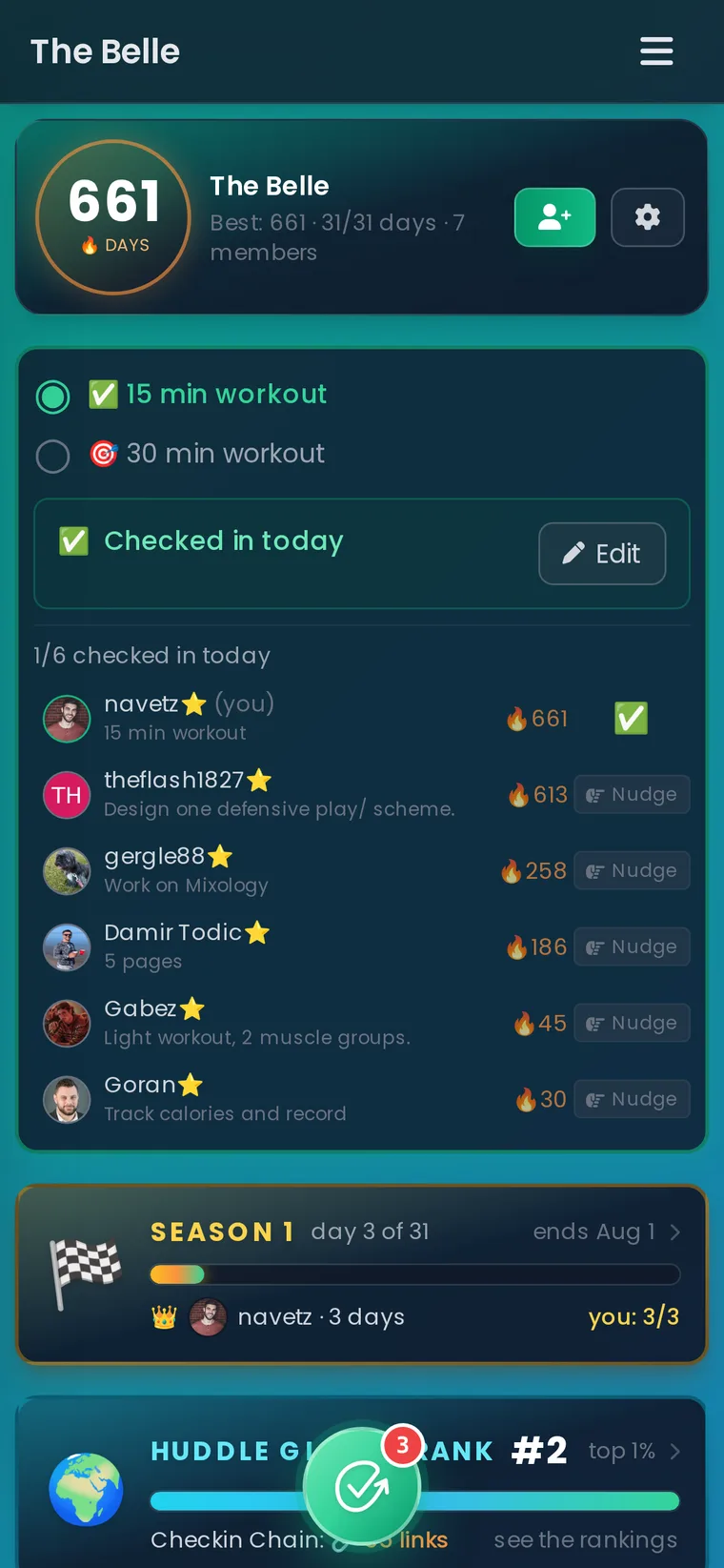
You track habits in a huddle, a small group keeping their own habits alongside you. Each checkin is a link in the group's Checkin Chain, and friends cheer you for showing up. Each habit gets a Floor, the minimum that counts on a busy day, and a Ceiling to burst through when you have more in you, which kills the all-or-nothing spiral that breaks grid trackers.
It runs in any browser, on iOS and Android, and inside Discord, so a server you already hang out in can double as your accountability group. The free version covers tracking with a huddle.
The trade-off: Habit Huddle is built for tracking with other people. If you want a purely solo, silent grid, Habi or everyday will feel lighter.
How to choose one you will still use in month three
Pick your online habit tracker for month three, not day one. In a University College London study, new habits took 66 days on average to become automatic, with a range of 18 to 254 days, so whatever you choose has to survive months of ordinary, unmotivated days.
The evidence says tracking itself is worth the effort. A meta-analysis of 138 experiments found that prompting people to monitor their progress reliably improved goal attainment, and that the effect grew when progress was recorded or reported to someone else.
That points to a simple sorting question: what actually keeps you logging?
If friction stops you, choose the lightest tool you will really open. Habi or a browser extension wins here.
If data keeps you engaged, choose Habitify or OpenHabitTracker and enjoy the charts.
If accountability keeps you honest, choose a social tracker. That reported-progress effect from the meta-analysis is the whole design idea behind Habit Huddle, and it is why we also keep a list of the best free internet accountability apps if you want to compare the category.
A tracker only earns its place on the days you do not feel like opening it.

Try tracking a habit with people who cheer for you
If solo grids have never carried you past week three, try the social route. Start a habit on Habit Huddle, set a Floor you can hit on your worst day, and invite one or two friends to keep theirs alongside you.
It is free to start, works in the browser you are reading this in, and every checkin gets seen and cheered instead of vanishing into a chart. For a broader comparison of tools first, our best habit tracker app page lines up the whole market.
FAQ
What is the best free habit tracker online?
Habi is the best free option for instant solo tracking because you can start in the browser without an account. OpenHabitTracker is the best fully free option long term, being open source with no subscription, and Habit Huddle's free version is the pick if you want to track online with friends.
Can I track habits online without downloading an app?
Yes. Habi, Habitify, OpenHabitTracker, and Habit Huddle all run in a normal browser tab, and Notion templates work in any browser with a Notion account. Mobile-only trackers like Loop and Streaks cannot be used this way.
Which habit trackers have no subscription at all?
Loop Habit Tracker on Android and OpenHabitTracker everywhere are free and open source with no subscription. Most polished web trackers, including everyday and Habitify's full feature set, charge for premium.
How long does it take for a tracked habit to stick?
Research from University College London found habits took 66 days on average to become automatic, with a range of 18 to 254 days depending on the person and the behavior. Plan for months of tracking rather than a 21-day sprint, and pick a tracker you can tolerate for that long.
Ready to Build Habits With Friends?
Stop failing alone. Join thousands using the #1 habit tracker with friends for real accountability and lasting results.
Prefer mobile? App Store · Google Play
Related Guides
More Habit Huddle articles on building habits with accountability.

HabitShare Alternatives: 6 Apps for Tracking Habits With Friends (2026)
Looking for a HabitShare alternative? Six social habit trackers compared by model, price, platforms, and what happens on a missed day, plus how to switch wit...

What to Do When You Miss a Workout Day: The 5-Step Comeback Plan
Missed a workout day? What one miss does to your body and habit, according to research, plus a five-step plan for the next 24 hours, when to make it up, and...

Habit Streak App With Friends: 7 Apps Compared (2026)
Seven habit streak apps with friends compared: Habit Huddle, HabitShare, Daily Pact, Habitica, Streaks, Habit Streak duels, HabitStreak.io. What friends see,...