
7 Team Goals Examples for 2026: A SMART Guide
Explore 7 actionable team goals examples. Learn to set SMART goals with metrics and accountability tips to boost productivity and wellness in 2026.
Most team goals fail because they aren't goals. They're slogans with a deadline. A manager announces them in a kickoff meeting, someone drops them into a spreadsheet, and the team revisits them only when performance slips. That approach sounds organized, but it leaves out the two things that effectively keep a group moving: visible progress and a repeatable checkin rhythm.
The popular advice doesn't help much. SMART goals are useful, and modern team-goal practice has been shaped heavily by SMART and OKR systems because they make goals measurable and reviewable, but teams still stall when nobody owns the daily behavior behind the metric (FranklinCovey on effective team goals). A peer-reviewed study also found that clear goals were associated with higher team effectiveness, and that self-management further improved effectiveness, which matches what most experienced team leads already see in practice: clarity matters, but autonomy matters too (peer-reviewed study on goal clarity and team effectiveness).
That's why I don't treat team goals as one-off projects. I treat them as collective habits. The strongest team goals examples don't just say what success looks like. They make showing up visible, give people a fallback on low-energy days, and create social momentum through simple checkins. That's where Habit Huddle's two-tier system is useful: a Minimum keeps the streak alive, and a Daily Goal gives the team something to stretch toward.
Table of Contents
- 1. Daily Workout Consistency Goal
- 2. Reading Goal
- 3. Hydration Goal
- 4. Productivity Writing Goal
- 5. Mindfulness Meditation Goal
- 6. Study Focus Goal
- 7. Stretch and Mobility Goal
- 7-Point Team Goals Comparison
- From Goals to Habits Your Team's Next Step
1. Daily Workout Consistency Goal
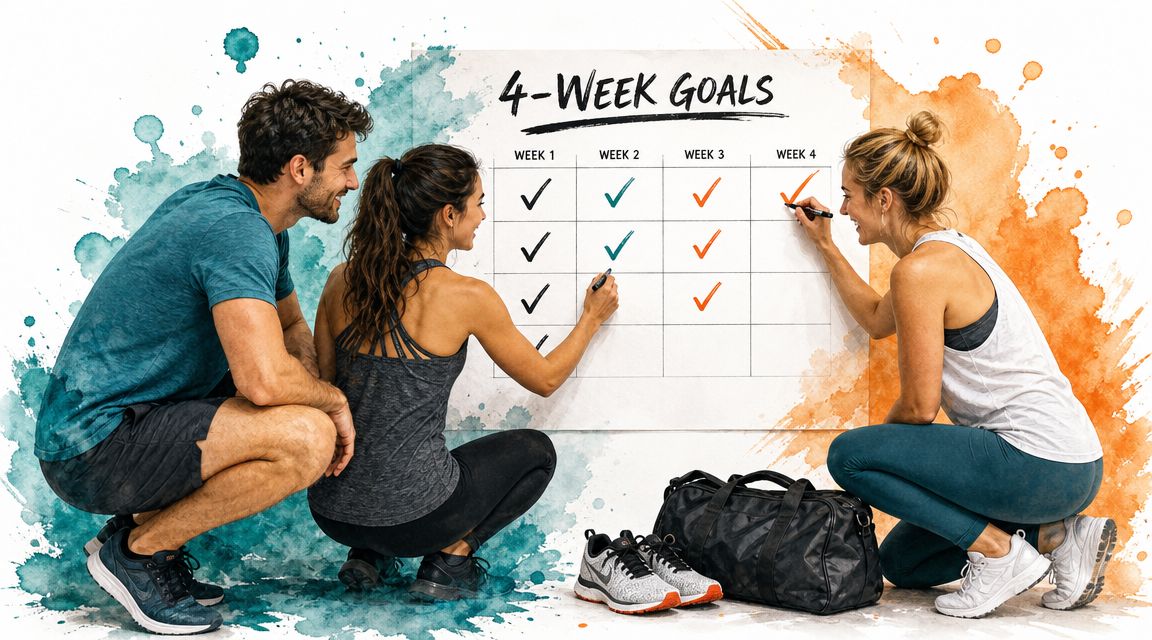
A strong fitness goal for a group is simple: train 5 days per week for 4 weeks, with a Minimum of 3 days to protect consistency when life gets messy. That structure stops the all-or-nothing spiral that ruins most team fitness challenges by week two.
This works well for CrossFit boxes, running clubs, personal training clients, and creator-led fitness communities on Discord. Everyone knows what counts, everyone posts checkins on the same cadence, and nobody gets knocked out of the challenge because they had one rough week.
Define the floor before you chase the ceiling
The mistake is setting only the stretch target. Teams say “we work out five days a week now” and leave no room for travel, soreness, family obligations, or workload spikes. A two-tier setup fixes that. The Daily Goal is 5 days. The Minimum is 3.
Practical rule: Define “workout” before day one. A strength session, a run, a class, or a programmed conditioning block can all count, but the team needs one shared definition.
Use Habit Huddle's Group Consistency Rating to make participation visible. That matters more than people think. In hybrid and distributed settings, coordination breaks down when progress lives in private notes. Guidance on hybrid work points out that teams increasingly need visible ownership and progress checkpoints across locations, especially as work patterns have shifted well beyond full on-site routines (Predictive Index on setting team goals for modern work).
A few setups I've seen work:
- Gym communities: Coaches post the daily workout in Discord and members post a checkin after training.
- Running groups: Members log whether they completed the planned run, not just total mileage.
- Client cohorts: Trainers review weekly consistency instead of obsessing over one heroic session.
- Streamer challenges: Community leaders use a bot to trigger reminders and keep momentum public.
If you're building this inside a habit system, a workout accountability app for group checkins makes the routine much easier to sustain than a spreadsheet.
2. Reading Goal

Vague reading goals waste group energy. Teams say they want to “read more,” then everyone picks a different pace, skips updates, and disappears by week two. A reading habit works better when the target is specific and the accountability is shared: read 20 pages a day, 5 days a week, for 8 weeks, with one Daily Goal checkin and one Minimum checkin if the day goes sideways.
That setup fits book clubs, professional development groups, university reading circles, and remote teams running a learning sprint. It gives the group one clear question to answer each day. Did you hit the pages or not?
The stronger move is to treat reading as a collective habit, not a private intention. Habit Huddle's two-tier checkin system gives teams room for real life without letting the goal get fuzzy. The Daily Goal can be 20 pages. The Minimum can be 10. That keeps the streak alive on heavy workdays and still protects the habit.
Practical rule: Agree on what counts before the first checkin. Pages from the assigned book count. Skimming summaries, listening at double speed, or hopping between three unrelated books usually should not, unless the group decides otherwise.
Reading groups also need one social layer beyond the page count. Otherwise people start optimizing for volume instead of comprehension. A short weekly discussion thread, voice note, or call fixes that. The daily checkin builds consistency. The weekly conversation shows whether the reading is sinking in.
I usually split Huddles by reading load, not just topic. A team working through short business books can use a simple page target. A cohort reading technical material, academic papers, or dense nonfiction may need a lower page target and a stronger Minimum. Equal page counts do not mean equal effort.
If your team is still deciding what “realistic” looks like, this guide on how many pages a day you should read helps set a pace people can keep.
3. Hydration Goal
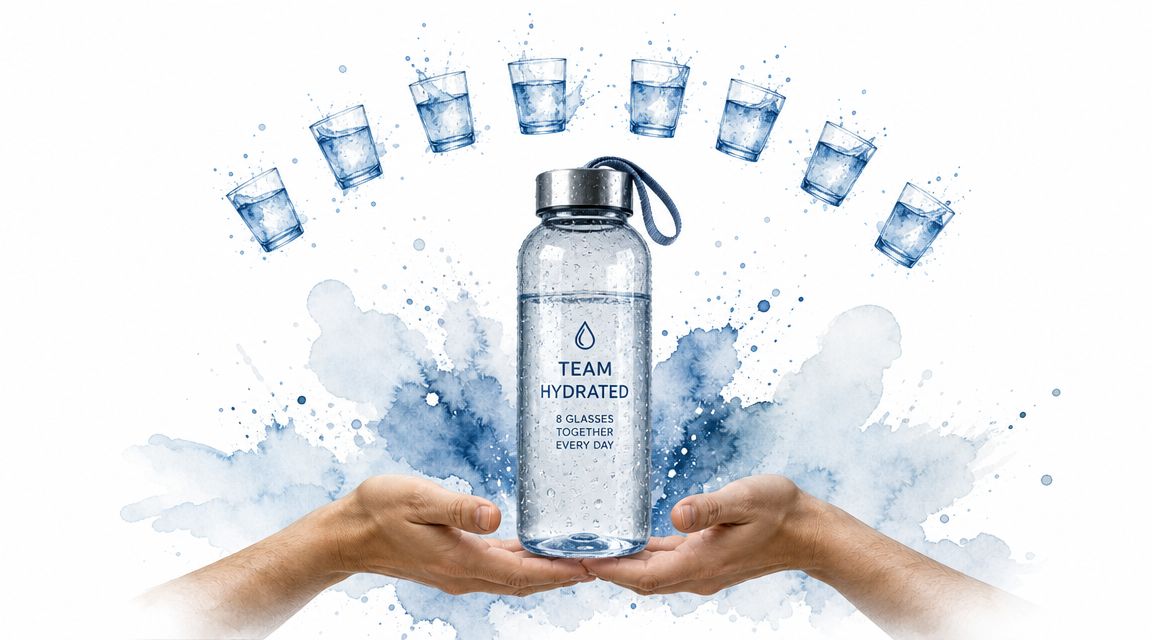
Hydration is one of the best team goals examples for beginners because the tracking is low friction. Drink 8 glasses daily, 7 days per week, for 30 days. That's clear, binary, and hard to misunderstand once the group agrees on what counts as one glass.
This format fits workplace wellness challenges, couples trying to improve routines together, online wellness communities, and fitness groups that want one easy win alongside training.
Use friction-free rules
Hydration challenges go sideways when people make the log more complicated than the habit. Don't build a scoring system. Don't create bonus categories. Just define one glass, choose checkin times, and keep the rule stable for the full month.
A practical setup looks like this:
- Morning anchor: Drink the first glass soon after waking.
- Meal anchor: Tie glasses to breakfast, lunch, and dinner.
- Work-break anchor: Add water during natural calendar breaks.
- Exercise anchor: Count pre- and post-workout hydration separately so nobody forgets it.
The social side matters here. People don't need a lecture on hydration. They need a visible streak and a small nudge from peers. That's why this kind of goal works so well in a shared Huddle. A teammate misses one day, notices the group checked in, and gets back on track before one miss turns into a dead habit.
One more trade-off. I wouldn't pair this challenge with too many other new habits at once. Hydration is a good “easy yes” goal. It loses that advantage if you pile on sleep tracking, meal logging, workouts, and meditation in the same month.
4. Productivity Writing Goal
Writing goals collapse when teams track output too late. If a team waits to measure progress by finished articles, a completed thesis chapter, or a polished paper draft, they won't know there's a problem until the deadline is close. A better team habit is 500 words per day, 5 days per week, for 12 weeks, with a Minimum of 3 writing days.
This works for content teams, MFA cohorts, academic writing groups, newsletter creators, and novelists who need a reliable draft habit instead of occasional bursts of inspiration.
Protect the draft habit
The key decision is what counts as writing. Drafting counts. Outlining can count if the team agrees. Editing usually shouldn't count unless the project is already in a revision phase. If you blur those lines, people start reorganizing notes instead of producing pages.
A simple rhythm is best. Writers post a checkin after the session with word count and a brief note on what moved forward. The checkin shouldn't become a mini performance review.
Coach's note: Teams that write consistently usually lower the bar for starting, not raise the bar for perfection.
That's where a two-tier system helps. The Daily Goal is the stretch target. The Minimum keeps the habit alive when the day gets crowded, as consistency usually breaks during low-motivation periods, and most goal examples ignore that. Research on habit formation found the average time to reach asymptotic habit automaticity was 66 days, with a wide range from 18 to 254 days, which is a useful reminder that routines need fallback rules before they feel automatic (Tability on team goals and habit formation).
For writers who need peer structure, an accountability partner app for daily progress can turn isolated writing into a group routine.
You already know you can change.
You just need to take the first step. Habit Huddle helps you build habits around your goals, alongside friends who keep you accountable.
5. Mindfulness Meditation Goal
Meditation is where teams often overcomplicate the setup. They debate techniques, apps, session types, and whether silence “counts.” Don't start there. Start with 10 minutes daily for 90 days and use a yes-or-no checkin.
That's enough structure for executive coaching cohorts, wellness groups, couples, and online mindfulness communities. Some people will use Headspace, Calm, or Insight Timer. Others will sit in silence. The team doesn't need one method. It needs one consistent practice window.
Short practices win
A daily meditation goal should feel almost too small. That's the point. If the target is ambitious enough to sound impressive, many people won't protect it when the day gets chaotic.
I like to pair this goal with an immediate checkin right after the session. Delay the checkin and people forget. For groups, weekly shared sessions help too, especially when motivation dips.
A few rules keep it clean:
- Keep the unit simple: Track minutes completed, not “depth” or quality.
- Separate methods if needed: Guided and silent groups can run in different Huddles.
- Use milestone recognition: Celebrate consistency at meaningful intervals without making it competitive.
- Link it to a cue: After waking, after lunch, or before bed works better than “whenever.”
This is also one of the strongest examples of why team goals should reinforce behavior, not just identity. Plenty of teams like the idea of being calmer or more focused. Fewer teams build a daily ritual that makes that identity real.
6. Study Focus Goal
For students, “study more” is almost useless. It produces guilt, not action. A better target is 3 focused study sessions daily, 5 days per week, over a semester, with a Minimum of 2 sessions on difficult days.
That format is strong for university study groups, test-prep cohorts, tutoring programs, and Discord study servers. It gives people something they can complete today without guessing what “enough” means.
Track sessions, not vague effort
The first rule is to define a focused session. Phone away. Notifications off. One subject or one task list. If the team doesn't define that standard, members will log distracted half-work and call it progress.
This kind of goal matters even more for modern teams and study groups that coordinate remotely. Work and collaboration are increasingly distributed, and practical guidance has noted that only 32.6% of U.S. workers were fully on-site in 2023, while 11.1% were fully remote and 55.8% were hybrid, which is why visible coordination rituals and checkpoints matter so much now (Predictive Index on distributed-team goal setting).
A few implementation choices make a difference:
- Midday checkin: Best for prompting the third session before the evening disappears.
- Subject-specific Huddles: Useful when a group studies very different material.
- Exception rules: Exam weeks may need a modified minimum instead of a total reset.
- Location cues: The same library seat or desk setup reduces start-up friction.
The trade-off is rigidity. A semester is long. If the system feels punishing after one disrupted week, students quit. Keep the structure tight, but leave just enough flexibility for real life.
7. Stretch and Mobility Goal
Vague wellness goals fail fast here. “Stretch more” sounds reasonable, then turns into something people mean to do after a workout and skip the moment time gets tight. A better team goal treats mobility as a shared recovery habit. Set the target at 15 minutes a day, 6 days a week, for 8 weeks, with Habit Huddle checkins that keep it visible and a Minimum of 3 days to protect continuity during busy weeks.
This works well for athletic teams, desk-heavy workplace groups, yoga communities, and recovery-focused fitness cohorts. It also solves a common problem in strength programs. People finish the hard part, then cut the recovery work first.
Make recovery visible
Mobility only sticks when the standard is obvious. If each person has to build a new sequence every day, the habit dies in the setup. Give the team a default routine with three clear options: upper body, lower body, or full body. Then use Habit Huddle's two-tier system to separate the goal from the fallback. Members post a checkin for the full 15-minute session when they complete it. They still have a lower bar available on disrupted days, which keeps the social accountability alive without pretending a missed week is fine.
Here's a setup I've seen work well. A lifting group runs one Huddle for training sessions and a second for mobility. The workout Huddle measures output. The mobility Huddle measures recovery behavior. That split matters because it stops stretching from getting buried inside a bigger fitness goal.
Use this clip as a shared starting point for the group routine:
The best mobility goal is the one your team will still do on a tired Thursday, not the one that looks impressive on paper.
Different modalities can count if the rule is tight. Yoga, foam rolling, and static stretching all fit under one mobility goal when the team agrees on minimum time, acceptable formats, and how to log the session. That flexibility helps adherence. Too much flexibility turns the goal into guesswork.
7-Point Team Goals Comparison
| Goal | Implementation Complexity ???? | Resource Requirements ⚡ | Expected Outcomes ???? | Ideal Use Cases ???? | Key Advantages ⭐ |
|---|---|---|---|---|---|
| Daily Workout Consistency (4 wks, 5/wk) | Moderate ???? (daily planning, group coordination) | Moderate ⚡ (workout time 20–60 min/day; access to equipment; community participation) | High ????⭐ (improved fitness, sustained routine, reduced dropout) | Group fitness programs, gyms, running clubs, streamer community challenges | Peer accountability, flexible two-tier system, visible momentum |
| Reading Goal (20 pages/day, 8 wks) | Low ???? (daily time commitment, minimal logistics) | Low ⚡ (books/ebooks; ~30–45 min/day) | High ????⭐ (sustained reading habit; ~800 pages in 8 weeks) | Students, book clubs, corporate L&D, coaching cohorts | Accessible, adjustable pace, encourages discussion and reduced screen time |
| Hydration Goal (8 glasses/day, 30 days) | Very Low ???? (simple binary checkin) | Minimal ⚡ (water, reminders; ~5 sec/day) | Moderate ???? (immediate health benefits; strong streak psychology) | Corporate wellness, teams, families, online wellness communities | Extremely low friction, quick wins, supports other health goals |
| Productivity Writing (500 words/day, 12 wks) | Moderate ???? (daily output + scheduling for creativity) | Moderate ⚡ (20–30 min/day; quiet workspace) | High ????⭐ (meaningful cumulative output; ~30k words in 12 weeks) | Authors, content teams, MFA cohorts, academic writers | Measurable progress, builds publishable output, accountability for solo work |
| Mindfulness Meditation (10 min/day, 90 days) | Low ???? (short daily practice; habit-building) | Minimal ⚡ (10 min/day; optional apps) | High ????⭐ (improved focus, stress resilience over 90 days) | Corporate wellness, coaching, mental health groups, individuals | Evidence-based benefits, low barrier, synergizes with other goals |
| Study Focus (3x50min/day, 16 wks) | High ???? (intensive daily time-blocking & verification) | High ⚡ (≈2.5 hr/day; quiet space, study materials) | High ????⭐ (improved retention and semester performance) | University students, test-prep cohorts, online course learners | Pomodoro-style focus, reduces procrastination, early identification of struggling students |
| Stretch & Mobility (15 min/day, 8 wks) | Low ???? (short routine; consistent daily practice) | Low ⚡ (15 min/day; mat, guided routines) | Moderate ????⭐ (range-of-motion gains, pain reduction in weeks) | Rehab programs, yoga/mobility communities, desk-bound professionals, athletes | Injury prevention, low intensity, complements strength training |
From Goals to Habits Your Team's Next Step
The gap between a team goal and a team habit is where most groups lose momentum. They set a target, but they don't build the daily behavior that gets them there. That's why the team goals examples above work better than broad quarterly declarations. Each one translates ambition into a repeatable action, a visible checkin, and a shared standard for what counts.
That structure matters because goal clarity has been linked with stronger team effectiveness, and self-management improves the picture further when teams have room to own the work (peer-reviewed research on team effectiveness and goal clarity). In practice, that means two things. First, be specific. Second, don't confuse management with constant supervision. Teams do better when the target is clear and the execution rhythm is shared.
The habit-based approach is also more realistic than the usual “all-in” challenge model. Daily performance levels vary. Energy shifts. Schedules change. Motivation dips. Good team goals account for that with a Minimum that protects consistency and a Daily Goal that encourages stronger days without making weaker days feel like failure.
If you're leading a team, don't launch seven goals at once. Pick one. Define what completion looks like. Set the checkin time. Make the progress visible. Then keep the rhythm long enough for the group to stop negotiating with itself every day.
That last part matters more than many groups anticipate. The strongest accountability systems don't rely on hype. They rely on repetition. A small action done together, in public, on a steady cadence will beat a dramatic kickoff speech almost every time.
So start with the habit your group is most likely to sustain. A workout team can begin with attendance. A study group can track sessions. A writing cohort can log words. Keep it narrow, visible, and social. That's how team goals stop being ideas and start becoming part of how your group operates.
Habit Huddle gives teams a practical way to run goals as habits instead of one-time campaigns. If you want a simple system for Minimum and Daily Goal checkins, visible streaks, and group accountability across iOS, Android, web, and Discord, try Habit Huddle and set up your first Huddle in minutes.
Ready to Build Habits With Friends?
Stop failing alone. Join thousands using the #1 habit tracker with friends for real accountability and lasting results.
Prefer mobile? App Store · Google Play
Related Guides
More Habit Huddle articles on building habits with accountability.

HabitShare Alternatives: 6 Apps for Tracking Habits With Friends (2026)
Looking for a HabitShare alternative? Six social habit trackers compared by model, price, platforms, and what happens on a missed day, plus how to switch wit...
What to Do When You Miss a Workout Day: The 5-Step Comeback Plan
Missed a workout day? What one miss does to your body and habit, according to research, plus a five-step plan for the next 24 hours, when to make it up, and...
Habit Streak App With Friends: 7 Apps Compared (2026)
Seven habit streak apps with friends compared: Habit Huddle, HabitShare, Daily Pact, Habitica, Streaks, Habit Streak duels, HabitStreak.io. What friends see,...