
How Many Calories Does a Push Up Burn? (About 0.3 Per Rep)
One push up burns about 0.3 calories (range 0.2 to 0.4 by weight and effort). Get the per-minute numbers and the formula for your own weight.
A single push-up burns about 0.3 calories on average for a person weighing 70 kg (154 lbs), with a typical range of 0.2 to 0.4 calories per rep depending on body size and effort. But the precise answer isn't one fixed number. It's a formula shaped by your weight, your pace, and how demanding each rep is.
That's where most advice on this topic goes wrong. It throws out one neat number, then acts like everyone burns the same amount doing the same rep count. In practice, a clean, controlled push-up done with full range of motion costs more energy than a rushed half-rep, and a heavier athlete usually burns more than a lighter one doing the same set.
If you want a useful answer to how many calories does 1 push up burn, stop chasing a universal number. Learn what drives the number, then use that to estimate your own burn and improve it over time.
Why 'One Push-Up' Is the Wrong Question to Ask
The question sounds precise, but it isn't. Asking “how many calories does 1 push up burn” is like asking how much fuel one mile uses without telling me the car, the speed, or the road. You can give a rough estimate, but you can't give a personal answer without context.
The common estimate is useful as a starting point. For a person around 70 kg, one push-up burns about 0.3 calories on average, with a realistic range of 0.2 to 0.4 calories per rep depending on intensity and body mass, based on the standard calculation used by the push-up calories calculator at Sport Calculator. That's good baseline information. It's not the full picture.
What matters more than one rep is the combination of variables behind the rep.
The variables that change the answer
- Your body weight: Moving more mass usually requires more energy.
- Your effort level: A slow, strict set and a fast, casual set don't cost the same.
- Your form: Full range of motion asks more from the chest, shoulders, triceps, and core.
- Your workout structure: Sets with short rest feel very different from scattered reps through the day.
Practical rule: Don't treat per-rep calorie burn as a scoreboard. Treat it as an estimate that helps you compare one session to another.
There's also a bigger trade-off people miss. Push-ups are excellent for upper-body strength endurance, trunk stiffness, and training convenience. They are not a magical fat-loss shortcut on their own. If your main goal is weight loss, the better question is whether your overall routine creates enough repeated effort across the week to matter.
That shift in thinking helps. Instead of obsessing over one rep, you start asking better questions. How hard am I working. How long am I sustaining it. How often am I showing up.
The Science Behind Calorie Burn From Push-Ups
A single per-rep calorie number sounds tidy, but exercise physiology does not work that neatly. Coaches estimate push-up calorie burn with METs, short for Metabolic Equivalent of Task, because METs account for effort over time instead of pretending every rep costs the same.
Push-ups can land in very different MET ranges depending on pace, range of motion, and how much tension you keep through the set. A loose set of half reps done casually is one thing. A strict set with full depth, a braced trunk, and short rest asks much more from the body.
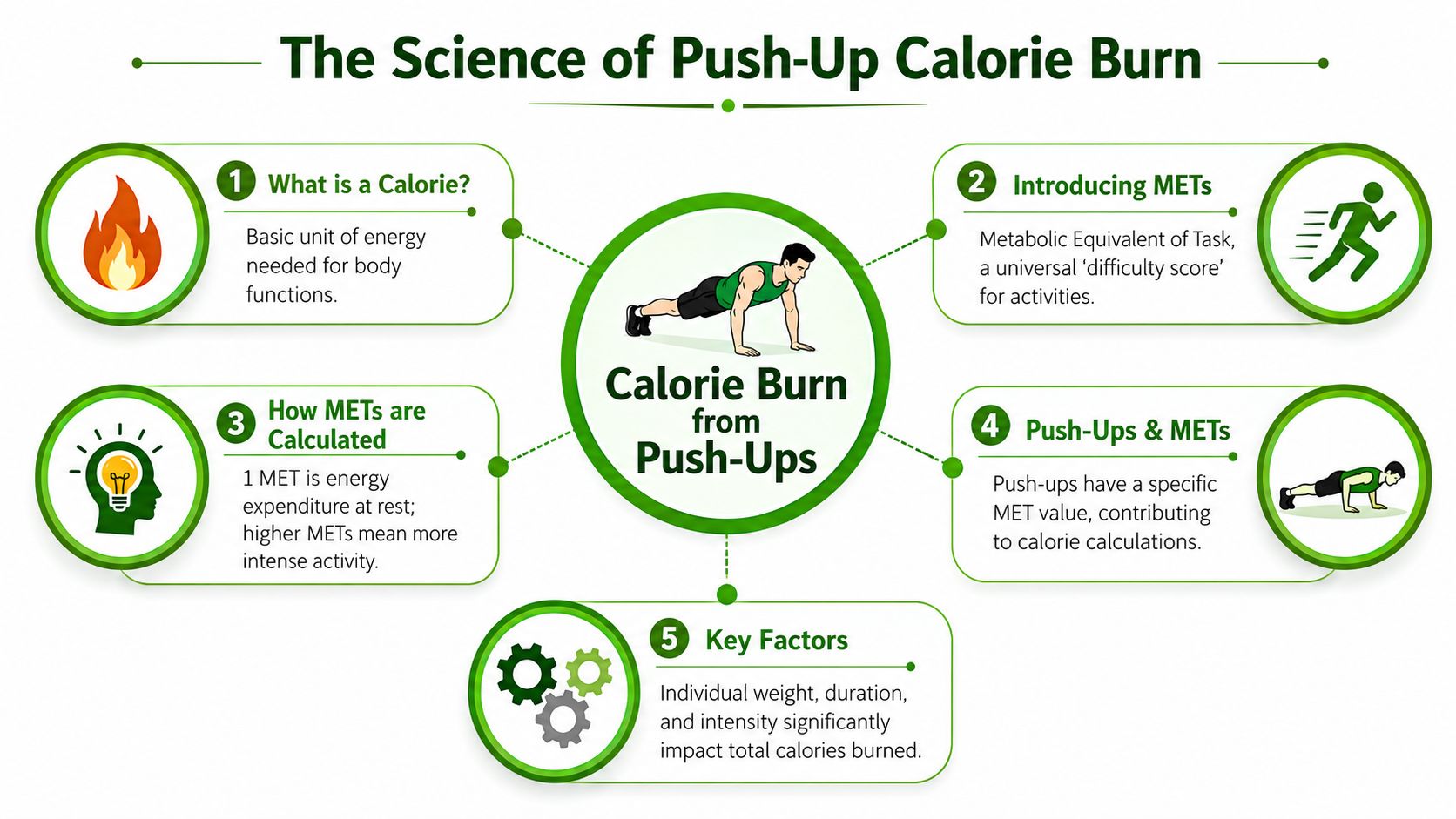
METs are the engine behind the estimate
METs work like a sliding scale for energy demand. As the work gets harder, the MET value rises. For push-ups, that change comes from factors readers can control: tempo, rest periods, total time under tension, and whether the set stays crisp or breaks down.
That matters in real training. Twenty push-ups spread across a morning do not create the same demand as twenty push-ups packed into a hard circuit. If you want context for how steady movement adds up over time, this guide on how many steps you get in a 30-minute walk is a useful comparison.
The formula that answers the question
The standard MET-based calorie formula is:
Calories burned = MET × body weight in kg × 3.5 / 200 × minutes
Each part does a specific job:
- MET: the intensity of the activity
- Body weight in kg: the mass being moved
- Minutes: how long the work continues
- 3.5 / 200: the standard conversion used in exercise physiology
This formula is more useful than a per-rep guess because it shows what changes the result. Body weight matters. Effort matters. Time matters.
In practice, rep count is only one small clue. I would rather see someone track the quality of the set, the pace, and the total session time than obsess over whether one rep burned 0.2 or 0.4 calories. That approach gives you a number you can repeat, compare, and improve.
Per-rep estimates still have a place. They are shorthand built from pace and session time, which is why they can be handy for quick planning. Just treat them as rough estimates, not lab data.
Push-Up Calorie Burn Examples by Body Weight
Individuals don't need laboratory math. They need a practical reference point they can use in the gym, at home, or during a quick bodyweight session. The best way to do that is to combine a known benchmark with your own body weight and pace.
A reliable anchor is this: for a person weighing 155 to 160 pounds (70 to 73 kg), push-ups at a moderate pace burn roughly 7 calories per minute, so a 10-minute session burns about 70 calories, based on Healthline's summary of push-up calorie burn.
A simple table you can use
| Body Weight (lbs / kg) | Calories Burned Per Minute |
|---|---|
| 155 to 160 lbs / 70 to 73 kg | ~7 |
That's only one verified weight range, so I won't invent extra rows and pretend the table is more precise than the evidence allows. If you weigh less, your burn is usually lower. If you weigh more, your burn is usually higher.
For comparison, walking is useful because it gives people a familiar effort benchmark. If you want to think about how body weight and time affect everyday calorie expenditure, this guide on how many steps are in a 30-minute walk helps frame how moderate movement adds up.
What a real session looks like
Take a person in that 155 to 160 pound range doing moderate push-ups for 5 minutes. Using the benchmark above, that session would burn roughly 35 calories. Stretch the same session to 10 minutes, and you're at about 70 calories.
That's why short push-up bursts are great for habit-building and strength practice, but they don't produce huge calorie totals by themselves unless you do a lot of volume, raise the intensity, or pair them with other work.
If you want the estimate to be more useful, track sessions in minutes and effort level, not just reps.
There's also a practical coaching point here. Two athletes can both finish 100 reps and report completely different training stress. One may grind through hard sets with minimal rest. Another may scatter easy reps throughout the day. Same total reps. Different session cost.
How to Increase the Calories You Burn Per Push-Up
You don't need to turn push-ups into circus tricks to make them more demanding. You need to turn the right dials. The three that matter most are tempo, range of motion, and variation.

You already know you can change.
You just need to take the first step. Habit Huddle helps you build habits around your goals, alongside friends who keep you accountable.
Use tempo as an intensity dial
A slow lowering phase forces your muscles to stay loaded longer. That doesn't magically transform one rep into cardio, but it does raise the work each rep demands. If you usually drop fast and bounce up, clean that up first.
Tempo work also improves control. That matters because sloppy reps often reduce both training quality and energy cost.
Make each rep longer and cleaner
Half-reps are common when fatigue kicks in. They're also less honest. A push-up with full depth, a stable trunk, and a complete lockout requires more mechanical work than a rushed partial.
Focus on:
- Chest depth: Lower under control instead of cutting the range short.
- Body line: Keep the torso rigid so the core does its share.
- Breathing: Good breathing keeps the set organized and sustainable. If that's an issue, this guide on how to breathe when doing push-ups is worth using during practice.
Choose harder variations when standard reps get easy
If standard push-ups no longer challenge you, more reps isn't always the best next step. Harder variations can increase the effort per rep and keep the movement productive.
Examples include:
- Incline push-ups: Good for beginners who need better quality reps
- Decline push-ups: Shift more demand to the upper body
- Plyometric push-ups: Increase explosiveness and raise effort sharply
A short demo can help you see how technique and variation change the demand of the movement:
The mistake is assuming more reps is always the answer. Better reps, harder reps, and denser sessions often move the needle faster.
Turn Push-Ups Into a Calorie-Burning Habit
It's common to overestimate what one workout does and underestimate what a repeatable routine does. That's especially true with push-ups. A set here and there feels productive, but the true payoff comes when the exercise becomes automatic enough that you stop negotiating with yourself.
Why consistency beats calorie obsession
If your only goal is to burn more energy with push-ups, combining them with intervals is far more effective than counting isolated reps. According to Lose It's discussion of push-ups and calorie burn, HIIT plus push-up combinations can reach 15 to 20 calories per minute, and 100 reps plus 5 minutes of HIIT can burn about 150 calories. That's a much more practical setup than expecting basic reps alone to do all the work.
Your strategy changes as a result. Instead of trying to squeeze significance out of one rep count, you build small, repeatable sessions that create a bigger total effect across the week.
A simple workout you repeat beats an ideal workout you keep postponing.
How to structure a push-up habit that lasts
A good push-up habit is boring in the best way. It's clear, easy to start, and flexible enough that you can still do it on a tired day.
Try this structure:
- Pick a minimum version: Set a floor you can hit even when motivation is low.
- Add a stretch version: On better days, extend the session with more reps, more sets, or a short conditioning finisher.
- Pair push-ups with another movement: Squats, mountain climbers, or a short interval block work well.
- Track the behavior, not just the burn: If you're inconsistent, calorie estimates won't help much.
If habit-building is the weak link, the better skill to train is starting. This article on how to start a habit is useful because it focuses on making repetition easier instead of making the plan more complicated.
The trade-off is simple. Precision feels satisfying. Consistency changes your body.
Your Simple Push-Up Calculator and FAQ
A fast rule of thumb
If you want a simple estimate, use this:
Moderate push-up sessions for average-weight adults often land around 7 calories per minute for people in the verified 155 to 160 pound range, based on the Healthline benchmark cited earlier. If you prefer a rep-based shortcut, 0.3 calories per push-up is a reasonable starting estimate for a 70 kg person under moderate effort, as covered earlier.
That gives you two ways to estimate:
- By reps: Reps × 0.3 for a 70 kg person at moderate effort
- By time: Minutes × your approximate moderate pace burn if you're near the verified weight range
FAQ
Are push-ups enough for weight loss?
Usually not by themselves. They can support fat loss, but individuals typically need a broader training and nutrition strategy.
How many push-ups should I do a day?
Use a number you can recover from and repeat consistently. The best daily target is the one you can sustain with good form.
Is it better to do more reps or harder variations?
If standard reps are still challenging, build volume gradually. If they're easy, harder variations often give you a better training return than endless extra reps.
If you want consistency instead of guesswork, Habit Huddle makes daily training easier to stick with. You can track a push-up habit with a simple minimum target, keep your streak alive on busy days, and use group accountability to stay on course when motivation drops.
Ready to Build Habits With Friends?
Stop failing alone. Join thousands using the #1 habit tracker with friends for real accountability and lasting results.
Prefer mobile? App Store · Google Play
Related Guides
More Habit Huddle articles on building habits with accountability.

What to Do When You Miss a Workout Day: The 5-Step Comeback Plan
Missed a workout day? What one miss does to your body and habit, according to research, plus a five-step plan for the next 24 hours, when to make it up, and...

Habit Streak App With Friends: 7 Apps Compared (2026)
Seven habit streak apps with friends compared: Habit Huddle, HabitShare, Daily Pact, Habitica, Streaks, Habit Streak duels, HabitStreak.io. What friends see,...

Reading Challenge App With Friends: 8 Apps Compared (2026)
Eight reading challenge apps for friends compared: Goodreads, StoryGraph, Fable, Bookclubs, ReadRats, Reading Rivals, BookBuds, Habit Huddle. What friends se...