
10 Company Goals Examples to Drive Growth in 2026
Find actionable company goals examples for sales, marketing, and product. See how to turn goals into habits with SMART rewrites and KPIs for 2026.
A company goal is not useful until a team can act on it in the flow of a normal workday.
Founders often set goals that look sharp in a board deck and then wonder why nothing changes inside the product, the pipeline, or the weekly numbers. The gap is rarely ambition. The gap is execution design. If nobody knows what to do by Tuesday morning, who owns the metric, and how progress gets reviewed, the goal is just a statement of intent.
SMART goals help, but they do not solve that problem on their own. A measurable target still needs an operating rhythm. That means one clear KPI, one directly responsible owner, one review cadence, and one repeated behavior that pushes the metric in the right direction.
Many articles on company goals examples stop at the phrasing. They give teams a cleaner sentence, then leave out the system that turns the sentence into action. That is why generic advice breaks down fast inside startups. The team gets a target, but not the weekly decisions, daily habits, and visible accountability required to hit it.
The examples below take a different approach. Each goal is specific, measurable, and tied to execution. The point is not just to write a better objective. The point is to build a system that makes follow-through hard to avoid. In practice, that can be as simple as pairing each goal with a weekly owner checkin and a social accountability tool like Habit Huddle to track the behaviors behind the outcome.
That is how goals stop living in planning docs and start changing the business.
Table of Contents
- 1. Increase daily active users through a channel-specific growth bet
- 2. Improve new-user retention by fixing onboarding friction
- 3. Expand beyond one audience without diluting the product
- 4. Grow recurring revenue with a sharper business model focus
- 5. Reduce streak abandonment by designing for imperfect users
- 6. Increase cross-platform usage where it improves consistency
- 7. Build a template library that shortens time to first success
- 8. Improve app-store reputation by fixing product moments that trigger reviews
- 9. Build partnerships that reduce friction instead of adding noise
- 10. Create a certification program that drives adoption through practitioners
- 10 Company Goals: Side-by-Side Comparison
- From Goals to Habits Your System for Execution
1. Increase daily active users through a channel-specific growth bet
A generic version of this goal sounds like “grow usage.” That wording is useless. A better version ties growth to one acquisition surface, one user behavior, and one review cycle.
If your product already fits into communities, a channel-specific goal is stronger than a broad acquisition goal. Discord is a good example because it isn't just another traffic source. It's a place where people already gather around identity, accountability, and recurring participation. For products built around group habits, that matters.

Rewrite the goal so the team can execute it
Write it like this: increase daily active users within six months by launching and improving a Discord integration, starting with a small set of pilot communities and tracking Discord activation separately from native app activation.
That forces clarity. The product team knows what to ship. Growth knows where to recruit. Support knows which user cohort to study. Leadership knows what success depends on.
A goal like this works when you avoid vanity metrics. Intrafocus explains why KPI selection has to be tightly linked to the objective, and warns that tracking the wrong metric, such as visits instead of conversions, creates false progress. In practice, that means “servers added” isn't enough. You want an activation KPI tied to recurring checkins.
Practical rule: Track the first repeated behavior, not the first signup.
A solid execution rhythm for this kind of goal looks like this:
- Pilot first: Start with a limited group of communities so the team can see where onboarding breaks.
- Separate cohorts: Compare Discord users with web and mobile users instead of lumping everyone into one funnel.
- Build for moderators: Create templates, prompts, and setup docs that make adoption easy for community leaders.
- Reward repeat use: Use streak reminders and group visibility to reinforce checkins after the first week.
The trade-off is focus. If you push Discord and three other channels at the same time, nobody learns fast enough to improve any of them.
2. Improve new-user retention by fixing onboarding friction
Activation gets too much credit. A startup can manufacture signups with pricing tests, paid traffic, or a polished landing page. Retention is harder to fake. If new users do not return after the first few interactions, the product has not earned a place in their routine.
A stronger company goal here is specific: improve 30-day retention for new users by removing friction from onboarding and getting more people to the first repeat checkin within their first week.
That wording matters. It ties the goal to a user behavior the team can influence every day.
Build onboarding around the first repeat, not the first impression
Founders often treat onboarding like a product tour. That creates busywork. New users do not need a full explanation of every feature. They need one clear action, a reason to come back tomorrow, and a low-effort path to do it again.
For an accountability product, the first meaningful moment is rarely account creation. It is usually something closer to this: define a goal, complete one real checkin, and see how the next checkin will happen. If the product includes group visibility, users also need to understand who will see their progress and why that helps them stay consistent.
That is why second-week retention usually breaks before it shows up in the dashboard. The onboarding flow failed to set up a repeat behavior.
For teams building this kind of system, social accountability in habit building is not a motivation slogan. It is an operating mechanism. Visible follow-through, expected checkins, and light social pressure give users a reason to return when enthusiasm drops.
A useful internal benchmark is simple. If the team cannot point to the one action that predicts retention, the onboarding is still too broad. This is the same discipline behind strong team goals examples. Everyone should know the behavior that matters, who owns it, and how it is reviewed each week.
Teams rarely have a top-of-funnel onboarding problem. They have a repeat-behavior problem that shows up a week later.
A few tactics tend to work:
- Reduce the first session to one win: Get the user to complete the smallest valid checkin before showing advanced options.
- Design the second action on purpose: Do not end onboarding at “success.” Schedule or prompt the next checkin while intent is still high.
- Trigger nudges from behavior, not a generic timeline: Message users based on missed checkins, incomplete setup, or failed group matching.
- Place users into the right accountability context: Default groups, templates, or peer visibility lower the effort required to return.
The trade-off is real. A shorter onboarding can make the product feel less feature-rich, and some teams resist that because it looks less impressive in demos. Ignore that instinct. Fast time to first repeat behavior beats a polished walkthrough every time, especially if you want company goals to survive contact with real user behavior instead of staying trapped in a planning doc.
3. Expand beyond one audience without diluting the product
A lot of founders confuse audience expansion with product sprawl. They add pages for writing, study, wellness, and productivity, but the workflow doesn't change. That's not expansion. That's relabeling.
Real category expansion starts when the product can support distinct use cases without losing its core mechanic. If the core mechanic is accountability, then the question isn't whether writing and wellness are different themes. It's whether those users need different prompts, templates, group norms, or reporting.
Use category goals only when the workflow changes
A better company goal example here is to enter three adjacent use-case categories by building dedicated templates, onboarding paths, and hub features for each one. That's specific enough to ship against and broad enough to matter strategically.
The easiest mistake is trying to launch all categories with the same default experience. Writers may need consistency prompts. Students may need deadline-based checkins. Wellness users may need softer streak language and lower-pressure group framing. The product can stay coherent while the wrappers change.
If you want a useful mental model, don't ask, “Can this audience use our product?” Ask, “What has to change for this audience to stick?”
Adobe's guidance on business goals recommends breaking annual goals into quarterly plans with 1 to 3 key results and then cascading them to departments and individuals. It gives a concrete healthcare technology example of improving patient engagement by 20% within six months, measured by app usage and appointment scheduling, in its business goals framework. The lesson isn't about healthcare. It's about making category expansion observable through behavior, not branding.
A practical structure looks like this:
- Choose adjacent categories: Expand into audiences that already believe in recurring practice and peer accountability.
- Build category defaults: Pre-fill goals, reminder language, and template recommendations based on use case.
- Assign category owners: One person should own activation feedback for each category during the launch window.
The product side of this matters too. A user exploring accountability tools for focus or study won't want a fitness-shaped experience. If you're positioning around shared routines, category-specific framing should feel as intentional as the habit-building app experience, not like a generic dashboard wearing a different label.
4. Grow recurring revenue with a sharper business model focus
Recurring revenue usually stalls for a simple reason. The company is trying to sell the same product through too many business models at once.
A goal like “increase ARR” is too vague to run. It does not tell the team which customer segment matters most, which plan should lead, or which behaviors need to happen every week to make the number move. Good company goals examples solve that problem by tying the revenue target to a specific revenue engine, then giving the team a review cadence that catches issues early.
For a product built around accountability, recurring revenue often gets stronger when the offer shifts from solo utility to team outcomes. Coaches, managers, and program leads are usually buying consistency, visibility, and follow-through across a group. That changes the sales motion, the onboarding path, and the metrics worth watching.
A sharper version of the goal looks like this: grow monthly recurring revenue by increasing the share of revenue from team plans, while reviewing pipeline quality and expansion opportunities every week. As noted earlier, strong financial goals work best when they include a clear timeframe and a regular inspection rhythm. Monthly review is not enough if the pipeline is thin or the trial-to-paid motion is weak.
The execution layer matters more than the headline goal. Revenue grows when someone owns the next ten sales conversations, the next five active trials, and the next three objections blocking conversion.
Use a structure like this:
- Choose one primary buyer: Start with the team customer who already feels the pain most clearly, such as coaches, workplace leads, or accountability group organizers.
- Simplify the offer: Give that buyer one plan, one demo path, and one clear outcome. Too many pricing choices slow sales and create messy positioning.
- Track leading indicators weekly: Review qualified calls, trial activation, multi-user setup, and the reasons deals stall or churn risk appears.
- Feed sales friction back into product: If buyers hesitate on reporting, permissions, or group setup, fix those points inside the product instead of asking sales to explain around them.
- Assign accountability for follow-up: A revenue goal without named owners turns into a dashboard artifact. Someone should own outbound, someone should own trial conversion, and someone should own expansion.
Generic company goal examples fall apart. They stop at the SMART statement. Teams need the operating system behind it. If the goal is to grow recurring revenue, the daily and weekly habits should be visible to everyone involved. Tools built around social accountability can help here because the team is not just tracking a number. They are tracking the repeated actions that support the number.
If your product sells group accountability, your commercial system should reflect that same logic. The examples in team goals and shared accountability workflows are useful because they show how ownership, visibility, and follow-through can work at the team level, not just in a finance sheet.
There is a trade-off. Narrowing the segment can feel expensive because it means saying no to some revenue in the short term. In practice, that focus usually improves close rates, retention, and expansion because the offer gets easier to explain and easier to adopt.
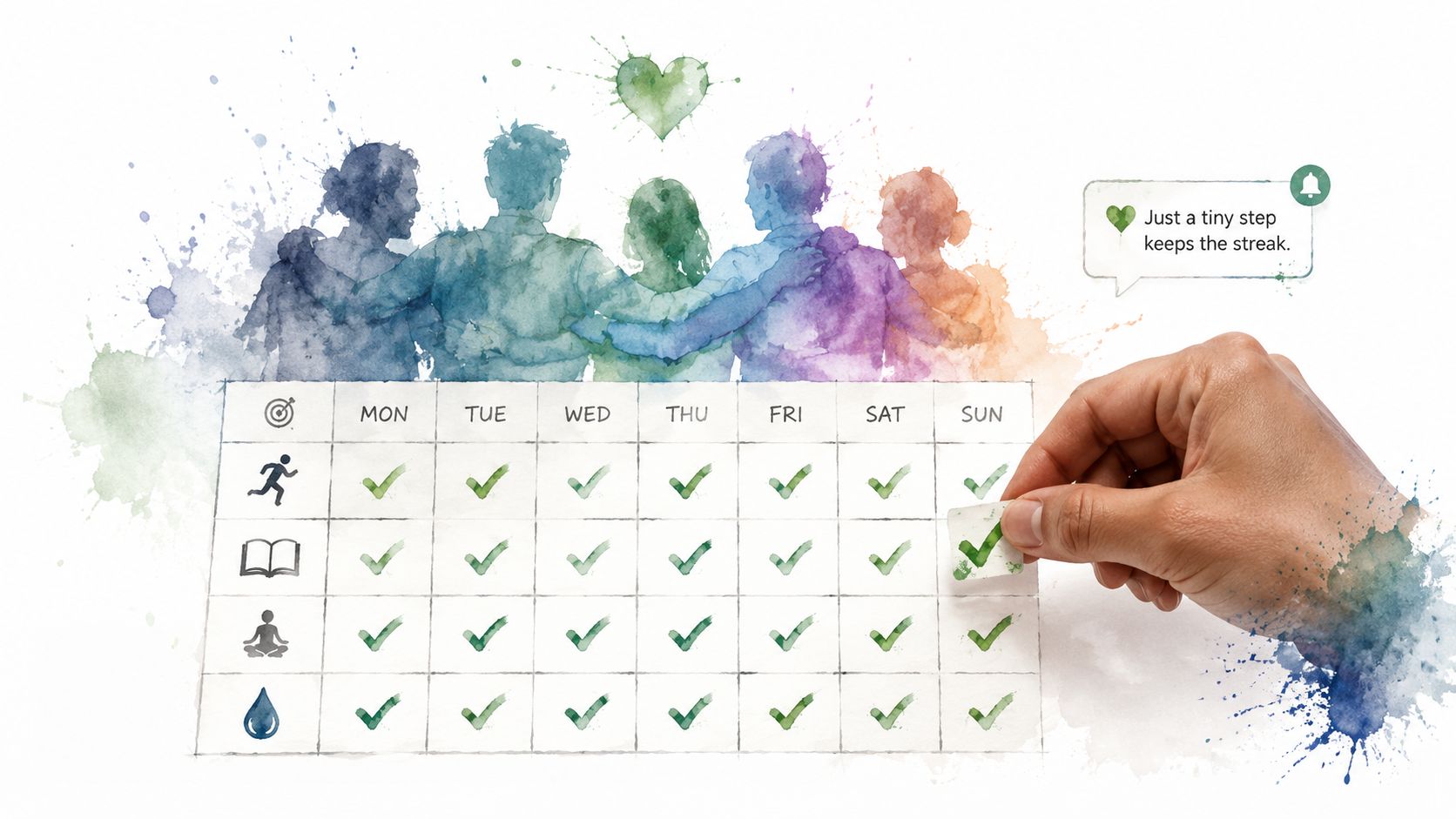
5. Reduce streak abandonment by designing for imperfect users
Most streak systems break for one reason. They assume users will behave like machines. Real people miss days, travel, get sick, lose focus, and feel guilty. Then they quit.
If your company goal is to reduce abandonment, don't start with more aggressive reminders. Start by reducing the shame built into the product. A streak mechanic should reward consistency, not punish one imperfect day so hard that the user disappears.
Protect consistency instead of demanding perfection
A useful goal here is to lower streak abandonment by redesigning checkins, nudges, and recovery messages around the minimum viable action. That shifts the product from all-or-nothing compliance to sustainable repetition.
A lot of company goals examples miss the operational layer. “Improve retention” sounds right, but the execution happens inside micro-decisions. What message appears after a missed day? Does the user have a smaller win condition? Can the group still reinforce effort if the full target wasn't met?
The practical moves are straightforward:
- Keep a low-friction fallback: Let users preserve momentum with a minimum checkin rather than forcing a full completion standard.
- Segment reminders: Same-day reminders, next-day recovery nudges, and weekly recap prompts should serve different moments.
- Show visible support: Group-based accountability works better when people can encourage consistency, not just perfect outcomes.
One of the biggest trade-offs in habit design is intensity versus longevity. Strict systems can create short bursts of engagement. Flexible systems often last longer because users don't feel expelled by a rough week.
If your product includes both a minimum action and a stretch action, that's not lowering the bar. It's protecting the loop that keeps the user in motion.
6. Increase cross-platform usage where it improves consistency
“Be everywhere” is not a strategy. Plenty of companies launch on web, mobile, and integrations, then discover users only really want one reliable path. Cross-platform goals only make sense when multiple surfaces reduce friction for the same recurring behavior.
For a habit or accountability product, that can be true. Someone may join a group on mobile, post a checkin from a desktop during work, and respond through Discord in the evening. The value isn't channel count. The value is continuity.
You already know you can change.
You just need to take the first step. Habit Huddle helps you build habits around your goals, alongside friends who keep you accountable.
Don't force channels that add complexity
A practical company goal example here is to increase the share of active users who post checkins across multiple supported platforms by the end of the year. The point isn't novelty. The point is proving that omnichannel access helps people stay consistent.
This works best when each platform has a clear job:
- Mobile handles immediacy: Quick checkins, reminders, and lightweight status updates.
- Web handles reflection: Progress views, history, and admin workflows fit better on a larger screen.
- Discord handles community: Group prompts, public consistency, and low-friction social reinforcement belong where the group already talks.
The mistake is cloning the same feature set everywhere. Cross-platform products become stronger when each surface is opinionated. If Discord just mirrors the app, it won't matter. If it turns checkins into a natural part of existing group behavior, it will.
A second mistake is evaluating all channel usage as if it's equal. You need to know whether users who adopt more than one platform return more consistently, complete more checkins, or stay active longer. Otherwise, “cross-platform adoption” is just another dashboard trophy.
This is one of those goals that should stay dynamic. If user behavior shifts, adjust the channel priority rather than defending a planning assumption that no longer fits.
7. Build a template library that shortens time to first success
Templates are one of the most underrated company goals examples because they look operational, not strategic. In practice, they're often strategic. They shape activation, reduce cognitive load, and encode what good usage looks like.
Teams often build templates too late. They wait until support requests pile up or users keep creating weak setups. That's backwards. If the team already knows what a strong setup looks like, templates should carry that knowledge from day one.
Guardrails beat endless customization
A smart goal here is to build a broad library of pre-built templates with category-specific defaults, clear guardrails, and regular pruning. What matters isn't the raw count. What matters is whether templates reduce bad starts.
Overloaded teams should pay attention to this. Recent business-goal guidance that goes beyond generic examples emphasizes situational analysis, stakeholder input, ownership, and measurable execution in its discussion of writing business goals that teams can actually execute. The implication is practical. More options don't help if the team can't support them. Fewer, better templates often beat a huge library nobody maintains.
The best template is the one that prevents a weak goal from being created in the first place.
A useful execution pattern looks like this:
- Start with proven paths: Turn your most successful existing goal setups into defaults.
- Label by difficulty and context: Beginners and advanced users shouldn't see the same starting point.
- Retire low-signal templates: If a template rarely leads to repeat use, remove or redesign it.
- Collect qualitative feedback: Ask what felt confusing, restrictive, or motivating.
The trade-off is freedom. Some users want full customization. Give it to them after they understand the structure. Early on, guardrails usually help more than openness.
8. Improve app-store reputation by fixing product moments that trigger reviews
App-store goals are often treated like marketing goals. They're product goals wearing a marketing costume. Ratings reflect whether users got value, hit friction, and felt heard when something broke.
If you're serious about this goal, don't begin with prompts. Begin with the sequence of product moments that produce either delight or frustration. Then ask for reviews only when the user has earned a reason to give one.
Ask at the right time or don't ask at all
A strong version of this goal focuses on both quality and volume, but the work sits upstream. Better review performance usually comes from tighter onboarding, more reliable reminders, cleaner notifications, and faster support loops.
The practical review prompt should follow a success event, not a random session. Think about moments like a completed first week, a recovered streak, or a useful group milestone. That's when users can answer from experience instead of politeness.
A few practices tend to work:
- Prompt after satisfaction moments: Trigger review requests after visible progress, not during setup.
- Catch problems before they hit the store: Route unhappy users into support or feedback channels first.
- Use release notes strategically: Tell users what changed in clear language so they see ongoing improvement.
- Watch themes, not just averages: A recurring complaint about reminders or bugs matters more than one angry comment.
The trade-off is speed. Aggressive prompt campaigns can increase review volume fast, but they often surface unresolved product issues just as quickly. A slower, cleaner approach usually produces a more durable reputation.
9. Build partnerships that reduce friction instead of adding noise
Partnership goals sound impressive in board meetings. They also create a lot of dead work. The fastest way to waste time is signing integrations that look strategic but don't remove any real user friction.
A useful partnership goal starts with one question. What data or workflow is the user already maintaining somewhere else that your product shouldn't ask them to recreate manually? If you don't have a good answer, the integration probably isn't worth building yet.
Start with the data the user already trusts
The best partnerships reduce setup time, improve reporting, or strengthen the accountability loop. Fitness users may want activity pulled in automatically. Productivity users may want a planning system to connect to the habit itself. Community-led products may benefit from integrations that keep the checkin inside the place where users already gather.
A practical way to sequence this work:
- Prioritize overlap: Build for platforms your current users already mention and use.
- Start read-only: Importing trusted data is often enough to prove value before adding more complex sync.
- Create partner-specific onboarding: An integration with no customized setup path won't get adopted.
- Measure retention impact: The only strategic partnership that matters is one that makes the product more useful over time.
This is also where founders need restraint. Five shallow integrations can create more maintenance burden than one deep, meaningful one. Partnership goals should improve the product's daily use, not just decorate the roadmap.
10. Create a certification program that drives adoption through practitioners
Certification pays off when it creates a repeatable delivery channel, not when it produces a badge. If coaches, trainers, consultants, or community leads already shape tool choice for end users, a certification program can turn those practitioners into a trained distribution layer.
That changes the goal.
The target is not "launch a certification." The target is to increase activation, retention, and expansion through practitioners who know how to implement the product well. A strong company goal here sounds more like this: certify 100 practitioners in 2 quarters, with at least 60% onboarding 5 or more active clients within 30 days of completion.
That framing matters because generic goal examples break at the execution stage. Teams build the curriculum, announce it, and then fail to track whether certified people change user behavior. If you want this initiative to work, tie it to daily actions and visible accountability. Give practitioners a rollout checklist, client onboarding scripts, reporting templates, and a weekly implementation cadence they can follow with peers. A social accountability layer such as Habit Huddle can help keep completion and field adoption from stalling after the first module.
Certification only works when it changes buyer behavior
Practitioners need applied training, not theory. Teach them how to set up client accounts, run the first week, recover a missed streak, interpret progress data, and lead group checkins. If they leave with information but no operating system, adoption stays low and support tickets rise.
As noted earlier, goal-setting research consistently points in the same direction. Time-bound goals and visible progress tend to improve follow-through. That is one reason certification can work well when the program includes deadlines, peer accountability, and clear implementation milestones.
A strong certification program usually includes:
- Short modules: Practitioners need training they can finish between client sessions.
- Implementation assets: Onboarding scripts, templates, dashboard walkthroughs, and recovery playbooks beat abstract lessons.
- Proof that has market value: Public badges, directory listings, or profile markers give certified practitioners a reason to use the credential.
- Ongoing peer accountability: A private cohort, office hours, or weekly checkins keeps usage standards high after graduation.
There is a real trade-off here. Certification creates a new product surface area. If the app changes every month, the curriculum, exam, and support docs need regular updates. Founders should only launch this goal after the core workflow is stable enough to teach and repeat.
10 Company Goals: Side-by-Side Comparison
| Initiative | Implementation Complexity ???? | Resource Requirements ⚡ | Expected Outcomes ????⭐ | Ideal Use Cases ???? | Key Advantages ⭐ |
|---|---|---|---|---|---|
| Increase Daily Active Users by 40% Within 6 Months Through Discord Integration | Medium–High ????, bot dev, moderation, API work | Medium, engineering + community ops & analytics ⚡ | 40% DAU uplift in 6 months; measurable by dashboards ???? | Community-first groups (gaming, fitness), large servers ???? | Low-friction tracking in-context, partner advocacy, rapid feedback ⭐ |
| Achieve 85% 30-Day Retention Rate by Implementing Onboarding Optimization | High ????, product iteration, A/B testing, analytics | High, product, UX, content, analytics, experimentation ⚡ | 85% 30‑day retention; stronger LTV and activation ????⭐ | New users completing onboarding; habit formation cohorts ???? | Faster time-to-value, higher retention, word-of-mouth growth ⭐ |
| Expand into 3 New Use-Case Categories (Writing, Study, Wellness) | Medium ????, category hubs, templates, moderation | Medium, content experts, community managers, product tweaks ⚡ | Launch 3 hubs with >100 users each; reduced churn ???? | Diversification beyond fitness; students, writers, wellness seekers ???? | Broader TAM, cross-category network effects, reduced single-use risk ⭐ |
| Achieve $500K ARR with 60% from Team/Organizational Plans | High ????, enterprise features, sales process | High, sales team, customer success, billing, product RBAC ⚡ | $500K ARR; 60% revenue from teams; predictable B2B revenue ????⭐ | Coaches, trainers, workplace wellness programs, teams ???? | Higher LTV, predictable revenue, team-driven adoption ⭐ |
| Reduce Streak Abandonment by 30% Through Minimum Checkin & Nudge Strategy | Medium ????, messaging flows, segmentation, experiments | Low–Medium, product, messaging, community ops ⚡ | 30% fewer streak breaks; improved retention and engagement ???? | Early habit formation users; huddles relying on streaks ???? | Cost-effective retention, preserves core engagement mechanic ⭐ |
| Achieve 50% Cross‑Platform Usage (iOS, Android, Web, Discord) by Q4 | High ????, platform parity, sync, QA | High, multi-platform engineering, QA, infra ⚡ | 50% active users on 2+ platforms monthly; better accessibility ???? | Multi-device users, remote teams, Discord communities ???? | Resilience to store changes, higher accessibility and LTV ⭐ |
| Build 200 Pre‑Built Huddle Templates with Best Practices by Year‑End | Medium ????, content creation, curation, UI placement | Medium, domain experts, content ops, product design ⚡ | 200 templates; faster time‑to‑first‑checkin, improved activation ???? | New users, category explorers, rapid onboarding flows ???? | Reduces decision fatigue, scalable activation, encodes expertise ⭐ |
| Achieve 4.5+ Star Rating Across App Stores with 10,000+ Reviews | Medium ????, quality improvements + review funnels | Medium, QA, support, marketing, review prompting ⚡ | 4.5+ rating and 10k+ reviews; improved ASO & conversion ????⭐ | App store discovery; convincing prospective users ???? | Strong social proof, increased organic discoverability ⭐ |
| Establish Strategic Partnerships with 5 Complementary Platforms by Mid‑Year | High ????, integrations, legal, data sharing | High, engineering, partnerships, legal/compliance ⚡ | 5 integrations; increased retention & partner-driven acquisition ???? | Users of Strava, MyFitnessPal, Notion; coaches ???? | Reduced CAC, data consolidation moat, partner distribution ⭐ |
| Launch Certification Program with 500+ Certified Practitioners by End of Q3 | Medium–High ????, curriculum, assessment, program ops | Medium, content production, LMS, marketing, community mgmt ⚡ | 500+ certified coaches; increased B2B advocacy & referrals ???? | Coaches, trainers, consultants selling habit programs ???? | Creates advocates, upsell channel, professional credibility ⭐ |
From Goals to Habits Your System for Execution
A good goal gives direction. It doesn't create momentum by itself.
That's the core mistake behind most company goals examples. They stop at the sentence. They tell you how to phrase a target, maybe how to attach a KPI, and then they assume execution will sort itself out. It won't. Teams need a system that turns a quarterly objective into recurring behavior that people can sustain.
The strongest guidance on goal setting makes that clear. Specific, measurable, time-bound goals outperform vague intentions, and written goals with accountability structures perform better than private ambition alone. But in practice, execution doesn't happen because a framework exists. It happens because someone translates the framework into routines the team can follow without reinterpreting the strategy every week.
That translation layer matters most for overloaded teams. If a company is already stretched, adding more goals won't create more output. It usually creates more context switching, weaker ownership, and softer follow-through. A smaller set of goals, each tied to one lead metric and one recurring team behavior, almost always has a better shot.
Here's the system that tends to work.
First, pick fewer goals than you want. If everything matters, nobody knows what to protect when trade-offs show up. Second, assign one owner for each goal, even if several teams contribute. Shared work still needs a single throat to clear. Third, define the review rhythm before the goal starts. Monthly and quarterly reviews are useful, but most growth goals also need a weekly operating check. Fourth, identify the habit behind the goal. If the goal is retention, maybe the habit is weekly onboarding review. If the goal is revenue, maybe it's a fixed number of demos or proposals. If the goal is engagement, maybe it's a daily checkin loop that users can complete in seconds.
Accountability tools become useful. A product like Habit Huddle can support the last mile of execution because it structures recurring checkins, visible group consistency, and small daily actions around one shared commitment. That doesn't replace strategy. It makes strategy harder to ignore.
The biggest shift is mental. Stop treating goals as statements and start treating them as systems. Every serious goal needs a metric, a deadline, an owner, a meeting cadence, and a repeated behavior that keeps the team moving when enthusiasm drops.
Start small. Choose one important goal. Turn it into one operating rhythm. Give one team a visible way to keep showing up. That's how goals stop living in planning docs and start changing outcomes.
If you want a simple way to turn team goals into visible daily follow-through, Habit Huddle gives you a structure for shared checkins, small-group accountability, and consistent habit tracking across iOS, Android, web, and Discord.
Ready to Build Habits With Friends?
Stop failing alone. Join thousands using the #1 habit tracker with friends for real accountability and lasting results.
Prefer mobile? App Store · Google Play
Related Guides
More Habit Huddle articles on building habits with accountability.

HabitShare Alternatives: 6 Apps for Tracking Habits With Friends (2026)
Looking for a HabitShare alternative? Six social habit trackers compared by model, price, platforms, and what happens on a missed day, plus how to switch wit...

What to Do When You Miss a Workout Day: The 5-Step Comeback Plan
Missed a workout day? What one miss does to your body and habit, according to research, plus a five-step plan for the next 24 hours, when to make it up, and...
Habit Streak App With Friends: 7 Apps Compared (2026)
Seven habit streak apps with friends compared: Habit Huddle, HabitShare, Daily Pact, Habitica, Streaks, Habit Streak duels, HabitStreak.io. What friends see,...