
How Much Lemon Juice for Lemon Water? a Practical Guide
Find the perfect ratio for how much lemon juice for lemon water. Our guide gives you exact amounts for wellness, safety tips, and how to make it a daily habit.

Use half a lemon's juice in 8 to 12 ounces of water as your default lemon water recipe. That works out to about 1.5 tablespoons of juice, and it's generally the cleanest starting point because it gives you flavor without turning the drink into a mouth-puckering acid shot.
If you're standing in your kitchen with a lemon in one hand and a glass in the other, that's usually the main question. Not whether lemon water is “good,” but whether you're using too much, too little, or just wasting a perfectly good lemon.
A complicated recipe isn't needed. What's needed is a repeatable ratio that can be remembered on a tired morning, after a workout, or while filling a bottle for work. That's what makes lemon water stick. When the amount is vague, the habit gets inconsistent. One day it's barely flavored water. The next day it's so sour you regret it after two sips.
A better approach is to treat lemon water like a flexible system. Start with one standard ratio for everyday use, then adjust only if you have a specific goal, a specific tolerance, or a specific reason. That's how a small wellness habit becomes easy enough to keep.
Table of Contents
- The End of Guesswork in Your Kitchen
- Your Daily Wellness Ratio The Perfect Starting Point
- Adjusting the Dose for Specific Health Goals
- Beyond the Basics Creative Lemon Water Variations
- The Lemon Water Safety Checklist Protect Your Health
- How to Make Lemon Water a Keystone Habit
The End of Guesswork in Your Kitchen
You slice the lemon, squeeze some into water, take a sip, and immediately wonder if you overdid it. That little moment is why so many healthy habits stay random. The friction isn't usually effort. It's uncertainty.
I've seen the same pattern with hydration habits over and over. People aren't failing because lemon water is hard. They're failing because there's no standard in their head. If the routine changes every day, it starts to feel like guesswork instead of a habit.
That's also why rigid “wellness rules” often backfire. If a drink has to be perfect to count, people skip it. The practical win is having one baseline you can repeat without thinking, then one higher-dose version only for specific use cases.
Practical rule: A simple recipe beats an ideal recipe you can't remember.
There is one major exception to the casual approach. For kidney stone prevention, the most specific guidance is much higher than a normal glass of lemon water. The National Kidney Foundation guidance summarized in this review of lemon water and urinary citrate recommends 4 ounces of lemon juice per day, and one clinic source notes that 1/2 cup of lemon juice can provide citric acid comparable to prescription varieties. That's a targeted strategy, not a casual splash in a bottle.
The kitchen solution is simple. Pick a default ratio for everyday drinking. Keep your glass or bottle size consistent. Use the same step every day. That kind of repeatability is what turns a one-off healthy intention into something that survives busy mornings, travel days, and low-motivation weeks.
If you like habit routines that remove morning decisions, the same logic shows up in simple breakfast systems too, like this guide to a 5 a.m. breakfast routine that reduces friction.
Your Daily Wellness Ratio The Perfect Starting Point
The default answer to how much lemon juice for lemon water is straightforward. Use half a lemon in 8 to 12 ounces of water.
What to put in the glass
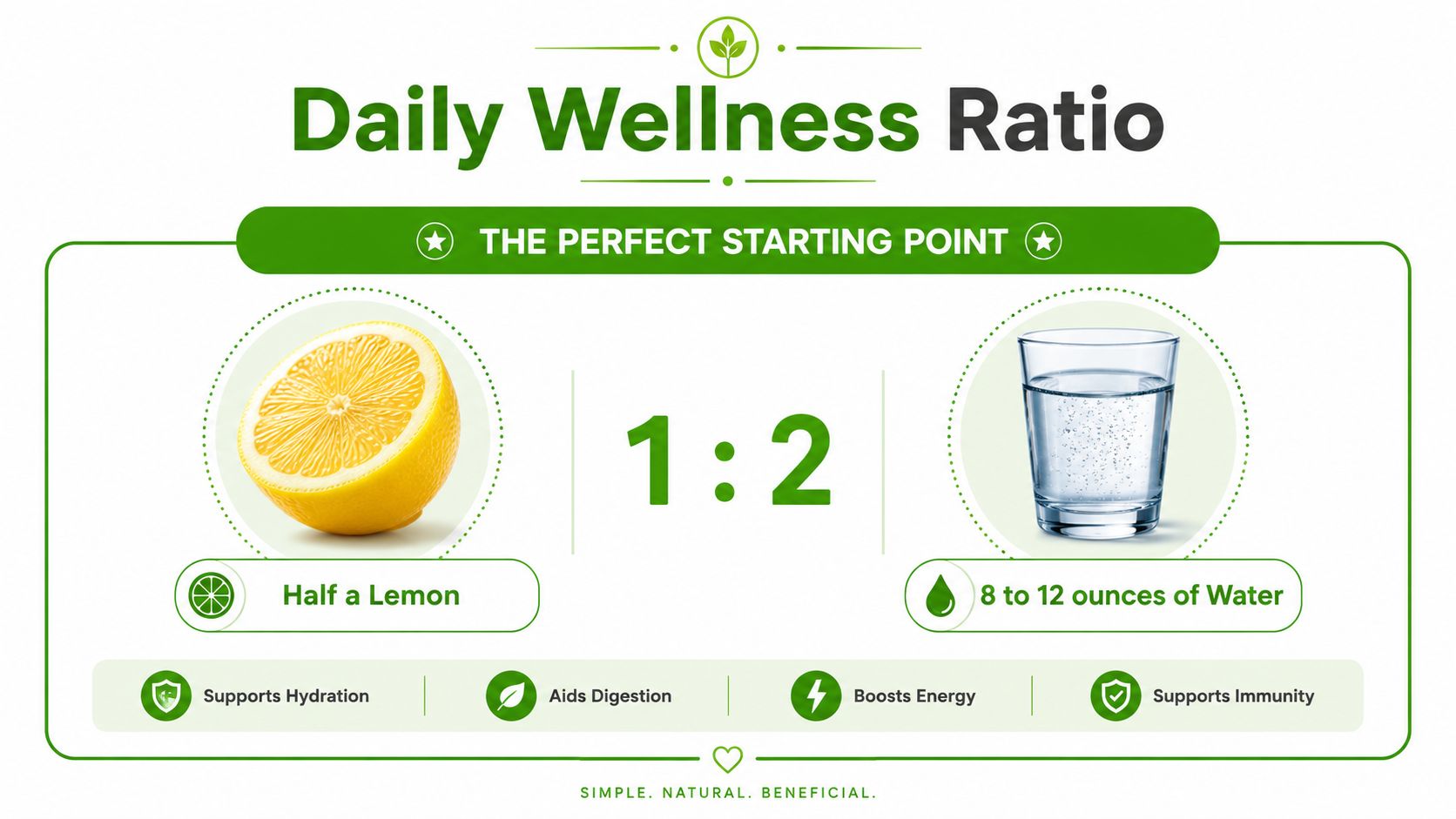
That ratio is the most practical place to start because it's consistent with the standard dilution described by Northwestern Medicine's lemon water guidance, which says half a lemon in 8 ounces is typically sufficient and notes you can stretch it to 12 ounces if the taste feels too strong.
Use fresh lemon if you can. Fresh juice gives you a cleaner flavor, and Northwestern Medicine explicitly recommends fresh lemon over bottled juice. Bottled juice may work in a pinch, but it often tastes harsher or flatter, which makes people use too much trying to “fix” the flavor.
Here's the easiest setup:
- Cut one fresh lemon in half. Use one half per serving.
- Squeeze it into a measured glass or bottle. Don't free-pour and hope for the best.
- Add 8 to 12 ounces of water. Keep the lemon amount stable and adjust the water if needed.
- Taste once, then standardize it. When it tastes right, repeat that same setup tomorrow.
For people who like visual cues and reminders, a hydration tracking app for daily intake habits can make it easier to keep the ratio consistent instead of starting over each day.
A quick visual can help if you want to lock in the routine:
Why this ratio works
This amount works because it balances three things people usually want at the same time: noticeable lemon flavor, easy hydration, and a dilution that isn't unnecessarily aggressive.
Too little lemon and the drink feels pointless. Too much lemon and people stop drinking it regularly because it's sharp, irritating, or unpleasant.
The best lemon water ratio is the one you'll actually keep using on an ordinary Tuesday.
This is also why I prefer adjusting the water volume first instead of adding more lemon. If the flavor is too intense, move from the lower end of the range toward the higher end. That keeps your recipe predictable and helps you learn what your own tolerance feels like without turning each glass into a new experiment.
Adjusting the Dose for Specific Health Goals
Not every lemon water routine is trying to accomplish the same thing. Someone who wants a tastier way to drink water doesn't need the same setup as someone using lemon juice as part of a kidney-stone-prevention strategy.
Daily use versus therapeutic use
Here's the clean comparison:
| Use case | Practical approach | What it means |
|---|---|---|
| Everyday hydration | Standard low-dose lemon water | Built for flavor, routine, and consistency |
| Kidney stone prevention | Higher daily lemon juice intake in water | Built for a specific health goal, not casual sipping |
For a kidney-stone-prevention style approach, the National Kidney Foundation recommendation cited by GoodRx's review of lemon water benefits is 4 oz of lemon juice per day in water. GoodRx also notes that people with a history of kidney stones who drank 1/2 cup of fresh-squeezed lemon juice daily had a lower chance of recurrence.

That is a very different category from ordinary lemon water. It's not “add a squeeze to your bottle and call it a day.” It's a higher-citrate routine used with a clear purpose.
When more lemon makes sense and when it doesn't
If your goal is general wellness, drinking more concentrated lemon water usually isn't the smart move. More acidity doesn't automatically mean a better daily habit. It often means the drink is harder on your mouth, rougher on reflux, and less pleasant to keep up.
A better way to think about it:
- Use the standard ratio if you want a sustainable hydration habit.
- Use a higher daily intake only for a specific reason such as a kidney stone prevention plan.
- Spread it out through the day rather than drinking an intensely acidic large serving all at once.
- Stay realistic about the evidence. The support is for people with a history of stones, not as a universal prescription for everyone.
Higher-dose lemon water is a targeted tool. It isn't the default setting for healthy living.
This distinction matters because a lot of people hear that lemon water “helps” and assume they should keep adding more. In practice, the better question is whether the stronger version matches your goal, your tolerance, and your ability to do it consistently.
You already know you can change.
You just need to take the first step. Habit Huddle helps you build habits around your goals, alongside friends who keep you accountable.
Beyond the Basics Creative Lemon Water Variations
A habit lasts longer when you enjoy it. Once your base ratio is dialed in, the easiest way to stay consistent is to vary the experience without changing the structure.
Hot or cold depends on compliance
People often ask whether warm lemon water is better than cold lemon water. For habit building, the honest answer is simple. The better version is the one you'll drink gladly and regularly.
Warm lemon water can feel gentler first thing in the morning and works well for people who want a calmer routine. Cold lemon water is often easier after exercise, outdoors, or during a workday when you want something more refreshing.
Neither option needs to become a belief system. Pick the temperature that makes the habit easier.
A simple way to test it:
- Morning routine person: Try warm water with your standard lemon amount.
- All-day bottle person: Use cold water and prep it ahead.
- Sensitive stomach person: Start milder and see how your body responds.
Simple add-ins that make it easier to keep drinking
The smartest customizations don't bury the lemon. They support it.
Try one of these if plain lemon water gets boring:
- Fresh mint: Brightens the flavor and makes the drink feel cleaner.
- Sliced ginger: Adds a sharper edge that many people enjoy in warm water.
- Cucumber slices: Softens the overall profile if plain lemon tastes too intense.
- A small touch of sweetness: If bitterness keeps stopping you, a tiny amount of honey or stevia can make the habit more realistic.
Keep the changes modest. If your lemon water turns into a full recipe with too many steps, the habit gets fragile. You want just enough variation to avoid flavor fatigue, not so much complexity that the routine becomes weekend-only.
One practical trick is to prep the “extras” once, then use them for a couple of days. Wash mint, slice ginger, or cut cucumber in advance. Friction matters. When the add-ins are ready, people use them. When they aren't, the plan usually collapses back to plain water or nothing at all.
Variety helps adherence. Complexity hurts it.
The Lemon Water Safety Checklist Protect Your Health
Lemon water can be a useful daily habit, but only if you respect the trade-offs. The main ones are simple. Acid can irritate teeth and it can bother people who deal with reflux or a sensitive stomach.
Your daily protection habits
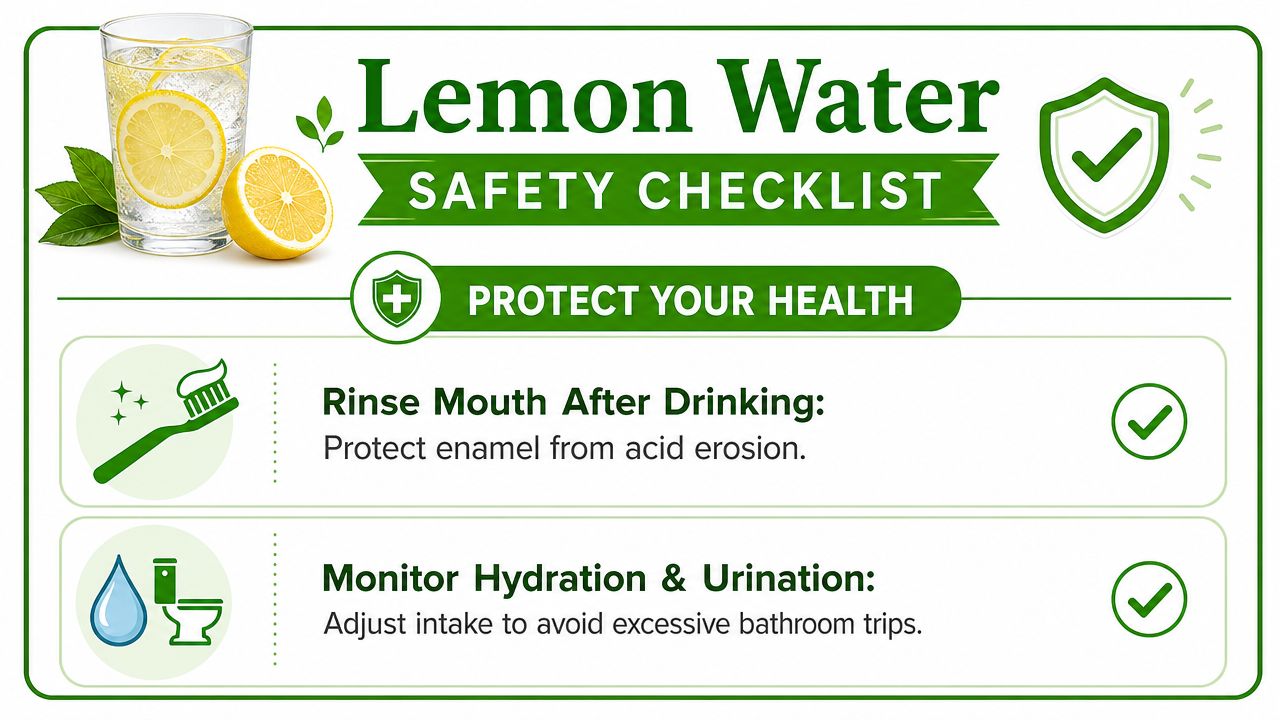
The best daily safety guidance is practical, not dramatic. According to Healthline's summary of expert recommendations, a good way to balance acidity is to use at least 8 ounces of water per half-lemon, drink through a straw, and rinse with plain water afterward.
That gives you a simple checklist:
- Dilute it properly: Don't cram a lot of lemon into too little water.
- Use a straw when possible: This reduces direct contact with your teeth.
- Rinse after drinking: Plain water helps clear lingering acid.
- Pay attention to sensation: If your mouth feels irritated or your chest starts burning, adjust.
These aren't “extra” steps for perfectionists. They're what make the habit sustainable.
Who should be more careful
Tolerance varies. That matters more than internet enthusiasm.
Northwestern Medicine notes, as summarized in the source above, that lemon water may not suit people who are prone to acid reflux or tooth sensitivity. If that's you, your answer may be a weaker dilution, less frequent use, or skipping lemon water entirely and focusing on plain water instead.
That isn't failure. It's good self-management.
A few smart boundaries help:
- If you get heartburn, reduce the intensity first. Don't push through just because a healthy habit sounds good on paper.
- If your teeth feel sensitive, stop making the drink stronger. More sour doesn't mean more effective.
- If you're using lemon water daily, keep the routine gentle. Daily habits need a lower-friction profile than occasional experiments.
A safe habit beats an aggressive habit you have to quit.
How to Make Lemon Water a Keystone Habit
Lemon water's power isn't the recipe. It's that the habit is small enough to anchor other good behaviors. When someone starts their day by preparing a simple drink, they often become more aware of hydration, meal timing, and follow-through in general.
Make the habit small enough to win
One reason this habit works is that the effort is low. A nutrition guide on lemon water basics notes that one medium lemon yields about 3 tablespoons (48 g) of juice, so a standard half-lemon serving gives you about 1.5 tablespoons. That's a small, manageable action, not a major kitchen project.
Many people overcomplicate things. They start with a large bottle, too much lemon, and a promise to do it perfectly every day. A stronger approach is to make one modest serving so easy that it feels automatic.
A few habit anchors work well:
- Pair it with an existing cue: Make it while your coffee brews or while breakfast is heating.
- Leave the lemon visible: A habit hidden in the crisper drawer gets forgotten.
- Use the same glass or bottle: Repetition reduces decision-making.
Build consistency before you build intensity
If you're trying to learn how much lemon juice for lemon water, don't begin by chasing the strongest possible version. Begin with the version you won't resist.
That's why habit stacking works. Attach lemon water to something that already happens. If you always feed the dog, start the kettle, or pack your lunch, that's your trigger.
If you need a framework for building that kind of repeatable cue, this guide on how to start a habit that actually sticks is a useful next step.
The pattern is simple. Keep the recipe easy. Keep the cue obvious. Keep the goal realistic. Once the behavior is stable, you can fine-tune taste, timing, or purpose. Individuals don't need more ambition. They need less friction.
If you want help turning small routines like lemon water into habits you'll maintain, Habit Huddle gives you a simple way to track daily check-ins, stay accountable, and build consistency with other people instead of doing it alone.
Ready to Build Habits With Friends?
Stop failing alone. Join thousands using the #1 habit tracker with friends for real accountability and lasting results.
Prefer mobile? App Store · Google Play
Related Guides
More Habit Huddle articles on building habits with accountability.

Family Habit Tracker App: 8 Best Picks by Age, and How to Make It Stick (2026)
Family habit tracker apps compared by age: Joon, Family Rewards, Family Checklist, Kinly, Habit+ Family, HabitShare, Habitica, and Habit Huddle. Plus the hab...

Gamified Habit Tracker: 7 Apps Compared by What the Game Rewards (2026)
Gamified habit trackers compared: Habitica, Finch, Forest, Streaks, Habits Garden, HabitForge, and Habit Huddle, by what the game rewards, what free gets you...

Running Accountability App: 8 Picks Compared (Stakes, Streaks, and Friends)
Eight running accountability apps compared: Strava, Nike Run Club, Runkeeper, Oath, RunMatch, RunHawk, StickK, and Habit Huddle, with prices, how runs are ve...