
How Long to Write 500 Words? a Realistic Guide for 2026
Curious how long to write 500 words? Our guide gives you realistic time estimates for all skill levels and explains how to write faster with proven workflows.
You're probably here because a deadline is close, the document is still blank, and you want a straight answer. How long to write 500 words? Sometimes it's a quick half hour. Sometimes it eats your whole afternoon. Both experiences are normal.
What frustrates people is that the raw number rarely helps. You sit down expecting one hour, then lose time to research, a weak outline, second-guessing, and mid-draft edits. The word count stays small, but the effort balloons. That doesn't mean you're slow. It usually means your process is fighting you.
Table of Contents
- It's Not About the Clock It's About the Process
- Writing Time Benchmarks From Typing to Polished Article
- The Four Levers That Control Your Writing Speed
- Two Proven Workflows for Writing 500 Words
- Build a Writing Habit That Sticks with Habit Huddle
- Stop Chasing Speed Start Building Systems
It's Not About the Clock It's About the Process
The question sounds simple. How long should 500 words take?
The trouble is that 500 words isn't a task. It's just an output. A quick Slack update, a blog draft from memory, a researched article, and a short essay can all be 500 words, but they don't ask the writer to do the same work.
That's why people get discouraged. They compare their writing session to pure typing speed when the writing process includes deciding what to say, choosing a structure, checking facts, and cleaning up the draft. The clock doesn't just measure writing. It measures friction.
Practical rule: If you want to write faster, stop treating speed as the target. Treat speed as the result of a repeatable process.
Good habits matter more than raw typing speed. A writer who knows the topic, starts from a rough outline, drafts in one pass, and edits later will usually finish sooner than someone with faster fingers and a messy workflow. The second writer keeps restarting the job.
That's also why small behavior changes help more than heroic bursts. A simple pre-writing routine, a focused timer, and a clear drafting rule do more for consistency than waiting to feel “ready.” If you're trying to make writing more regular, this guide on how to start a habit pairs well with the systems in this article.
The better question isn't “How fast can I type 500 words?” It's “What process lets me produce 500 useful words without wasting energy?” Once that shifts, the time estimates start making sense.
Writing Time Benchmarks From Typing to Polished Article
A writer opens a blank document at 9:00, planning to finish 500 words before the next meeting. At 9:12, the keyboard has produced the words. At 10:05, the piece is finally usable. That gap is the true benchmark.
Raw typing sets the floor, not the finish line. Using the basic formula of 500 ÷ words per minute, someone typing at 40 words per minute can enter 500 words in 12.5 minutes. A finished piece usually takes longer because the job includes decisions, structure, and cleanup. On a defined topic, a complete 500-word article often lands in the 60 to 90 minute range, based on Gorby's writing time estimator.
That difference matters in practice. Writers who expect the typing number often feel slow for no good reason. Writers who budget for the full process usually finish with less stress and a better draft.
A short piece still asks for several kinds of work:
- Angle selection: deciding what the piece will say
- Structure: choosing the order that makes the point easy to follow
- Drafting: getting the words down without constant self-interruption
- Revision: cutting repetition, sharpening transitions, and fixing weak lines
- Fit check: making sure the piece matches the audience, prompt, or assignment
The same pattern shows up in speech writing. A short speech can be harder than a long one because every sentence has to carry more weight. This guide to optimal speech duration for weddings is a useful comparison.
Estimated time to write 500 words by task
These ranges work best as planning estimates. They help you block enough time and choose the right workflow for the assignment in front of you.
| Task Type | Typical Time Range | What usually determines the range |
|---|---|---|
| Simple email or casual note | 15 to 20 minutes for a first pass on a straightforward task, based on NPHCDA's writing-time summary | Clarity of purpose matters more than typing speed |
| Blog post draft | Often 30 to 60 minutes for experienced writers working from a clear angle and light outline, according to Capitalize My Title | Topic familiarity and whether the writer edits while drafting |
| Quality article on a defined topic | Typically 60 to 90 minutes with planning, drafting, and revision included, as noted earlier | A clean outline and a narrow topic keep the session under control |
| Essay or researched article | Often 2 to 4 hours because the process includes research, outlining, revision, and proofreading, according to Hubbion's essay breakdown | Research depth and source organization usually dominate the schedule |
| Research-heavy content with citation checking | Can stretch into several hours | Verification work slows everything down, even for experienced writers |
One trade-off shows up again and again. Fast drafting usually produces a rougher first pass, but the total time is often lower because the writer is solving one problem at a time. Slow drafting can feel careful, yet it often creates hidden waste because the writer is outlining, drafting, and editing in the same sentence.
That is why broad estimates frustrate people. “500 words” sounds small, but the key variable is how many decisions the piece demands. A familiar topic with a clear structure can move quickly. A fuzzy topic with live research can absorb an afternoon.
The Four Levers That Control Your Writing Speed
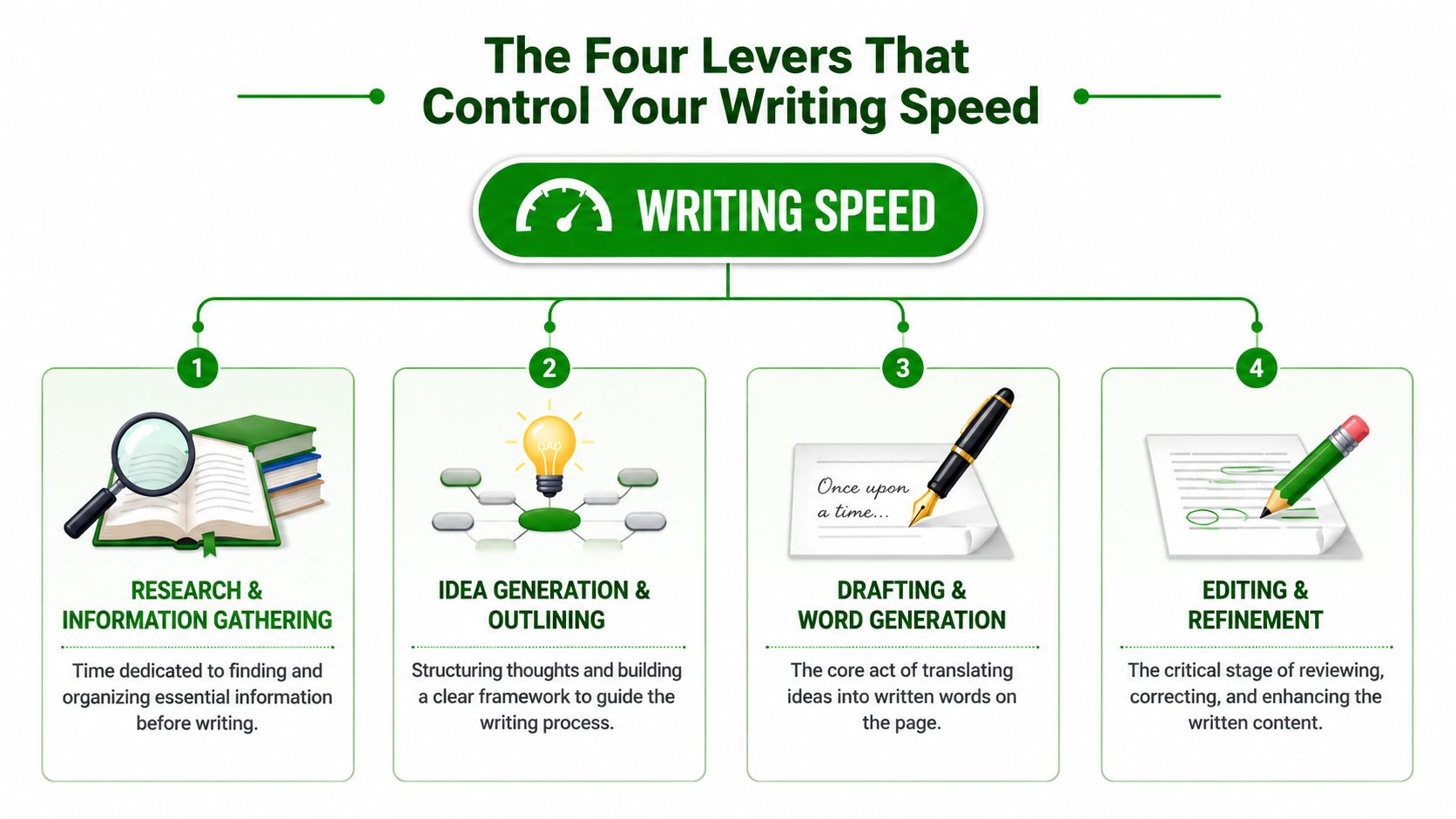
A writer sits down to draft 500 words, opens a blank document, and loses 20 minutes before the first useful paragraph appears. The problem usually is not typing speed. It is friction in the process.
In practice, four levers control how fast writing moves: research, planning, focus, and editing discipline. Get these right and 500 words feels contained. Let them drift and even a short piece can eat half a day.
Research decides whether the draft moves or stalls
Research sets the pace before drafting starts. If the facts, examples, or angle are still unclear, the draft turns into a stop-start session full of searching, second-guessing, and half-finished paragraphs.
As noted earlier, research-heavy writing often takes far longer than the word count suggests because drafting is only one part of the job. That is the trade-off many writers miss. A short assignment with unclear inputs is slower than a longer one with clean notes.
The fix is not “research less.” It is to research with a stopping point.
- Define the question before you open tabs. A narrow question produces useful notes faster than a broad topic.
- Collect evidence for the piece you are writing. Do not gather material for three possible articles.
- Store notes in writing order. Put sources, examples, and quotes where they will appear in the draft.
That last step matters more than it looks. Organized notes reduce context switching, which is one of the biggest hidden drains on writing time.
Planning removes hesitation
Writers often skip planning because outlining feels slower than drafting. In real work, the opposite is usually true. The missing outline shows up later as a wandering middle, repeated points, and long pauses between sentences.
A usable plan can be simple. One sentence for the main claim. Two or three bullets for the support. One line for the takeaway. That is enough to keep the piece moving.
If the topic is fuzzy, use a stronger scaffold before you draft. This guide for structuring blog posts is a practical starting point because it helps turn a broad idea into an order you can write from.
Good planning shrinks the number of decisions you have to make while drafting. That is what speeds writers up. They are not solving structure, wording, and logic all at once.
You already know you can change.
You just need to take the first step. Habit Huddle helps you build habits around your goals, alongside friends who keep you accountable.
Focus protects momentum
Every interruption has a cost. Not just the minute spent checking a message or looking up a side fact. The greater cost is losing the thread of the paragraph and having to rebuild it.
I see this constantly with writers who say they are “writing for an hour” when they really mean they are writing in fragments between other tasks. That setup almost guarantees a slower draft and a messier revision.
Focus gets better when the writing block has clear rules:
- One document open
- One goal for the session
- One timer
- No formatting or cleanup until the draft exists
This is also where habits matter more than motivation. Writers who produce consistently usually protect a repeatable block of focused time. Writers who rely on mood tend to restart the same paragraph over and over. Group accountability can help here. A structured check-in, like the kind Habit Huddle is built around, makes it easier to show up, start on time, and finish the session you planned.
Editing belongs after drafting
Drafting and editing use different kinds of attention. Mixing them sounds careful. It usually slows the work and weakens the draft.
Mid-sentence polishing is one of the most common causes of slow writing. The writer keeps trying to perfect lines before the argument is fully on the page. That feels productive because the sentences improve. But the piece as a whole stalls.
A better standard is simple: draft for usefulness first, then edit for clarity.
Coach's note: Draft with a loose standard. Edit with a strict one.
That means letting awkward sentences stand for a while, marking weak spots instead of fixing them immediately, and finishing the piece before tightening it. Once the full draft exists, revision gets easier because you are improving something real instead of trying to perfect ideas that are still forming.
Two Proven Workflows for Writing 500 Words
You sit down to write 500 words and lose ten minutes deciding how to start. That is usually the main problem. The writers who finish fast are rarely typing at superhuman speed. They are using a process that reduces hesitation.
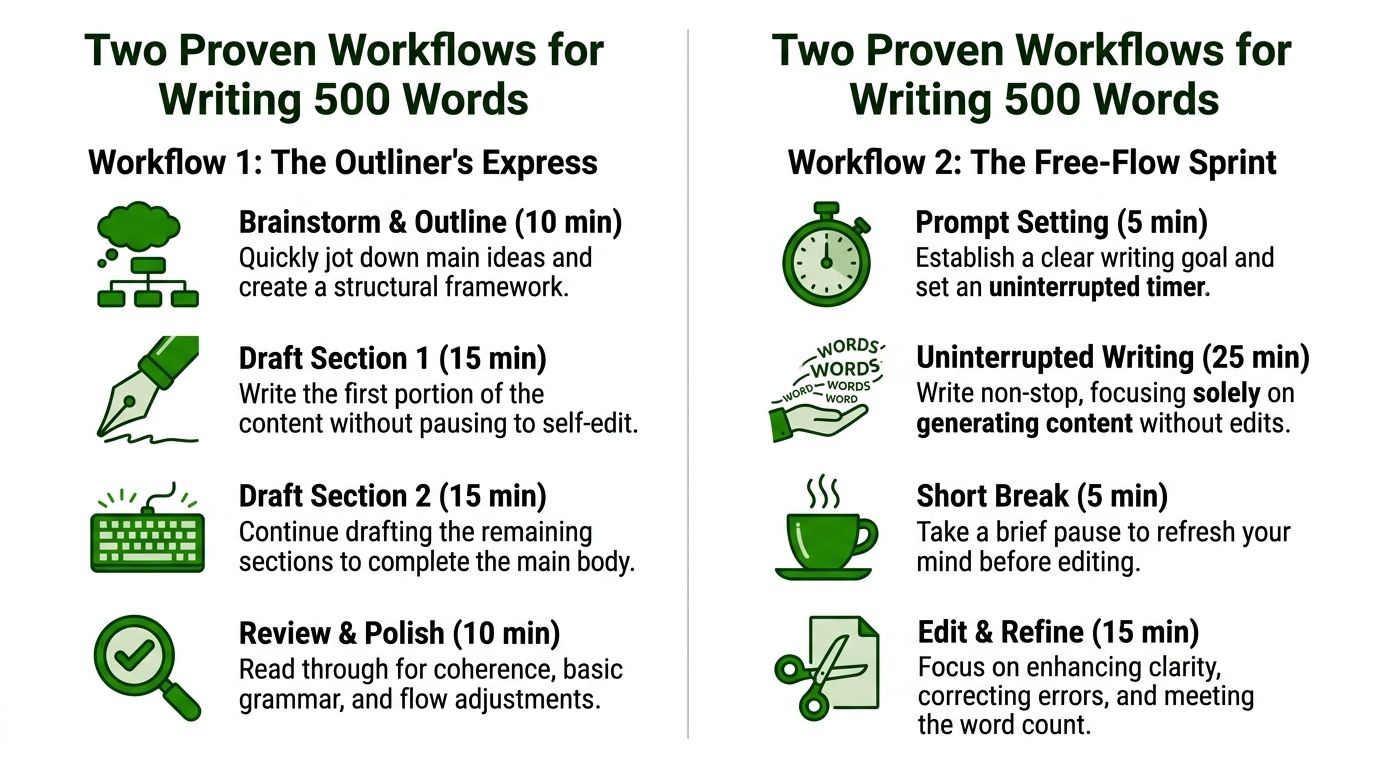
For straightforward pieces with a clear angle, 500 words can come together in one focused session. For client work, researched articles, or anything that needs cleaner reasoning on the first pass, the same length takes longer. The difference is not just skill. It is how well the workflow matches the assignment.
The 30-minute sprint
Use this workflow when the idea is already clear and the cost of imperfection is low. It works well for internal updates, recap posts, opinion pieces, and short blog drafts built from notes you already trust.
Set the point for 5 minutes
Write one sentence that answers, “What should the reader understand by the end?” Then add three bullets for the body.Draft for 20 minutes
Move top to bottom. Keep the cursor going. If a sentence feels weak, mark it and continue.Revise for 5 minutes Tighten the opening, cut repeated phrasing, and make sure the final paragraph closes the point.
This method works because it protects momentum. I use versions of this with writers who stall in the first paragraph. Once they stop treating every line like a final draft, their output rises quickly and the writing often gets better.
A short walkthrough can help if you want to see a focused writing session in action:
The 90-minute focused workflow
Use this when accuracy, structure, or client-readiness matters more than raw speed. This fits blog posts, short essays, thought leadership drafts, and explainers that need a few supporting points handled well.
Break the session into three distinct blocks:
Preparation block
Gather the few facts, examples, or notes you need. Turn them into a short outline before you draft a single paragraph.Drafting block
Write the full piece in one pass. Stay with the structure you chose instead of researching mid-paragraph.Revision block
Read for logic first, then clarity, then style. Fix weak transitions, cut extra throat-clearing, and check whether each paragraph earns its place.
The trade-off is simple. You spend more time up front, but you waste less time stopping to solve basic decisions while drafting. In practice, that usually feels easier than a chaotic 45-minute session that turns into two hours of switching between tabs, notes, and half-edited sentences.
Writers who want to make either workflow repeatable need more than good intentions. A daily writing accountability app can help turn these sessions into a routine, especially if starting is the hardest part.
Choose the workflow you can run on an ordinary Tuesday. Reliable output usually comes from a process you can repeat, not from occasional bursts of motivation.
Build a Writing Habit That Sticks with Habit Huddle
You sit down to write after three missed days. The document is open, but your real task is not the paragraph. It is getting back into the subject, finding your structure again, and pushing through the drag that comes from an irregular routine.
That friction slows writers down more than they expect.
As noted earlier, the gap between a fast 500-word session and a slow one usually comes from process, not talent alone. Writers who work regularly spend less time ramping up. They know how to start, where to put rough sentences, and when to leave a line alone instead of fixing it too early.
Repetition builds useful instincts:
- Starting gets easier because the session has a familiar shape
- Decisions get faster because the writer is not rebuilding the process each time
- Drafts improve sooner because imperfect first passes stop feeling like a problem
The habit that lasts is usually smaller than the habit people promise themselves. “Write 500 words every day” sounds clear, but it breaks the moment the day gets crowded or your brain is cooked. A better target is behavior you can repeat under ordinary conditions.
Set a minimum that survives a bad day:
- Write for a fixed block, even if the word count is low
- Use the same start cue each session
- Judge the session by follow-through first, output second
Group accountability helps here because it adds a reason to show up before motivation arrives. A daily writing accountability app gives that habit a visible structure, which matters on the days when writing feels easy to postpone.

I have seen writers improve speed only after they stopped treating each session like a performance. They kept the bar low enough to begin, repeated the same setup, and let consistency do the work. If you want another practical angle on habits that boost writing productivity, that guide complements this approach well.
Build the routine for your tired Tuesday, not your perfect Saturday. That is the version you will keep, and the one that eventually makes 500 words feel normal.
Stop Chasing Speed Start Building Systems
If you only remember one thing, remember this. How long to write 500 words depends less on the number 500 and more on the system behind it.
Writers get faster when they reduce research chaos, outline before drafting, protect focus, and edit later. They improve even more when they repeat that process often enough that starting no longer feels dramatic. If you want another practical perspective on habits that boost writing productivity, that guide is worth a read too.
Track the process, not just the output. A simple habit log helps you notice what improves your pace, which is why it helps to track progress in a way you can review. Pick one change and use it this week. That's how writing gets easier.
If you want writing to become more consistent, not just faster on your best day, try Habit Huddle. It gives you a simple way to keep a daily writing habit visible, stay accountable with other people, and build momentum through regular check-ins instead of relying on willpower.
Ready to Build Habits With Friends?
Stop failing alone. Join thousands using the #1 habit tracker with friends for real accountability and lasting results.
Prefer mobile? App Store · Google Play
Related Guides
More Habit Huddle articles on building habits with accountability.

HabitShare Alternatives: 6 Apps for Tracking Habits With Friends (2026)
Looking for a HabitShare alternative? Six social habit trackers compared by model, price, platforms, and what happens on a missed day, plus how to switch wit...

What to Do When You Miss a Workout Day: The 5-Step Comeback Plan
Missed a workout day? What one miss does to your body and habit, according to research, plus a five-step plan for the next 24 hours, when to make it up, and...

Habit Streak App With Friends: 7 Apps Compared (2026)
Seven habit streak apps with friends compared: Habit Huddle, HabitShare, Daily Pact, Habitica, Streaks, Habit Streak duels, HabitStreak.io. What friends see,...