
Mastering Breaking Bad Habits: A Science-Backed System
Tired of breaking bad habits that always return? Discover a science-backed system to conquer them for good in 2026. Stop the cycle.
Most advice on breaking bad habits is wrong at the starting line. It tells you to want it more, stay disciplined, and push through urges with grit. That sounds noble. It also fails a lot of people because habits don't run on noble intentions. They run on repetition, cues, convenience, and environment.
When someone says, “I know what to do, I just don't do it,” that usually isn't a character flaw. It's a systems problem. The bad habit already has a built-in trigger, a familiar routine, and a reward your brain expects. If your only countermeasure is motivation, you're trying to beat an automatic process with a fading emotion.
The better approach is blunt and practical. Stop trying to overpower the habit. Redesign the conditions that keep it alive. Build replacement behaviors that can happen fast. Add accountability that keeps you consistent when the mood disappears. That's how breaking bad habits gets real.
Table of Contents
- Why 'Trying Harder' Is the Worst Way to Break a Bad Habit
- Map Your Habit Loop to Find the Failure Point
- Engineer a Better Behavior with Replacement Habits
- Install an Accountability Engine Not a Guilt Machine
- How to Handle Relapse and Troubleshoot Your System
- Your 30-Day Blueprint for Breaking a Bad Habit
Why 'Trying Harder' Is the Worst Way to Break a Bad Habit
“Try harder” is terrible advice for habitual behavior.
It assumes the problem is weak effort. Most of the time, the problem is that the behavior is already running on autopilot. New research summarized by the University of South Carolina found that 66.34% of daily behaviors were habitually instigated and 87.6% of habits were habitually executed. It also found that 76.2% of daily behaviors were intentional, with 46% overlap between habit and intention, which helps explain why people can sincerely mean to change and still repeat the same behavior (University of South Carolina habit research summary).
That changes the whole framing. You're not manually flying a machine that waits for your command. You're trying to redirect a machine that already defaults to a route. If you only rely on effort in the moment, you're stepping in after the habit has already started.
Why willpower loses
Willpower has uses. It can help you pause, make one better decision, or start a new rule. But it's a poor operating system for daily behavior because habits show up in ordinary, repeated contexts. Morning fatigue, work stress, boredom at night, your walk past the pantry, the phone next to the bed. These aren't dramatic failures. They're predictable setups.
That's why guilt makes things worse. Guilt keeps attention on identity. Systems keep attention on mechanics.
Practical rule: Stop asking, “Why am I like this?” Start asking, “What keeps triggering this behavior, and what would make the better choice easier?”
A lot of people confuse intention with control. They think wanting to change should be enough. It rarely is. If you want a useful mindset shift, replace self-judgment with observation. Notice the time, place, emotion, and sequence that make the habit easy to repeat.
For people also working on mood, stress, and emotional stability, these patterns often overlap with broader mental health habits that shape daily behavior. You don't need more shame. You need a setup that still works on a tired Tuesday.
What works instead
A better strategy has three parts:
- Reduce exposure to the cue. If the trigger starts the routine, your first win is fewer automatic starts.
- Install a replacement response. Don't create a blank space. Fill it with something immediate.
- Make the behavior visible to other people. Hidden habits stay slippery. Visible habits get structure.
Breaking bad habits gets easier when you stop treating every urge like a test of character. It's a design problem. Design can be changed.
Map Your Habit Loop to Find the Failure Point
If you can't describe the habit, you can't change it.
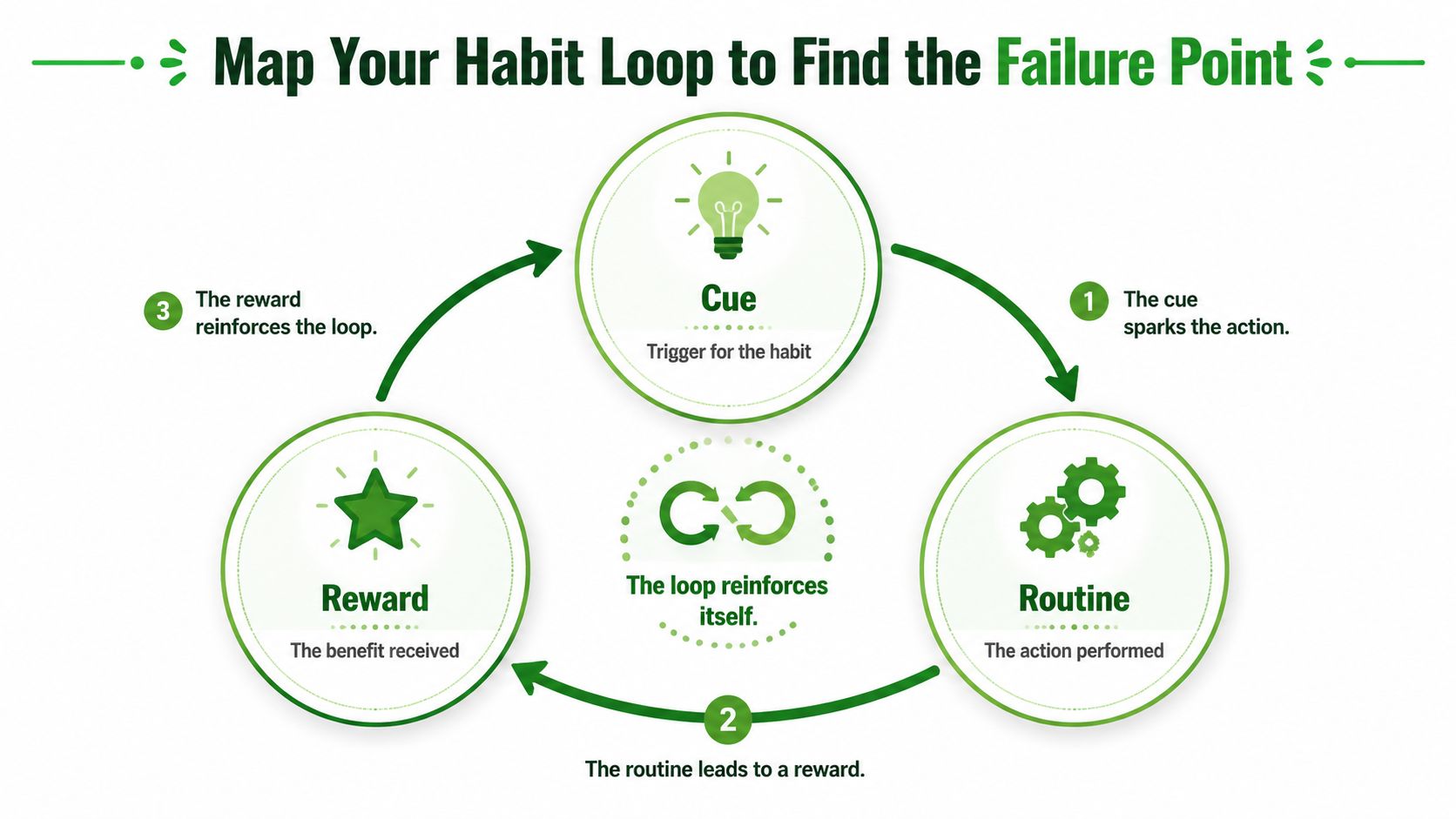
Harvard Health recommends mapping the habit loop as cue/reminder → routine → reward, then designing a substitute routine that can happen immediately when the cue appears. NIH also emphasizes that change works best when people identify cues and replace the unwanted routine, especially because habits are often tied to specific places and activities (NIH on breaking bad habits).
Start with one habit only. Not three. Not your whole life. One.
Why the cue matters most
Many individuals often obsess over the behavior itself. They focus on “stop eating junk,” “stop scrolling,” or “stop procrastinating.” That skips the part that launches the behavior.
The cue is often more concrete than people expect. It may be a location, a time of day, a person, an emotional state, or a preceding action. NIH's examples are practical. If someone always buys candy at the hallway machine, the hallway matters. If smoking is tied to certain places, those places matter. The cue isn't background noise. It's part of the habit.
Use this worksheet on paper or in your notes app:
- Write the cue. Where are you? What time is it? What happened right before?
- Write the routine. What exactly do you do?
- Write the reward. What do you get out of it? Relief, stimulation, comfort, escape, delay, novelty?
- Mark the weak point. Which part is easiest to change first?
A visual explanation helps if this framework is new to you:
A simple phone habit example
Take the habit of picking up your phone every time work feels dull.
Here's what the map might reveal:
| Part | Example |
|---|---|
| Cue | You hit a difficult task and feel mental friction |
| Routine | You unlock your phone and open social apps |
| Reward | You get relief from effort and a quick burst of stimulation |
That's a very different problem than “I lack discipline.” The issue is that boredom plus friction triggers an easy escape. Once you see that, the intervention becomes more precise.
The failure point usually isn't motivation. It's the few seconds between discomfort and your default response.
Try this for three days before changing anything. Track when the habit happens, what happened right before it, and what reward you were chasing. Don't aim for perfect insight. Aim for a usable pattern. When the same cue keeps showing up, you've found the lever.
Engineer a Better Behavior with Replacement Habits
Removing a habit without replacing it leaves a hole. Holes get filled by the old behavior.
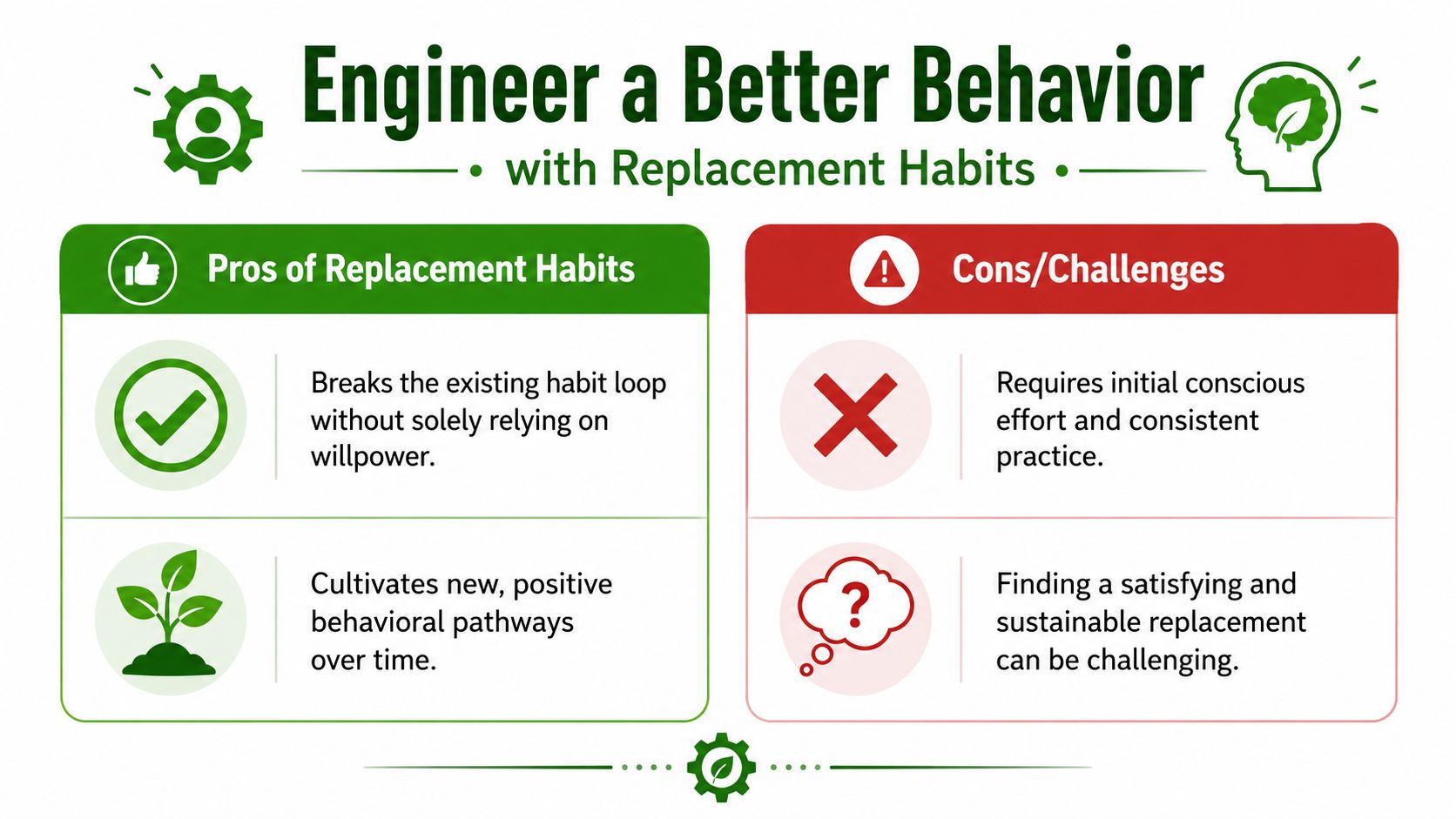
Harvard Health's practical guidance is the right standard here: map the loop, then design a substitute routine that is incompatible with the old one and can be done immediately when the cue appears (Harvard Health on trading bad habits for good ones). That word matters. Incompatible means the new behavior and the old one can't happen at the same time.
You already know you can change.
You just need to take the first step. Habit Huddle helps you build habits around your goals, alongside friends who keep you accountable.
What a good replacement actually looks like
Most replacement habits fail because they're too ambitious, too abstract, or emotionally mismatched.
If stress triggers snacking, “be more mindful” is weak. If late-night boredom triggers scrolling, “read for an hour” is too much friction. Your replacement needs to win in the moment, not on paper.
Use this filter:
- Immediate: Can you do it within seconds of the cue?
- Simple: Does it require almost no setup?
- Incompatible: Does it physically interrupt the old routine?
- Similar reward: Does it give relief, stimulation, comfort, or closure?
A replacement habit should feel like a clean swap, not a moral lecture.
Before and after examples
Here are a few patterns that work better than generic self-help advice:
| Old loop | Weak replacement | Better replacement |
|---|---|---|
| Stress eating at work | “I'll just resist it” | Walk to the water fountain and drink water while leaving the snack area |
| Mindless scrolling in bed | “No phone ever again” | Put the phone across the room and read a few pages already placed on the pillow |
| Procrastination on a hard task | “Focus harder” | Work for one small, clearly defined action such as opening the document and writing one rough sentence |
| Evening drinking cue | “I'll relax naturally” | Take a short walk, make tea, or call a friend if the reward you're chasing is decompression or transition |
Notice the pattern. The better replacement is smaller, faster, and easier to start.
“Good” habits fail when they ask too much from the exact moment you're weakest.
Environment design helps too. If the cue is visible, move it. If the bad routine is frictionless, add friction. If the good routine is annoying to begin, reduce the setup. Put the book on the bed. Leave the shoes by the door. Keep snacks out of the visible path. Log out of the app. Charge the phone outside the bedroom.
For a useful distinction here, it helps to understand the difference between a habit and a routine in everyday behavior. A routine is something you plan. A habit is something that starts running with very little thought. Breaking bad habits means converting your better response from a planned idea into a default action.
One more rule from practice: don't choose a replacement that only works when you're calm, motivated, and fully rested. Choose one that still works when your day is messy. That's the version that lasts.
Install an Accountability Engine Not a Guilt Machine
People often try to break bad habits privately. They make a promise to themselves, miss a day, feel annoyed, and gradually loosen the standard. No one sees it happen, so nothing interrupts the slide.
That's why solo habit change is fragile. Private goals are easy to renegotiate. The moment gets blurry, the rule gets softer, and the habit sneaks back in under a new excuse.
Why solo habit change is fragile
Accountability isn't about shame. Shame makes people hide. Real accountability makes behavior visible, specific, and harder to rationalize.
The strongest version is small-group accountability around one clearly defined habit. Not a giant challenge board. Not a vague “we should all do better” chat. A tiny group with a narrow target, simple daily checkins, and a shared expectation that everyone reports truthfully.
This structure solves several problems at once:
- It removes ambiguity. The habit is defined, so people know what counts.
- It creates a return point. If you wobble, the group pulls you back quickly.
- It turns drift into data. Missed checkins expose patterns you'd otherwise ignore.
- It lowers emotional load. You don't need to generate motivation alone every day.
How to build a Habit Huddle
Call it a Habit Huddle, a checkin circle, or a streak group. The name matters less than the operating rules.
Keep it simple:
- Pick one habit per group. Mixed goals create noise.
- Keep the group small. Small groups notice when someone disappears.
- Define the minimum. Your floor should be realistic on hard days.
- Post a checkin daily. Weekly reporting is too delayed for most habits.
- Respond with support, not policing. The point is consistency, not social punishment.
A tool can help if it makes checkins visible and easy. Habit Huddle's social accountability system is one example. It lets people join or create a small group around a single habit and post a daily checkin, which fits the kind of accountability structure that works better than isolated effort.
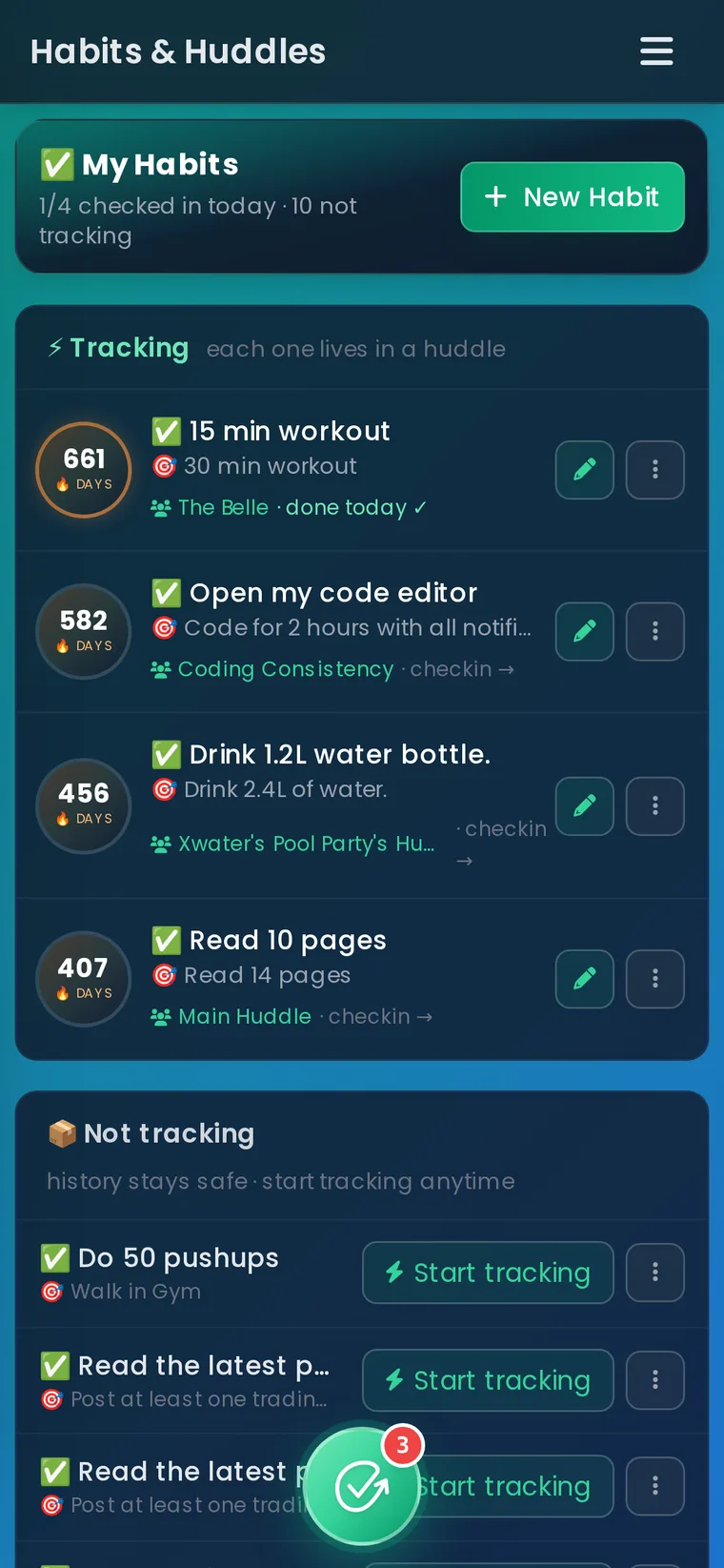
What doesn't work is turning accountability into surveillance. If people feel judged, they start managing impressions instead of changing behavior. Keep the tone factual. Did you do the minimum? If not, what was the trigger? What's the adjustment tomorrow?
The right group doesn't ask you to feel bad. It makes it easier to show up again.
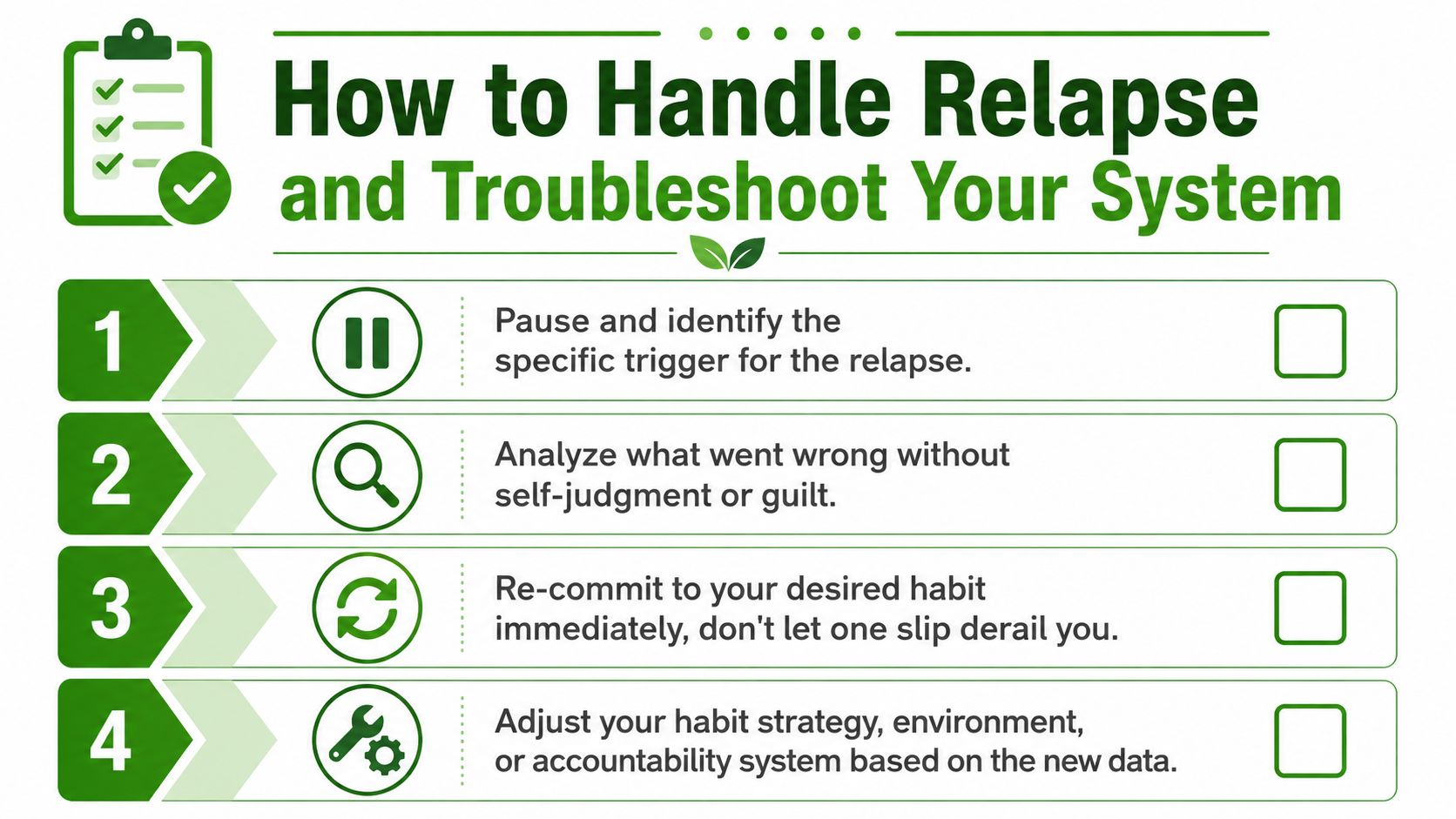
How to Handle Relapse and Troubleshoot Your System
Relapse doesn't mean the plan failed. It usually means the plan revealed where it was weak.
Cleveland Clinic reports that experts believe it takes at least 10 weeks to break a bad habit, and longer for more ingrained behaviors. The same guidance warns against trying to change too many behaviors at once and supports self-monitoring to identify high-risk windows (Cleveland Clinic on how to break bad habits). That timeline matters because it strips away the fantasy that one good week means the habit is gone.
Relapse is feedback
The most damaging mistake is all-or-nothing thinking. One slip becomes “I'm back to square one,” which becomes a weekend of giving up. That's not a habit problem anymore. That's a reaction problem.
Use a simpler rule. Never miss twice.
If you slipped last night, your job isn't to redeem yourself with a heroic comeback. Your job is to complete the next available repetition of the better behavior. Fast recovery matters more than emotional drama.
When relapse happens, review it like a coach:
- Was the cue stronger than expected? Maybe the trigger wasn't stress. Maybe it was being alone after work.
- Was the replacement too hard? Good intentions fail when the substitute has too much friction.
- Did the environment betray you? If the cue stayed visible, the old path stayed open.
- Was the target too broad? Trying to overhaul multiple habits at once usually creates decision fatigue.
A quick troubleshooting checklist
Use this short post-mortem after a slip:
- Write down the exact moment. What time, place, and emotion showed up?
- Name the old reward. Relief, escape, stimulation, comfort, delay?
- Check the replacement. Was it available immediately?
- Adjust one variable. Don't rewrite the whole system after one bad day.
- Re-enter fast. Do the next rep of the desired behavior as soon as possible.
Missing once is a disruption. Repeating the miss is how you rebuild the old habit.
Self-monitoring matters here. Track the windows where the habit is most likely. Morning stress, late afternoon slump, post-dinner boredom, Friday social cues. Once those windows become visible, you can stop acting surprised by them and start preparing for them.
Your 30-Day Blueprint for Breaking a Bad Habit
Use the next month to run an experiment, not to prove your character.
Here's the blueprint:
- Choose one habit only. If you try to fix everything at once, you'll blur the cues and weaken your attention.
- Track it for a few days before changing it. Write down the cue, routine, and reward in real time.
- Remove or reduce the cue where possible. Change the environment first when you can.
- Design one replacement habit. Make it immediate, simple, and incompatible with the old behavior.
- Set a minimum version. On hard days, the minimum keeps the pattern alive.
- Create daily accountability. Use a small group, partner, coach, or checkin system that makes the behavior visible.
- Review slips without drama. Treat each relapse like debugging. What triggered it? What needs adjusting?
- Protect consistency over intensity. Quiet repetition beats occasional perfect days.
- Reassess at day 30. Keep the habit if the system is working. If not, change the setup, not just your level of effort.
Breaking bad habits works when you stop negotiating with the old pattern and start engineering a better one. You don't need a more inspiring speech. You need a repeatable system that still holds up when willpower fades.
If you want a simple way to make that system visible, Habit Huddle gives you a practical structure for group accountability. You join or create a small huddle, focus on one habit, and post a daily checkin so consistency doesn't depend on mood. That's a much sturdier setup than trying to change in private and hoping motivation lasts.
Ready to Build Habits With Friends?
Stop failing alone. Join thousands using the #1 habit tracker with friends for real accountability and lasting results.
Prefer mobile? App Store · Google Play
Related Guides
More Habit Huddle articles on building habits with accountability.

HabitShare Alternatives: 6 Apps for Tracking Habits With Friends (2026)
Looking for a HabitShare alternative? Six social habit trackers compared by model, price, platforms, and what happens on a missed day, plus how to switch wit...
What to Do When You Miss a Workout Day: The 5-Step Comeback Plan
Missed a workout day? What one miss does to your body and habit, according to research, plus a five-step plan for the next 24 hours, when to make it up, and...
Habit Streak App With Friends: 7 Apps Compared (2026)
Seven habit streak apps with friends compared: Habit Huddle, HabitShare, Daily Pact, Habitica, Streaks, Habit Streak duels, HabitStreak.io. What friends see,...