
What Brings You Joy: A Practical Guide to Finding It
Feeling disconnected? This guide answers 'what brings you joy' with a step-by-step process for rediscovering it through practical experiments and new habits.
Joy is often framed as a personality trait or a lucky discovery. For people under stress, that framing is useless. If you're tired, overextended, or edging into burnout, "find what you love" sounds less like guidance and more like homework.
A better starting point is diagnosis.
If the question "what brings me joy?" keeps producing a blank stare, that does not automatically mean you're out of touch with yourself or incapable of feeling good. In practice, it usually means you're looking for an answer in the wrong format. Joy rarely arrives as one clear passion or a dramatic life change. It tends to show up in brief, low-volume moments: a certain kind of conversation, ten quiet minutes before work, making something with your hands, finishing a small task cleanly, stepping outside at the right time of day.
Those signals are easy to miss. They are also easy to dismiss because they look too small to count.
That is the mistake.
People trying to feel better often search for a big fix, a new hobby, a weekend reset, a more positive mindset. Small, repeatable lifts usually do more real work. They ask less energy from you, fit inside ordinary days, and give you something you can test instead of something you have to believe in.
The useful question is not "What is my passion?" The useful question is "What reliably makes me feel a little more alive, steady, or open, and under what conditions does it happen?" Once you approach joy that way, it stops being a vague aspiration and becomes a pattern you can observe, test, and build into daily life.
Table of Contents
- Why "Just Find a Hobby" Is Terrible Advice
- Adopt the Mindset of a Joy Detective
- Your Joy Audit A Practical Toolkit for Self-Reflection
- Run Low-Stakes Mini-Experiments
- Turn Your Discoveries into Repeatable Micro-Habits
- Build Lasting Momentum with Social Accountability
Why "Just Find a Hobby" Is Terrible Advice
“Just find a hobby” sounds practical. Usually it isn't. It assumes joy is sitting out there as an obvious activity, waiting for you to choose pottery, running, or watercolor and suddenly feel better.
That framing fails people under stress. Burnout narrows attention, flattens motivation, and makes even pleasant options feel like work. When someone asks what brings you joy in that state, your brain often returns silence, not because nothing matters, but because the signal is faint.
Therapist-led guidance points to a more useful approach. The unmet need isn't another list of cheerful ideas. It's a diagnostic framework for noticing tiny “flickers of interest” when joy feels blocked by stress, as described in Annie Wright's guidance on what brings me joy.
The hobby advice confuses identity with recovery
A hobby can be joyful. It can also become another performance arena. People turn reading into a target, hiking into a gear problem, and creativity into content production. Then the activity stops restoring them.
Often, what's needed isn't a new identity, but a reliable recovery mechanism. That might be music while cooking, sunlight before screens, texting one specific friend, or five quiet minutes with coffee and no input.
Practical rule: If an activity creates pressure before it creates relief, don't treat it as your joy practice yet.
Joy is usually smaller than people expect
Generic advice also makes joy sound dramatic. It pushes people toward peak experiences and obvious pleasures. That's why so many articles keep repeating travel, hobbies, and socializing without helping readers translate those themes into ordinary life.
A better question is simpler: what restores you on a weekday you didn't plan well?
Try this quick contrast:
| Unhelpful prompt | Better prompt |
|---|---|
| What is my passion? | What gives me a little more energy than it costs? |
| What hobby should I start? | What do I already lean toward when no one's grading it? |
| What should make me happy? | What actually softens my body or clears mental fog? |
The point isn't to think more positively. The point is to observe more accurately. Joy can feel inaccessible for real reasons. Stress, grief, trauma, and exhaustion all interfere with access. That's why the process has to be concrete, forgiving, and repeatable.
Adopt the Mindset of a Joy Detective
Start with curiosity, not pressure. The wrong mindset turns this into a search for a life answer. The useful mindset turns it into field research.
A joy detective doesn't ask, “What should define me?” They ask, “What shifts my state, even slightly?” That lowers the stakes enough for honest data to appear.
There's also an important distinction most advice skips. The fundamental issue isn't only pleasure. It's whether something reliably restores you on an ordinary day, a gap highlighted in this discussion of micro-joy and low-effort rituals. That's why small signals matter more than dramatic experiences.
Look for flickers, not fireworks
People often miss joy because they're waiting for certainty. Certainty is rare. A flicker is easier to spot.
A flicker can look like this:
- A pause in scrolling: You stop and re-read a poem, a recipe, or a photo caption because something in it feels good.
- A slight bodily shift: Your shoulders drop when you hear rain, smell citrus, or step outside.
- A pull toward repetition: You keep returning to the same playlist, walking route, café corner, or type of conversation.
These aren't trivial. They're clues.
For many people, the most useful frame comes from behavior change psychology. Motivation is unstable, context matters, and tiny actions reveal more than big intentions. Joy works the same way. You learn faster by noticing what you repeat voluntarily than by writing aspirational lists.
Separate escape from restoration
Not everything that feels good helps. Some activities numb you. Others restore you. Both have a place, but don't confuse them.
Use these filters:
- After-effect: Do you feel steadier afterward, or only distracted while doing it?
- Friction: Is it easy to begin again tomorrow, or does it require ideal conditions?
- Carryover: Does it improve your next hour, your focus, or your patience with other people?
The best joy practices are small enough to repeat and strong enough to change the tone of the next part of your day.
A detective mindset also means dropping moral judgment. If your joy is folding laundry with a podcast, reorganizing a shelf, watering plants, or standing in the sun for three minutes, that's useful information. It doesn't need to be impressive to count.
Your Joy Audit A Practical Toolkit for Self-Reflection
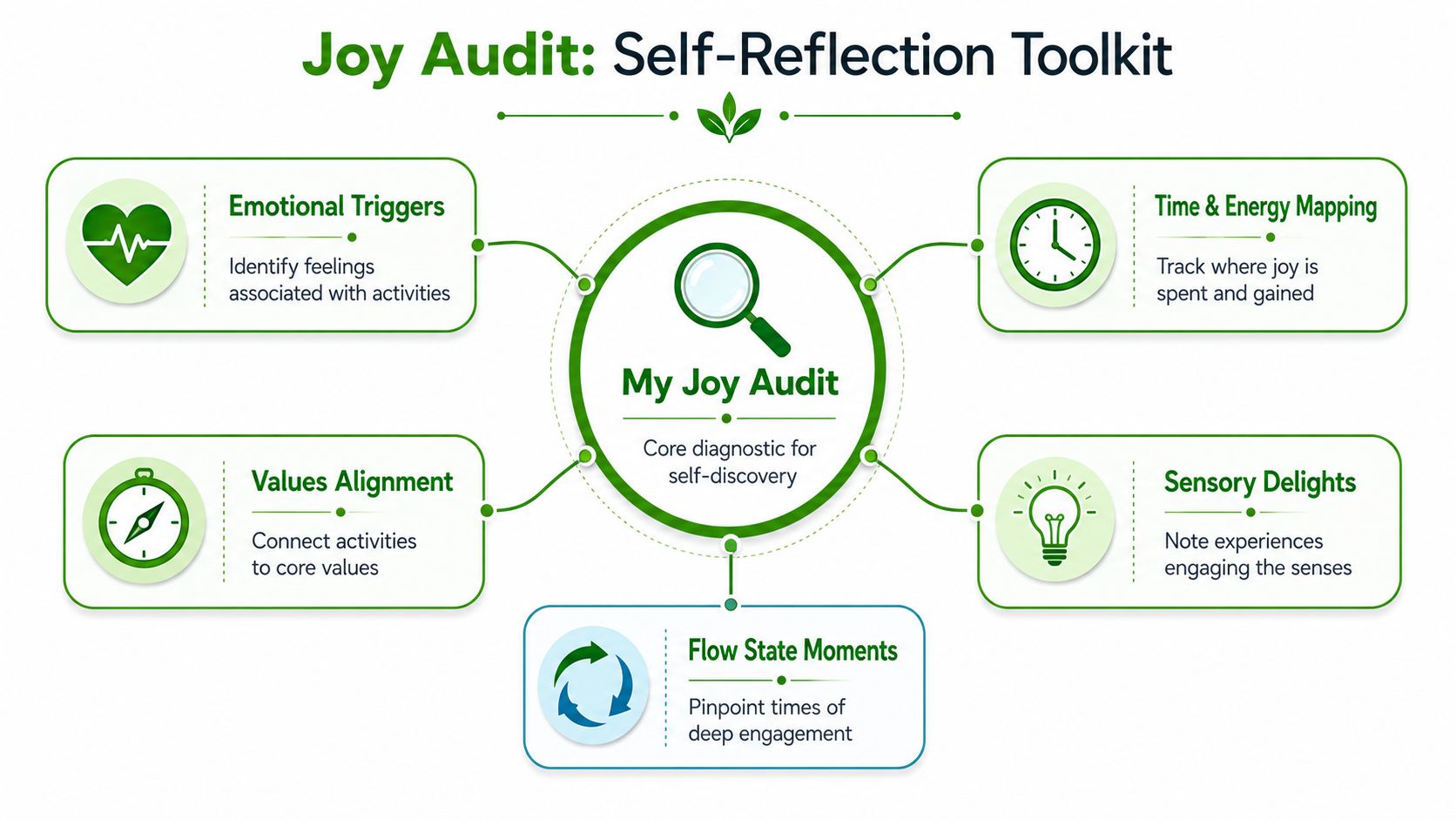
A joy audit works best when it feels a little clinical.
Stress and burnout distort memory. People remember the big, photogenic moments and miss the small things that steady them on an ordinary Tuesday. If you want useful answers, stop asking what should make you happy. Review what has already produced a measurable lift in your real life.
As noted earlier, survey data on happiness tends to cluster around a few recurring themes: close relationships, mental well-being, and a sense of control. That matters because it keeps the audit grounded. Start by checking where your day already contains small signs of connection, relief, choice, or ease. Those signals are easier to repeat than a fantasy version of joy that needs more time, money, or energy than you have.
Audit what is repeatable
A good audit does not reward impressive answers. It rewards accurate ones.
“Travel” is too broad. “Twenty minutes alone with coffee before anyone needs me” is usable. “Creativity” is vague. “Sorting photos while music plays” gives you something you can test, protect, and schedule.
Use four evidence sources:
- Your calendar: Which recent activities left you clearer, lighter, or less reactive afterward?
- Your body: When did your jaw relax, your breathing deepen, or your attention stop splintering?
- Your defaults: What do you choose without needing discipline, reminders, or a perfect setup?
- Your deprivation points: What disappears first during busy weeks, and what do you noticeably miss?
That last question matters more than people expect. Joy often shows up most clearly through absence.
You already know you can change.
You just need to take the first step. Habit Huddle helps you build habits around your goals, alongside friends who keep you accountable.
Five prompts that produce better data
Keep your answers short. Specificity beats introspection theater.
The nostalgia test
What absorbed you before anyone asked whether it was productive? The useful clue may be the condition, not the activity. Maybe you did not love drawing itself. Maybe you loved quiet focus, color, and working with your hands.The envy indicator
Track moments of specific envy. Not status envy. Interest envy. If you keep noticing people who host simple dinners, tend a garden, browse libraries, or take morning walks, pay attention to the underlying pattern.The private hour question
If you had one free hour with no audience and no chance to turn it into content, what would you do? This strips out performance and gives you cleaner data.The energy ledger
Make two lists: gave energy, took energy. Use plain language. “Talking to one close friend” belongs on the page. “Open-ended group plans” might belong on the other. Patterns usually appear faster than expected.The sensory check
List the environments that help you feel more like yourself. Light, sound, texture, temperature, pace, and visual clutter all matter. Burned-out people often need sensory relief before they can even feel joy.
One caution. Do not force this exercise to produce a grand passion. In practice, the better outcome is usually a handful of micro-joys with low friction: a certain walking route, five minutes of music while cooking, a voice note from a friend, a clean desk lamp at dusk, fresh air before opening your laptop.
Write down the small things you are tempted to dismiss. Those are often the easiest to repeat, and repeatable joy is far more useful than occasional intensity.
If you're trying to answer what brings you joy, this audit gives you raw material you can evaluate instead of ideals you cannot maintain.
Run Low-Stakes Mini-Experiments
Insight is cheap. What matters is whether a clue survives contact with real life.
The good news is that joy responds well to small interventions. The Big JOY program used a short onboarding survey and seven daily micro-acts, and preliminary analysis found a 23% increase in positive emotions after the week-long protocol. The useful lesson isn't that you need their exact sequence. It's that small, structured actions can work.
A better test than “start a new routine”
Don't jump from “I miss nature” to “I should become a hiker.” That's too big, too expensive in energy, and too easy to abandon.
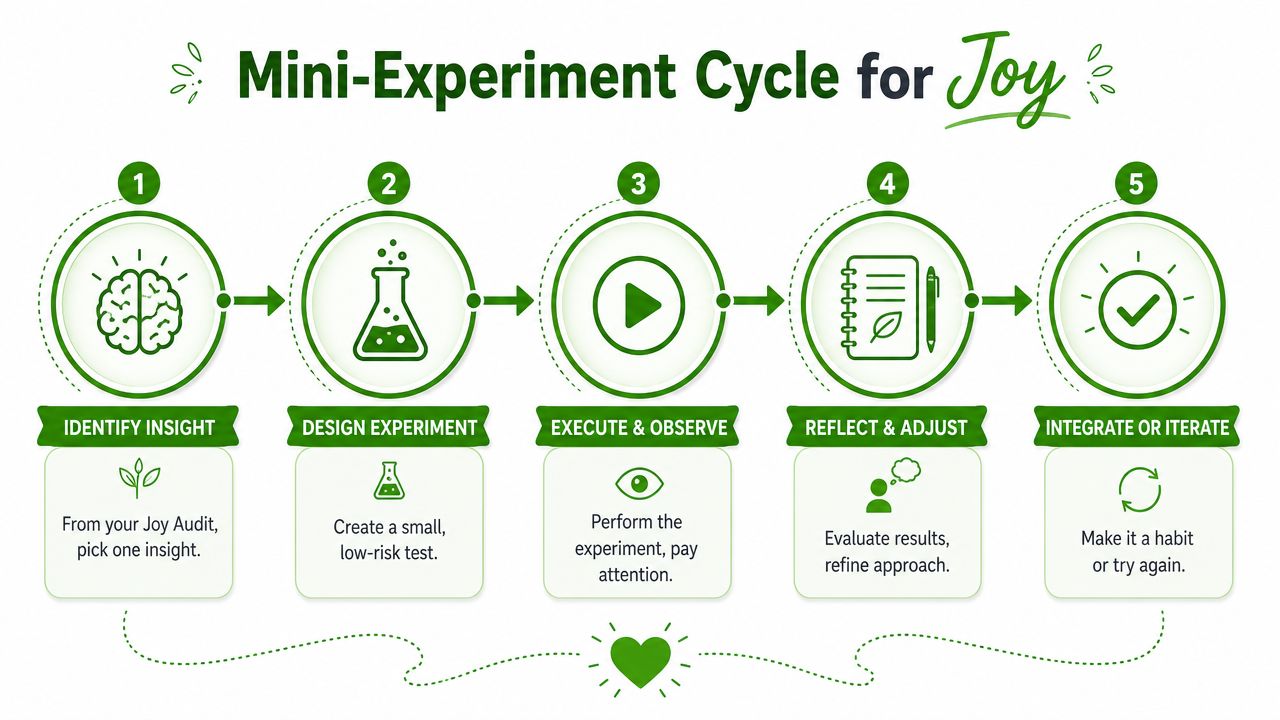
Use a mini-experiment instead. Keep it narrow enough that failure teaches you something.
A workable template looks like this:
- Insight: I feel better when I have visual quiet and fresh air.
- Experiment: Sit on a park bench for ten minutes after lunch on Tuesday and Thursday, no phone.
- Observation: Before and after, note mental fog, irritability, and body tension in plain language.
- Decision: Repeat, adjust, or discard.
One example from audit to action
Say your audit shows that your best moments involve low stimulation, movement, and no demands from other people. The wrong conclusion is “I need to fix my whole lifestyle.” The right move is to test one condition.
You try this: after your afternoon slump starts, you walk one block without headphones, then stand still for a minute before going back inside. That's not glamorous. It is measurable.
What usually works in these tests?
- Small scope: One action, one cue, one observation.
- Specific timing: Attach it to an existing moment like lunch, shutdown, or the first work break.
- Loose expectations: You're checking for a shift, not demanding transformation.
What usually doesn't work?
- Identity leaps: “I'm becoming the kind of person who…”
- Overdesigned systems: Fancy trackers before you've tested the action.
- Mood perfectionism: Assuming a useful practice failed because it didn't create a big emotional high.
If you're serious about answering what brings you joy, run the smallest experiment that could prove you wrong or right. That gives you data you can trust.
Turn Your Discoveries into Repeatable Micro-Habits
A good experiment gives you a clue. A good habit keeps the clue available when life gets messy.
The trap here is trying to “lock in” joy with too much structure. Don't do that. You want enough structure to repeat the action, not so much that the action starts feeling like compliance.

Track the action and the effect
One of the most useful distinctions in habit coaching is process versus outcome. The Institute for Healthcare Improvement's Joy in Work framework recommends daily, weekly, or monthly measurement, testing changes before scaling, and tracking both process and outcome measures in real time, as outlined in the IHI Joy in Work framework.
For personal use, that means keeping a simple joy log with two lines:
| What to track | Example |
|---|---|
| Process | Did I do the five-minute action? |
| Outcome | What changed afterward, if anything? |
Some actions are easy to complete but don't help much; others help a lot but need a better cue or smaller version.
A few examples:
- Music reset: Process is one song before opening email. Outcome is whether you feel less resistance starting work.
- Connection habit: Process is sending one real message, not a reaction emoji. Outcome is whether you feel more grounded.
- Sensory break: Process is stepping outside or making tea without multitasking. Outcome is whether your nervous system feels less jagged.
If you want ideas for attaching these actions to routines you already have, these habit stacking examples are useful because they reduce startup friction.
Build a small portfolio of reliable lifts
Don't look for one perfect answer to what brings you joy. Build a short list for different states.
Use categories, not favorites. One joy habit for low energy, one for loneliness, one for mental overload, one for boredom.
That portfolio approach is more durable than forcing the same ritual every day. A brisk walk might help on a restless day and fail on an exhausted one. A call with a friend might restore you one evening and feel like too much the next.
A short video can help reinforce the shift from vague self-improvement to simple repeatable actions.
The best micro-habits are modest. They don't ask you to become a new person. They give you a way back to yourself quickly and often.
Build Lasting Momentum with Social Accountability
Private insight is fragile.
People under stress often identify a few actions that help, then lose them within a week because nothing in their environment protects those actions. Work expands. Messages pile up. Family logistics take over. A micro-joy habit gets treated like an optional extra, which means it usually disappears first.
That is why accountability matters here. Not because joy should become performative, but because repeatable lifts survive better when someone else can see the pattern with you. The point is not motivation. The point is protection.
Why solo insight often fades
Knowing what helps is different from doing it consistently, especially during burnout. Burnout narrows attention. It pushes people toward urgent tasks and away from restorative ones, even when those restorative actions are small and proven.
Social accountability adds an external cue. Someone asks, "Did you take the walk?" or "Did you do the screen-free coffee break?" That question is specific enough to be useful and small enough to avoid turning a joy habit into another burden.
Use support to protect consistency
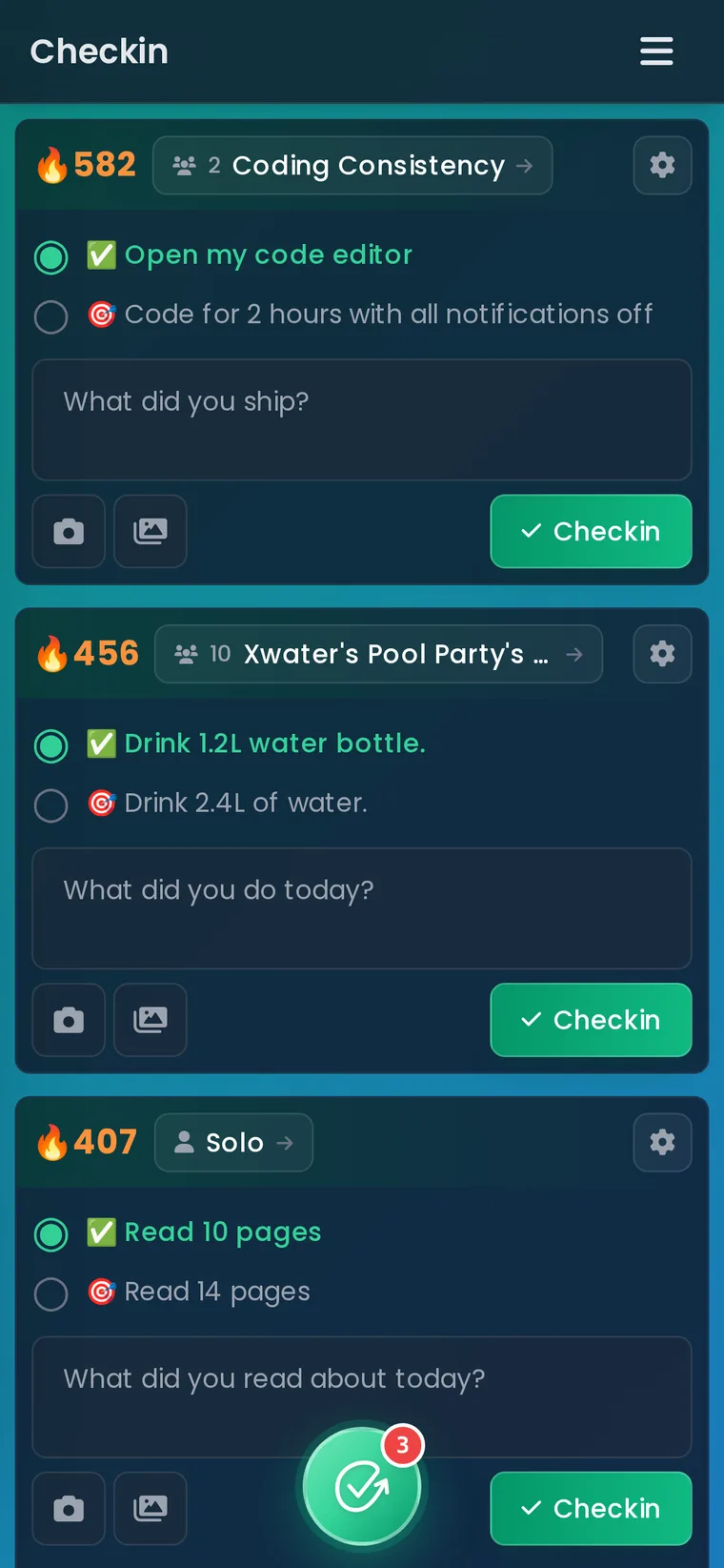
A simple structure works better than vague encouragement. Habit Huddle is a social habit tracker where people create or join a small group, choose one habit, and check in daily. For this article's purpose, the best use is narrow: track one micro-joy action with a partner, friend, or small group so the habit does not depend on memory alone.
If you want the mechanics behind that approach, this guide to social accountability for habit consistency explains why visible check-ins improve follow-through.
A few rules make this work in real life:
- Track one behavior, not a feeling: “Sit outside for five minutes” is measurable. “Feel happier” is not.
- Use a low-friction check-in: One tap, one message, or one short note beats a long daily reflection.
- Report what happened: “Did it, felt slightly calmer” is enough data.
- Keep the minimum version active: On bad days, shrink the habit instead of skipping the pattern entirely.
- Choose people who support the process: Accountability works better with steady people than with people who turn every check-in into advice.
A useful rule here is simple. Share the habit with people who respect small wins.
Joy is rarely one big discovery. For stressed or burned-out people, it is usually a short list of reliable lifts that can survive a messy week. Social accountability helps those lifts become repeatable instead of occasional.
Ready to Build Habits With Friends?
Stop failing alone. Join thousands using the #1 habit tracker with friends for real accountability and lasting results.
Prefer mobile? App Store · Google Play
Related Guides
More Habit Huddle articles on building habits with accountability.

Gamified Habit Tracker: 7 Apps Compared by What the Game Rewards (2026)
Gamified habit trackers compared: Habitica, Finch, Forest, Streaks, Habits Garden, HabitForge, and Habit Huddle, by what the game rewards, what free gets you...

Running Accountability App: 8 Picks Compared (Stakes, Streaks, and Friends)
Eight running accountability apps compared: Strava, Nike Run Club, Runkeeper, Oath, RunMatch, RunHawk, StickK, and Habit Huddle, with prices, how runs are ve...

How to Restart a Habit After Falling Off (Without Starting Over)
How to restart a habit after falling off: do the Floor version today instead of Monday, hold it for seven days, write one if-then for what knocked you off, a...