
Is Rice Paleo? the Clear Answer and Practical Guide
So, is rice paleo? Get the definitive answer. Explore paleo principles, the white vs. brown rice debate, and practical food swaps for your health goals.
Strictly speaking, rice is not paleo because it's a grain, and the paleo diet is built around foods thought to have been available before agriculture became common about 10,000 years ago within the broader Paleolithic era of about 2.5 million to 10,000 years ago. But that clean “no” leaves out what matters to many, which is why some paleo eaters still debate white rice, brown rice, and whether the strict rule is always the most useful one in real life.
You're probably here because the question came up in a very ordinary moment. You're at a restaurant, building a burrito bowl or curry plate, and the server asks, “White or brown rice?” You pause because you know paleo usually means no grains, but then you remember hearing someone in the fitness world say white rice is a “safe starch.” Suddenly a simple side dish turns into a philosophy exam.
That confusion makes sense. Most people asking “is rice paleo” aren't looking for a history lecture. They want to know what to put on their plate tonight, what counts if they're trying to eat paleo, and how strict they actually need to be to make progress without turning every meal into a debate. If you also struggle more with consistency than knowledge, building social accountability around health habits often matters just as much as having the perfect food list.
Table of Contents
- The Paleo Dieter's Dilemma A Simple Question with a Complex Answer
- Understanding the Paleo Diet Framework
- The Official Verdict on Rice and Why It Is Excluded
- White Rice vs Brown Rice The Paleo Dilemma
- Practical Paleo Swaps and Delicious Meal Ideas
- Making Your Paleo Choices Stick with Consistent Habits
The Paleo Dieter's Dilemma A Simple Question with a Complex Answer
A client once described this exact moment to me. She ordered salmon and vegetables, felt good about her choice, and then the server asked which rice she wanted with it. She knew enough about paleo to hesitate, but not enough to feel confident saying yes or no without second-guessing herself.
That's the dilemma. The rule sounds simple until it collides with normal eating. Rice isn't a candy bar or a fast-food dessert. It's a basic staple food, and for a lot of people it feels “healthy enough,” so being told it doesn't fit paleo can seem arbitrary.
Practical rule: If a food rule keeps tripping you up, don't just memorize the rule. Learn the reasoning behind it so you can make faster decisions without feeling confused every time.
The strict answer is still straightforward. If you're following paleo in the classic sense, rice doesn't make the cut. But the more useful conversation starts after that answer, because there are really two different questions hiding inside one.
The first question is about definition
If you mean, “Does rice fit strict paleo rules?” the answer is no. That's a category question. Rice is a grain, and strict paleo excludes grains.
The second question is about application
If you mean, “Can some people eat rice while following a more modern, modified paleo style?” that's where the debate opens up. People start weighing digestion, training demands, food quality, and how rigidly they want to follow ancestral rules.
Those two questions get blended together all the time. That's why conversations about rice and paleo often feel messy. One person is arguing from historical purity. Another is arguing from practical nutrition. Both think they're answering the same thing, but they're not.
When you separate those questions, the topic gets much clearer. You can honor the original paleo framework and still have an honest discussion about whether some modern eaters choose to bend it.
Understanding the Paleo Diet Framework
The paleo diet makes more sense when you stop seeing it as a random list of allowed and banned foods. It's a framework built around an ancestral eating idea. The core thought is simple: eat foods that would have been available before farming became the norm, and avoid foods that arrived with agriculture and industrial processing.
According to the Mayo Clinic explanation of the paleo diet, the Paleolithic era ran from about 2.5 million to 10,000 years ago, and modern paleo diets are based on foods thought to have been available before agriculture became common about 10,000 years ago. Because rice is a grain, it falls into a category paleo guidance typically excludes.
What paleo is trying to copy
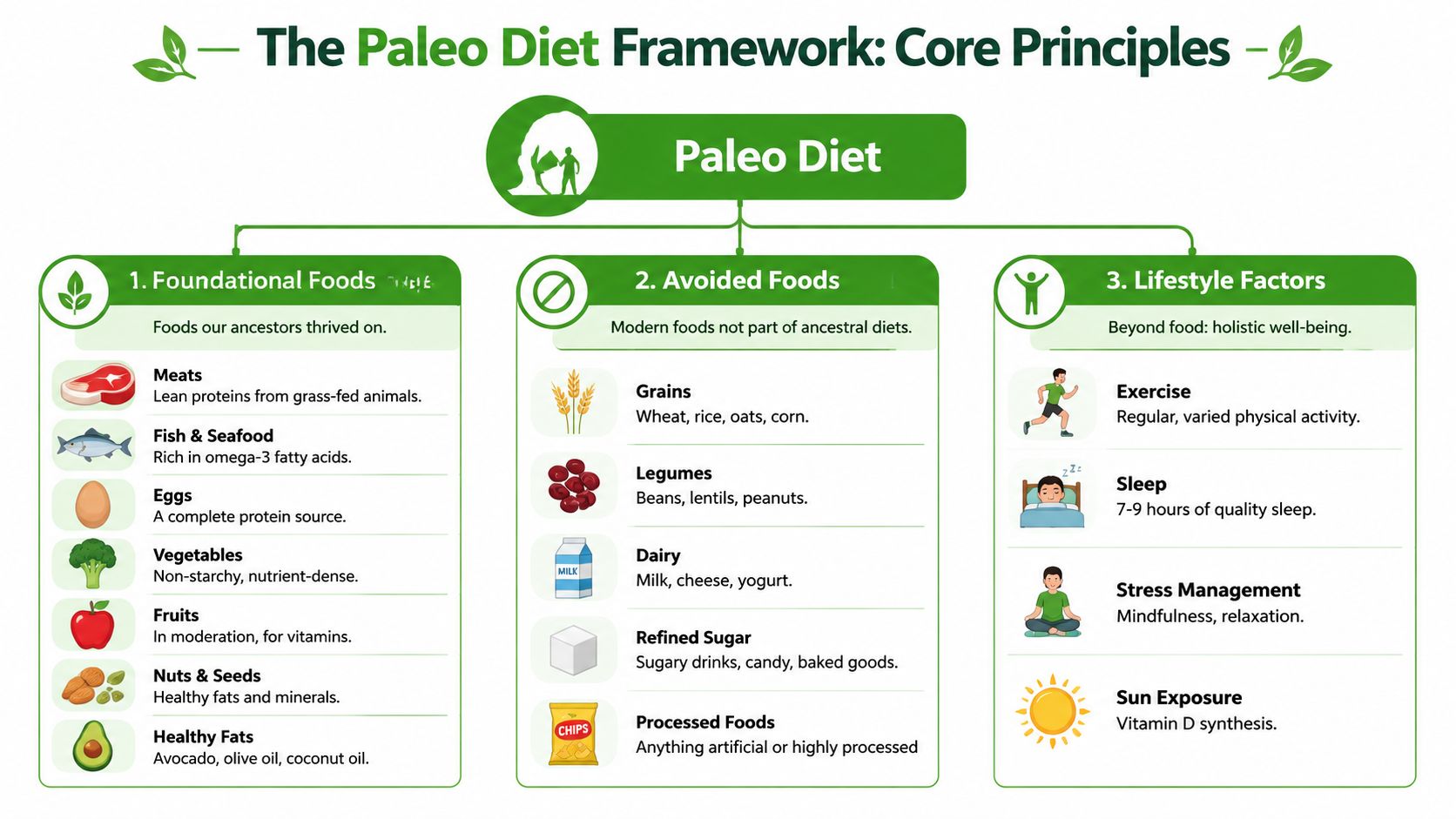
Think of paleo as asking one big filtering question: Would this food have fit naturally into a pre-agricultural pattern of eating? That's why paleo usually centers meals around meat, fish, eggs, vegetables, fruit, nuts, seeds, and fats like olive oil or avocado.
It also explains the common exclusions. Grains, legumes, dairy, refined sugar, and heavily processed foods are usually treated as outside the original template.
A useful way to remember it:
- Foundational foods are foods people could hunt, gather, fish, or forage.
- Avoided foods are foods tied more closely to farming, refining, or industrial processing.
- Lifestyle factors matter too. Many people pair paleo eating with exercise, sleep, stress management, and time outdoors.
How the food rules are built
People often get tripped up on this concept. Paleo isn't only saying, “Old foods good, new foods bad.” It's using historical context as a starting point for modern health choices. That means the rules are partly historical and partly nutritional.
For example, someone may avoid a food because it's agriculturally derived. Someone else may avoid it because it tends to be less nutrient-dense or more irritating for them personally. Those are related ideas, but they aren't identical.
Paleo works best when you understand it as a decision framework, not a moral ranking of foods.
Once you understand that, rice becomes much easier to evaluate. It doesn't belong in strict paleo because of where it sits in the food system. It's a cultivated grain. From there, the next question becomes whether modern nutrition arguments soften that rule for some people, or whether they reinforce it.
The Official Verdict on Rice and Why It Is Excluded
If you want the official strict-paleo verdict, rice is out. Not partly out. Not only brown rice. All rice starts from the same problem: it's a grain, and strict paleo excludes grains.
That point matters because people often skip straight to “But what about white rice?” before dealing with the basic classification issue. In a strict paleo model, the discussion stops early. Rice belongs to an excluded food category, so it doesn't fit.
Rice fails the historical test
Paleo's historical premise is the cleanest reason for exclusion. Rice is associated with agriculture, and paleo draws its line before agriculture became common. If your goal is to eat in a way that tracks closely with the ancestral model, rice doesn't qualify.
This is why the question “is rice paleo” has such a simple textbook answer. It's not about whether rice is minimally processed or culturally traditional. It's about whether it fits the diet's defining historical boundary.
A lot of frustration around paleo comes from forgetting that point. People try to argue rice back into the diet by saying it's gluten-free, inexpensive, or easy to digest. Those may be valid practical points, but they don't change its category.
Rice also fails the strict nutrient logic
There's also a nutritional argument that strict paleo followers use. According to Healthline's discussion of whether rice is paleo, a key reason rice is usually excluded is that grains, including rice, have high phytate content. That's one of the main arguments for avoiding them on strict paleo plans, although some people still include small amounts of white rice because it's relatively lower in phytic acid.
Here's the practical meaning of that:
- Phytates matter to strict paleo followers because they're often grouped under the broader “anti-nutrient” concern.
- Brown rice raises more objections in this framework because it keeps more of the grain intact.
- White rice gets debated because refining removes parts of the grain, which changes how some people judge it.
That doesn't make white rice officially paleo. It just explains why the conversation gets fuzzy once people move from strict rules to practical nutrition.
If you're following paleo for philosophical consistency, rice is excluded because it's a grain. If you're following paleo for symptom management or body-composition goals, you may hear more debate because people start prioritizing different criteria.
This is the fork in the road. One path says, “A grain is a grain.” The other says, “Maybe some grain-derived foods create fewer problems than others.” The strict version chooses the first path every time.
White Rice vs Brown Rice The Paleo Dilemma
Many find this surprising. In most general nutrition conversations, brown rice gets framed as the more wholesome choice and white rice as the more processed one. In paleo discussions, the tradeoff isn't that simple.
The central issue is that brown rice keeps the bran and germ, while white rice has them removed. In mainstream nutrition, that often makes brown rice look better because it retains more nutrients. In paleo-style thinking, keeping those outer layers can also mean keeping more of the compounds people are trying to avoid.
You already know you can change.
You just need to take the first step. Habit Huddle helps you build habits around your goals, alongside friends who keep you accountable.
Why brown rice is not automatically the better paleo choice
According to Paleo Leap's discussion of rice, brown rice contains more nutrients, but it also concentrates more arsenic in the bran. White rice, with the bran removed, is lower in these compounds but also less nutrient-dense. That creates a very real tradeoff for people trying to minimize both anti-nutrients and contaminants.
That's the part many readers haven't heard. Brown rice may look more “natural,” but from a strict paleo lens it can raise more concerns because the bran is exactly where some of the debated compounds are concentrated.
Paleo Perspective White Rice vs. Brown Rice
| Factor | White Rice | Brown Rice | Paleo Implication |
|---|---|---|---|
| Grain status | Still a grain | Still a grain | Neither fits strict paleo |
| Bran and germ | Removed | Retained | Brown rice keeps more of what strict paleo eaters often avoid |
| Nutrient density | Lower | Higher | Brown rice offers more nutrients, but that isn't the only factor paleo considers |
| Contaminant concern | Lower in bran-related compounds | More arsenic concentrated in bran | Brown rice can look less favorable from a risk-management angle |
| Practical use | Often treated as a simple starch | Often treated as a whole grain | White rice is more likely to be included in modified paleo approaches |
Why some people make room for white rice
Some paleo writers treat white rice as a kind of compromise food. Once the bran and germ are removed, it behaves more like a near-pure starch source. That means it gives mostly fast-digesting carbohydrate, with little fiber and less micronutrient density, which is why some active people use it more as a carb source than as a health food.
That logic usually shows up in a few situations:
- Athletes or hard trainers may want a quick, simple starch around intense activity.
- People with sensitive digestion sometimes tolerate white rice more easily than heavier whole-grain options.
- Modified paleo eaters may prefer a food that's simple and predictable over one that technically has more nutrients but also more compounds they want to limit.
Brown rice is often the better choice in a general nutrition conversation. White rice is often the less problematic choice in a modified paleo conversation. Those are not the same conversation.
The mistake is thinking the debate is about permission. It's really about tradeoffs. If you're strict paleo, neither form belongs. If you're flexible, white rice is usually the version people debate, while brown rice is the version many paleo-minded eaters remain more cautious about.
A practical way to think about it is this: strict paleo asks, “Is it a grain?” Modern flexible paleo asks, “If I'm going to include some rice, which form creates the least friction for my goals, digestion, and tolerance?” Those are different filters, and they lead to different answers.
Practical Paleo Swaps and Delicious Meal Ideas
Knowing rice isn't paleo is one thing. Building meals that still feel satisfying is another. At this point, many people either get creative or give up and start eating sad salads.
A better move is to replace the job rice was doing in the meal. Rice usually adds bulk, carries sauce, softens bold flavors, and makes a bowl feel complete. Once you understand that, you can swap it intelligently.
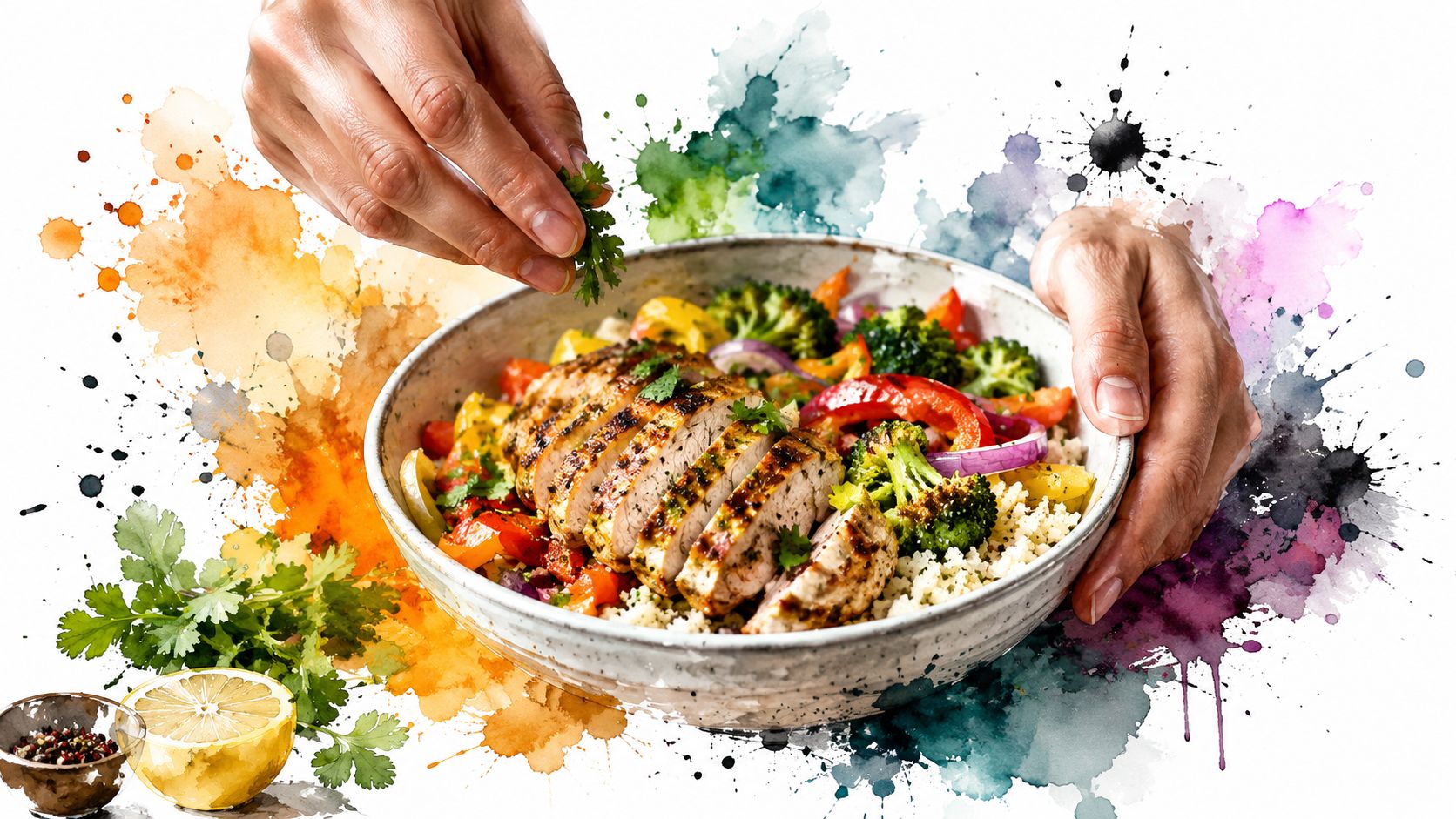
Rice-free swaps that actually satisfy
Cauliflower rice gets all the attention, but it's not the only option. The best substitute depends on the meal.
- Cauliflower rice works well in burrito bowls, stir-fries, fried-rice style dishes, and curries because it absorbs flavor without getting heavy.
- Broccoli rice has a stronger taste, but it pairs especially well with ground beef, garlic, sesame, or ginger.
- Parsnip rice feels slightly sweeter and starchier, which makes it useful when you want a more comforting texture.
- Finely chopped cabbage can work in skillet meals where you want bulk and bite rather than a rice-like feel.
- Butternut squash cubes or mash can fill the “base” role in bowls that need warmth and a little sweetness.
If you still want something familiar in drinks and treats while cleaning up your meals, reducing extras like sweeteners can help too. This guide on how much sugar to put in coffee is a good reminder that small defaults add up.
Don't ask, “What's the perfect paleo rice replacement?” Ask, “What texture and function does this meal need?”
Simple meal templates
You don't need a complicated recipe library. A few repeatable templates will carry you through most weeks.
Paleo curry bowl
Start with cauliflower rice or parsnip rice. Add chicken, shrimp, or ground turkey. Spoon over a coconut-based curry with peppers, onions, or zucchini. Finish with cilantro and lime.
Burrito-style bowl
Use cauliflower rice as the base. Add seasoned steak or ground beef, shredded lettuce, salsa, avocado, and a handful of sautéed peppers. If you miss the heft of a restaurant bowl, add roasted sweet potato.
Here's a simple visual if you want inspiration for rice-free cooking at home:
Stir-fry skillet
Choose broccoli rice or cabbage. Cook it quickly in a hot pan so it stays a little firm. Add ground pork, chicken, or eggs, then build flavor with garlic, ginger, scallions, and a simple sauce that fits your version of paleo eating.
A few practical cues make these swaps much better:
- Cook off moisture well. Wet cauliflower rice turns mushy fast.
- Season more aggressively. Vegetables need salt, herbs, citrus, or spice to feel satisfying.
- Add enough fat and protein. Most disappointment with rice swaps isn't about the swap itself. It's because the meal ends up underbuilt.
Once the rest of the meal is strong, the missing rice matters much less than people expect.
Making Your Paleo Choices Stick with Consistent Habits
The hardest part of paleo usually isn't knowing whether rice fits the rules. It's sticking to the version of the rules you chose when life gets busy, social, or inconvenient.
That's why I encourage people to decide their standard in advance. Don't wait until you're hungry, traveling, or standing in line at a fast-casual restaurant to invent your food philosophy on the spot.
Pick your rule before you need it
You might choose one of these approaches:
- Strict paleo means no rice, because grains are out.
- Modified paleo might mean no grains most of the time, but occasional white rice in specific situations.
- Performance-focused paleo may leave room for white rice around hard training while still excluding it from everyday meals.
None of those approaches works if you keep renegotiating the rules daily. Progress gets easier when your default is already clear.
Consistency beats constant renegotiation
A lot of nutrition stress comes from decision fatigue, not lack of knowledge. You already know enough to eat well. What usually slips is follow-through, tracking, and the ability to notice patterns before a rough week turns into a rough month.
That's why it helps to use a simple system and review your progress regularly. If you want a better way to measure whether your eating habits are holding, this guide on how to track progress is worth reading.

The best food strategy is the one you can repeat with calm, not the one that sounds toughest on paper. If rice isn't paleo for your plan, know why. If you make a deliberate exception, know why. Either way, let the decision be intentional instead of accidental.
If you want help turning food decisions into repeatable habits, Habit Huddle makes that process much easier. You can create a small group around one habit like “Daily Paleo Meals,” check in with a flexible Minimum or Daily Goal, and use shared accountability to stay consistent without chasing perfection.
Ready to Build Habits With Friends?
Stop failing alone. Join thousands using the #1 habit tracker with friends for real accountability and lasting results.
Prefer mobile? App Store · Google Play
Related Guides
More Habit Huddle articles on building habits with accountability.

HabitShare Alternatives: 6 Apps for Tracking Habits With Friends (2026)
Looking for a HabitShare alternative? Six social habit trackers compared by model, price, platforms, and what happens on a missed day, plus how to switch wit...

What to Do When You Miss a Workout Day: The 5-Step Comeback Plan
Missed a workout day? What one miss does to your body and habit, according to research, plus a five-step plan for the next 24 hours, when to make it up, and...

Habit Streak App With Friends: 7 Apps Compared (2026)
Seven habit streak apps with friends compared: Habit Huddle, HabitShare, Daily Pact, Habitica, Streaks, Habit Streak duels, HabitStreak.io. What friends see,...